
Caregiver resume examples that prove reliability, not just kindness.
Caregiving is a job of the heart, but a caregiver resume can't win on adjectives. “Compassionate and caring” describes every applicant; “four years with one Alzheimer's client, requested back by the family” proves it. This guide shows how to put honest numbers on a soft-skill job — client counts, tenure, named conditions — without inventing a satisfaction percentage you can't defend. It untangles the caregiver / HHA / PCA / CNA credential maze, turns unpaid family caregiving into real experience, and gives you the straight facts on training and pay in the largest occupation in the country.
- Ideal length
- 1 page
- Top keyword
- ADLs
- The proof
- Tenure + named conditions
- Outlook
- +17% (765K jobs/yr)
Grace Adeyemi
Caregiver · Dementia & Elderly Care
Columbus, OH · CPR/First Aid certified
Summary
Caregiver with 5 years of in-home and assisted-living experience, most of it with elderly clients living with dementia and limited mobility. CPR and First Aid certified, HHA-trained, and known for the kind of reliability that gets me requested back by families. I handle personal care with dignity, keep medications on schedule, and catch the small changes before they become emergencies. Two clients kept me on for three years each — that's the reference I'm proudest of.
Experience
Caregiver / Home Health Aide · Brightpath Home Care (agency)
2022 — Present
- Provide personal care and companionship for 3–4 elderly clients, supporting activities of daily living (ADLs): bathing, dressing, grooming, toileting and meals.
- Care for a client with mid-stage Alzheimer's through a redirection-and-routine approach that keeps her calm, safe and at home.
- Keep medication reminders and care logs current in the agency's care-management app, flagging changes to the nurse on schedule.
- Requested back by two families for repeat contracts; retained by the same client three years running.
Personal Care Aide · Maple Grove Assisted Living
2020 — 2022
- Assisted 12+ residents with ADLs, mobility and safe transfers using a gait belt, supporting a fall-prevention routine on my hall.
- Led small group activities — story time, music, games — that lifted resident engagement on the shift.
- Documented care per each resident's plan and maintained HIPAA-compliant confidentiality.
Family Caregiver · In-home (self)
2018 — 2020
- Provided full-time in-home care for a parent with limited mobility — personal care, medication management, meals, appointments and scheduling — the experience that brought me into the field.
Skills
Education
High school diploma — East Columbus High School, 2018
Certifications
Home Health Aide (75-hr, 2021) · CPR & First Aid (current) · Passed background check
Why this example works
Compassion shown, not claimed
“Requested back by two families” and “retained three years running” prove reliability an adjective can't. For a soft-skill job, evidence — tenure, repeat contracts, being asked for by name — is the honest way to show you're good at it.
Named conditions, not “cared for elderly”
Alzheimer's, limited mobility, fall prevention — naming the specific conditions signals real, relevant experience and matches what a posting is screening for. Vague “senior care” reads as thinner than it is.
Unpaid family care counts
The two years caring for a parent are listed as a real role with real skills — medication management, scheduling, personal care. Formalizing family caregiving turns a résumé gap into relevant experience.
Caregiver resume summary examples
Three to four lines: scope, stack or specialism, one quantified win. Match the register to your seniority.
Entry / family caregiver formalizing
Compassionate caregiver who provided three years of full-time in-home care for a parent with limited mobility — personal care, medication reminders, meals and appointments. CPR and First Aid certified and ready to bring that proven patience and reliability to an agency role. No agency title yet, but a real caregiving track record and the character the work actually depends on.
Experienced agency caregiver
CPR and First Aid certified caregiver with 5 years across private homes and assisted living, supporting elderly clients through ADLs, mobility and medication reminders. Fluent with care-management software and care-plan documentation, calm in the small daily crises, and the reliable hand families ask for by name. Looking for an agency that values a caregiver who actually stays.
Dementia / Alzheimer's specialist
Caregiver with 8+ years of person-centered care for clients living with dementia and Alzheimer's. Skilled in redirection, managing behavioral changes with patience, keeping routines that reduce agitation, and protecting dignity and independence at every stage. I create the calm, structured environment these clients need — and I know how to support the family through it too.
Hospice / end-of-life caregiver
Empathetic hospice caregiver with 6 years of compassionate end-of-life care, focused on comfort, dignity and presence. Experienced in symptom-comfort support, gentle personal care, and standing alongside families through the hardest days while coordinating with the interdisciplinary team. This is emotionally demanding work I'm steady enough to do well.
Live-in caregiver
Live-in caregiver with 4 years providing around-the-clock personal support and companionship to elderly clients with mobility and cognitive challenges. Skilled at structured daily routines, household management, medication schedules and calm emergency response. Comfortable being the constant presence a client needs and the eyes a family trusts overnight.
Home Health Aide (HHA)
HHA-certified home health aide (75-hour training) with 3 years supporting clients through both personal care and light health-related tasks — vital-signs checks, medication assistance and care-plan documentation. Listed on the state aide registry, CPR certified, and experienced coordinating with agency nurses. Bringing the certification and the clinical-adjacent comfort an agency role calls for.
Skills that belong on a caregiver resume
Personal care
- Activities of daily living (ADLs)
- Bathing, grooming, dressing, toileting
- Mobility assistance & transfers
- Meal preparation
- Incontinence care
- Companionship
Health support
- Medication reminders
- Vital signs
- Care plans & documentation
- Fall prevention
- Dementia / Alzheimer's care
- CPR / First Aid
Home & reliability
- Light housekeeping
- Errands & transport
- Care-management software
- HIPAA / confidentiality
- Clean background check
- Dependability / punctuality
Bullet point formulas that get interviews
Fill the brackets with your numbers — the structure does the selling.
- Cared for [n] clients/residents — e.g. “supported 3–4 elderly clients through ADLs” (client count is almost always truthful and concrete).
- Retained [tenure] with a client — e.g. “kept on by the same client three years running.”
- Supported ADLs including [named tasks] — e.g. “bathing, dressing, toileting, transfers and meals.”
- Cared for a client with [named condition] — e.g. “mid-stage Alzheimer's, using redirection and routine.”
- Kept medications on schedule — e.g. “maintained medication reminders and flagged changes to the nurse.”
- Supported fall prevention / safe transfers — e.g. “used a gait belt and a fall-prevention routine on my hall.”
- Requested back / by name — e.g. “asked back by two families for repeat contracts” (honest proof of trust).
- Documented care per plan — e.g. “kept HIPAA-compliant care logs in the agency's app.”
- Trained / mentored [n] aides — e.g. “oriented 4 new caregivers to client routines” (lead roles).
- Improved [adherence|mobility|engagement] — only if you can defend it; a real proxy beats an invented percentage.
ATS keywords for caregiver roles
Filters match tokens from the posting. These are the terms worth mirroring — verbatim — when they appear in the job ad.
| Keyword | Priority |
|---|---|
| activities of daily living (ADLs) — spell out both forms | High |
| personal care / personal hygiene assistance | High |
| bathing, grooming, dressing, toileting | High |
| medication reminders (not 'administration' for PCA/HHA scope) | High |
| meal preparation | High |
| mobility assistance / transfers / ambulation | High |
| companionship | High |
| CPR / First Aid certified | High |
| care plans / documentation / care logs | High |
| light housekeeping | High |
| dementia / Alzheimer's care | Medium |
| hospice / palliative / end-of-life care | Medium |
| vital signs (more HHA than PCA) | Medium |
| incontinence care · Hoyer lift / gait belt · fall prevention | Medium |
| HIPAA / confidentiality · care-management software (EHR/eMAR) | Medium |
| live-in / 24-hour care | Medium |
Don't guess — score your resume against the specific posting and see exactly which terms are missing.
How to write a caregiver resume
Show compassion with evidence, not adjectives
“Caring and compassionate” fits every applicant and proves nothing. Show it instead: client tenure, being requested back by a family, repeat contracts, a specific condition you supported for years. On a soft-skill job, evidence of trust is the strongest thing on the page — a family that kept you three years says more than any adjective.
Quantify honestly — count what you can defend
Caregiving is hard to measure, so use the numbers that are truthful and concrete: how many clients you cared for, how long you stayed with each, the named conditions you supported, the ADLs you handled. Skip the invented “increased satisfaction 15%” — a real caregiver rarely has that metric, and it collapses in an interview. A defensible client count beats a fabricated percentage every time.
Name the conditions and settings
“Cared for the elderly” reads thin. Name what you actually did: dementia, Parkinson's, post-stroke, hospice; in-home, assisted living, live-in. Specificity signals real, relevant experience and matches the exact language a posting screens for. If you supported someone through Alzheimer's, say Alzheimer's — that's the experience an agency is searching for.
Turn unpaid family caregiving into a real role
If you cared for a relative, list it as experience — “Family Caregiver, self, City, State,” with dates — and bullet the transferable skills: personal care, medication management, scheduling, appointments, budgeting. Unpaid doesn't mean unqualified; it's often years of exactly the work agencies hire for. Formalizing it turns a résumé gap into your strongest section.
Put CPR and certs where they're seen — and mirror the posting
CPR and First Aid are cheap, fast, and expected on most postings, so make them easy to spot; add your HHA 75-hour training and registry status if you have them. Then mirror the posting's exact words — write “activities of daily living (ADLs)” so either search term matches — and prove skills inside bullets. Ignore the “75% of resumes are auto-rejected” scare (see the FAQ); clean formatting helps you rank, it isn't beating a bot.
Skip the blank page.
Build this resume in Resumap — free templates, unwatermarked PDF, and an ATS check against the exact posting when you're ready.
Start freeMistakes that filter caregivers out
Listing duties instead of outcomes
“Bathed and fed clients” describes the job, not you. Add the client, the condition, the tenure, the result — that's what proves reliability.
No specific-condition experience
Vague “cared for the elderly” hides your real value. Name dementia, Parkinson's, hospice, post-stroke — the words a posting is screening for.
Generic compassion claims with no proof
“Compassionate and caring” is unbacked. Show it with tenure, repeat contracts, or a family that requested you by name.
Inventing satisfaction percentages
A made-up “98% satisfaction” collapses under one interview question. Use honest proxies you can defend — client count, years retained.
Burying or omitting CPR and certs
Recruiters look for CPR, First Aid and HHA training. Put them where they're spotted immediately, not in a footnote.
No client count or tenure
“Provided care” with no scale is invisible. Say how many clients and how long — the numbers that are always truthful.
Graphics, columns and typos
Decorative layouts break screening parsers and typos cost interviews. Clean single column, standard headings, proofread contact line.
Caregiver salary ranges (US)
United States market. Absolute figures differ by country — the gaps between levels travel better than the numbers.
| Median (BLS 31-1120, May 2024) | ~$34,900/yr (~$16.78/hr) |
| Caregiver (self-reported avg) | ~$15.50 – $17/hr |
| Certified / elderly caregiver | ~$17 – $17.40/hr |
| Higher-paying states (WA/MA/coastal) | Above national median |
| Live-in / specialized (dementia, hospice) | Premium over standard |
Home health and personal care aides earn a median of about $34,900/year (US Bureau of Labor Statistics, May 2024 — roughly $16.78/hour). It's the largest occupation in the country (~4.3 million jobs) and among the fastest-growing: +17% projected 2024–2034, with about 765,800 openings a year. Entry is a high-school diploma; home health aides at Medicare/Medicaid agencies need a federal minimum of 75 hours of training. Pay is self-reported to vary widely by state and setting (agency, private, live-in).
Primary source: U.S. Bureau of Labor Statistics (OEWS/OOH). Self-reported aggregator figures are labelled as such.
Certifications worth listing
- For broad caregiver and PCA roles, certification is often not required — many agencies and families hire on reliability and character, then train on the job
- CPR & First Aid — the highest-ROI credential: cheap, fast, and expected on most postings; get it first if you have nothing else
- HHA certification (federal minimum 75 hours, incl. 16 hands-on + a competency exam) is required for home health aides at Medicare/Medicaid-certified agencies; some states require more
- A clean background check (and clean driving record if you'll transport clients) is effectively required — note it on your resume if true
- CNA is the natural step up (state-certified, clinical) and a strong differentiator, but it's not a caregiver requirement — as is dementia or hospice specialty training
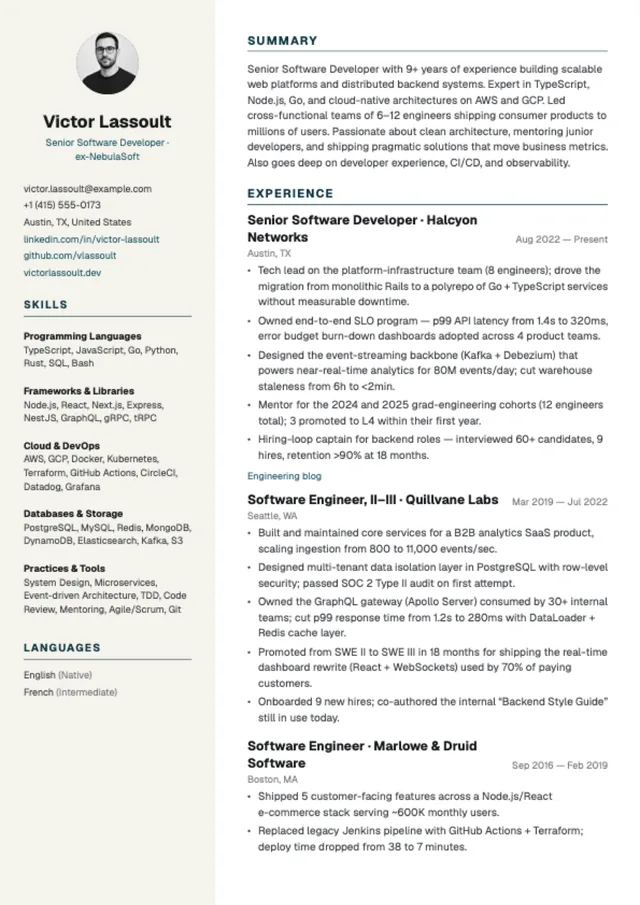
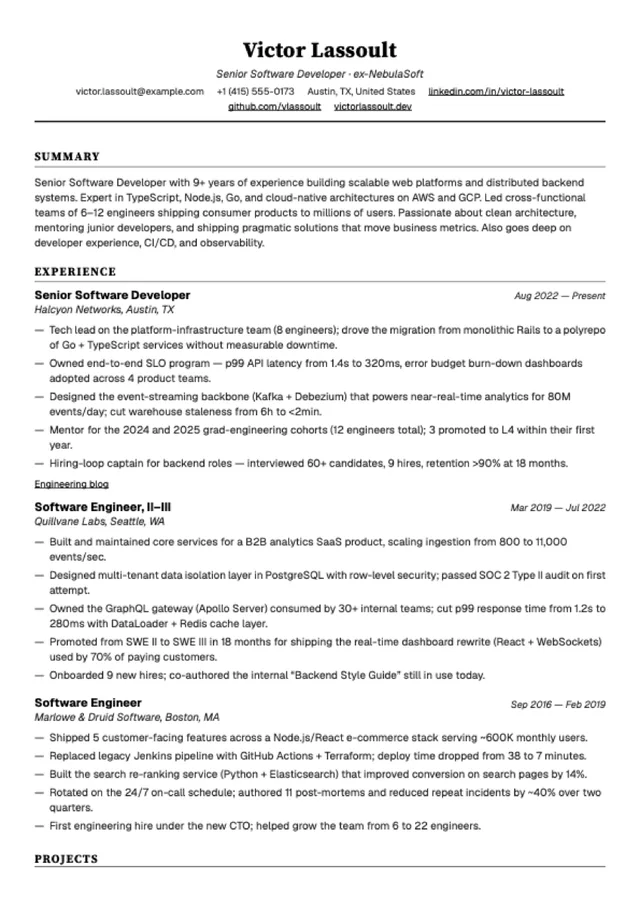
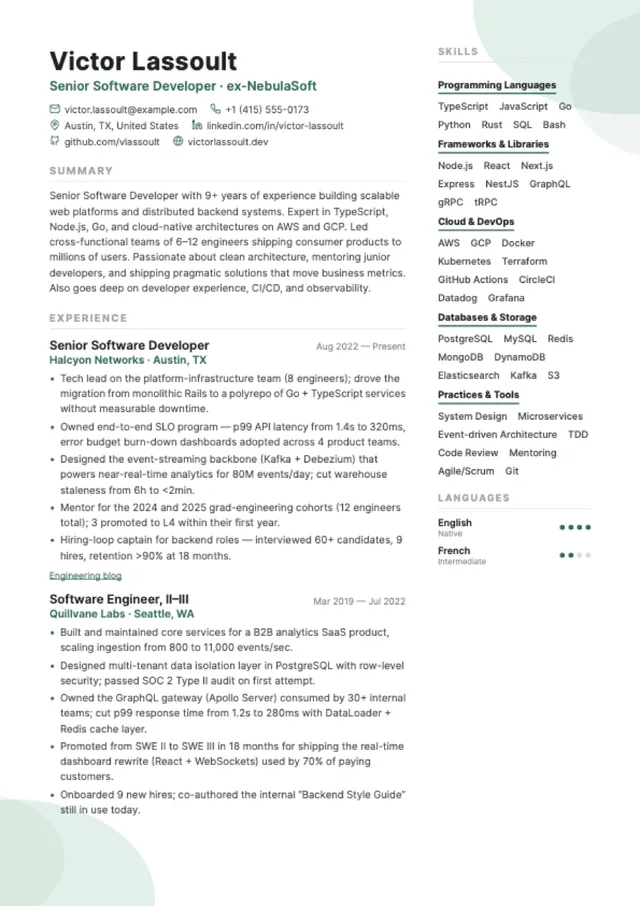
Templates that fit caregiver resumes
Caregiver resume FAQ
What's the difference between a caregiver, HHA, PCA and CNA?
They're a cluster with different credentials and scope. A PCA (personal care aide) does non-medical work — bathing, meals, hygiene, companionship, housekeeping — with little or no required certification. An HHA (home health aide) adds limited health tasks like vital signs and medication assistance, and needs a federal 75-hour training minimum at Medicare/Medicaid agencies. “Caregiver” is the broad umbrella — private, family or agency — that overlaps both and is often trained on the job. A CNA (certified nursing assistant) is the outlier: state-certified, clinical, and usually facility-based, doing tasks like wound and catheter care under a nurse. The one-liner: CNA is certified and clinical in facilities; caregiver, HHA and PCA are personal-care and in-home, with lighter or varied credentialing.
How do I turn unpaid family caregiving into a resume entry?
List it as a real role, because it is one. Use a title like “Family Caregiver, self-employed, City, State” with the dates you provided care, and bullet the transferable skills: personal care, medication management, scheduling and appointments, meal prep, budgeting, coordinating with doctors. If you'd rather, put it under a “Volunteer / Unpaid Experience” heading and add a line in your cover letter. Keep any gap explanation short, positive and forward-looking. Years spent caring for a relative are often exactly the experience an agency is hiring for — don't leave them off.
Do I need a certification or CPR to be a caregiver?
Not always. Many private-caregiver and PCA roles hire without formal certification and train you on the job. But CPR and First Aid are inexpensive, quick to earn, and expected on most postings — so if you have no credentials yet, get CPR first. Home health aide roles tied to Medicare or Medicaid funding do require the federal 75-hour HHA training (some states require more), and most agencies require a background check regardless. Certification helps, but for the broad caregiver role, demonstrated reliability and specific-condition experience often matter more than paper.
How do I show compassion and soft skills credibly?
Show them, don't claim them. Anyone can write “compassionate and caring,” so it carries no weight. Instead, lead with evidence: how long you stayed with a client, a family that requested you back for a second contract, the specific conditions you supported, being asked for by name. Retention and repeat trust are the honest, verifiable signals that you're genuinely good at this work — far more persuasive than adjectives, and they hold up in an interview because they're true.
What do agencies want from a caregiver's background?
Agencies typically require a background check, often a clean driving record if the role involves transporting clients, checkable references, and verification of any certification or registry status. If these are clean for you, say so on the resume — “passed background check,” “clean driving record,” “listed on the state aide registry” — because they remove obstacles a hiring manager would otherwise have to ask about. Reliability and trustworthiness are the whole job, so signaling them up front works in your favor.
How do I move up from a caregiver role?
The ladder runs caregiver or PCA → HHA (with the 75-hour certification) → CNA (state-certified) → LPN → RN, and each step adds clinical scope and pay. Becoming an HHA formalizes your training; becoming a CNA opens facility work and clinical tasks; nursing school is the longer climb from there. On your resume, frame your current caregiving as the foundation it is — the reliability, personal-care skill and condition-specific experience you're building now are exactly what carry you up each rung.
Is it true that ATS software auto-rejects most resumes?
No — the “75% of resumes are auto-rejected” claim is a myth from a 2012 sales pitch by a company that folded the next year and never published a methodology. Applicant tracking systems parse, store and rank resumes so recruiters can search them; they don't blanket auto-reject on content. What actually filters applicants before a human are employer-set knockout questions like work authorization, not a keyword score. The real risk is a decorative layout that won't parse, so use a clean single-column format, standard headings, and the posting's own wording. Resumap's ATS check scores your parse and keyword match against a specific job.
More resume examples
Your caregiver resume, done properly — free.
Unwatermarked PDF, ATS-safe templates, and a real score against any posting when you want it.
Build my resume