
Chef resume examples that plate covers, food cost, and control.
Kitchen resumes get read fast and screened hard, and most fail the same way: they list duties and equipment instead of proving service speed, consistency and cost control. Chefs hiring cooks want three things on the page — the stations you can run, the covers you've pushed, and (for anyone past the line) the food cost you've held. Food cost is the promotion signal here, the back-of-house equivalent of a bartender's pour cost: hold it at 28–30% and you're telling the chef you think in P&L, not just plates. This guide shows the format for every rung, plus the certification and career-path realities the generic example dumps skip.
- Ideal length
- 1 page
- Food cost benchmark
- 28–35% of sales
- Quantify
- Covers · food cost · waste
- Bullets per role
- 3–5
Marco Benitez
Chef de Cuisine · New American · High-Volume
Chicago, IL
Summary
Chef with 11 years from dish pit to chef de cuisine, currently running a 140-seat New American kitchen. Hold food cost at 29% against a 32% target while pushing 220+ covers on a Saturday; rebuilt the menu to cut waste 22% and lift specialty-dish sales $33K a year. Lead a 9-person brigade, passed the last two health inspections with zero critical violations. ServSafe Manager certified.
Experience
Chef de Cuisine · Foundry & Fern (140-seat New American)
2022 — Present
- Run the full kitchen at 220+ covers a Saturday; hold food cost at 29% against a 32% target through portioning discipline and vendor negotiation.
- Rebuilt the seasonal menu to cut food waste 22% and lift specialty-dish sales by $33K a year.
- Lead a 9-person brigade across grill, sauté, garde manger and pastry; cut new-cook ramp to independent station coverage from 4 weeks to 3.
- Passed the last two health inspections with zero critical violations; own HACCP logs and allergen protocols.
Sous Chef · The Copper Table (upscale casual)
2019 — 2022
- Ran the line and expo through 180-cover services at 96% ticket accuracy; cut average ticket time from 14 to 11 minutes.
- Managed ordering and inventory (FIFO, par levels), holding food cost within a point of target across three years.
- Trained and scheduled a 6-cook team; stepped in as acting exec chef for a two-month gap without a service slipping.
Line Cook → Lead Line Cook · Harvest Room (farm-to-table)
2015 — 2019
- Ran grill and sauté through 150+ cover services; became the cook the chef trusted on the busiest station.
- Worked up from prep, staged at two higher-end kitchens on days off to broaden technique.
Skills
Education
High school diploma · staged at Alinea and Girl & the Goat (Chicago)
Certifications
ServSafe Manager (exp. 2028) · ServSafe Allergens · ACF Certified Sous Chef (CSC), 2021
Languages
English (native) · Spanish (fluent)
Why this example works
Food cost is the promotion signal
29% against a 32% target, with the levers named (portioning, vendor negotiation). Holding food cost under target is the back-of-house pour cost — it tells a chef this candidate thinks in P&L, not just plates. Almost no line-cook resume shows it.
Covers and stations, not “prepared food”
220+ covers, 96% ticket accuracy, the specific stations run. Recruiters can't gauge a cook without the scale — covers per service and station coverage are the numbers that place you on the right line.
The ladder is visible and the pedigree is named
Dish pit → line → sous → chef de cuisine, with stages at name kitchens. Progression and pedigree beat equal knife skills with no staying power — and fine dining reads the stage line before the certificate.
Chef resume summary examples
Three to four lines: scope, stack or specialism, one quantified win. Match the register to your seniority.
Line cook
Line cook with 3 years running grill and sauté through 150+ cover services at a busy farm-to-table spot. Fast, clean, and steady when the tickets stack; ServSafe Handler certified, knife skills sharp, mise dialed before service. Worked up from prep and stage at higher-end kitchens on days off. Ready for the station nobody else wants on a Saturday.
Entry / culinary grad
Culinary-arts graduate with hands-on kitchen experience through pop-up dinners and catering events (up to 200 covers). Trained across stations, obsessive about mise and sanitation, ServSafe Handler in hand. What I lack in years I make up for in showing up early and never leaving a station dirty. Seeking a line-cook seat in a kitchen that promotes on merit.
Sous chef
Sous chef with 6 years, the last three running the line and expo through 180-cover services at 96% ticket accuracy. Own ordering and inventory, hold food cost within a point of target, and train the cooks the exec chef never has to re-check. ServSafe Manager and ACF Certified Sous Chef; the number two who keeps the kitchen running when the chef is off.
Executive chef
Executive chef with 12 years leading high-performing kitchens, now running a two-outlet hotel operation. Hold blended food cost at 30% and labor within target across 400+ covers a day; developed menus that lifted average check 14% and passed every health inspection clean. Hired, trained and retained a 14-cook brigade through a tight labor market. The business runs on the numbers, and mine are green.
Pastry chef
Pastry chef with 8 years in fine dining and hotel kitchens: laminated doughs, sugar work, plated desserts that photograph and sell. Rebuilt a dessert menu that lifted dessert attach 20% and cut waste through cross-utilization. Lead a 4-person pastry team and hold my section's food cost to target. Classical French foundation, modern plating instinct.
Banquet / catering chef
Banquet chef with 7 years running high-volume plated and buffet service: 400+ guest events executed on a one-hour plating window, 93% positive client feedback, repeat bookings tied to menus I built. Logistics, timing and food cost under control at scale. When 350 plates have to hit the pass hot and at once, that's the service I'm built for.
Skills that belong on a chef resume
On the line
- Station coverage (grill, sauté, fry, garde manger)
- Mise en place
- Knife skills
- Plating & presentation
- High-volume / covers per service
- Ticket speed & accuracy
Kitchen management
- Menu development
- Food cost / COGS control
- Inventory & ordering (FIFO, par)
- Labor cost & scheduling
- Vendor negotiation
- Brigade leadership & training
Safety & compliance
- ServSafe (Handler / Manager)
- HACCP
- Allergen protocols
- Temperature & cooling logs
- Cross-contamination control
- Health-inspection readiness
Bullet point formulas that get interviews
Fill the brackets with your numbers — the structure does the selling.
- Pushed [n]+ covers per service on [station] — e.g. “220+ covers a Saturday; 150+ on the sauté station.”
- Held food cost at [x]% vs [target] — e.g. “29% against a 32% target through portioning and vendor negotiation.”
- Cut ticket time from [x] to [y] — e.g. “14 to 11 minutes during peak service.”
- Reduced food waste [x]% — e.g. “22% via menu cross-utilization and tighter par levels.”
- Led a [n]-cook brigade — e.g. “9-person team across grill, sauté, garde manger and pastry.”
- Passed [n] health inspections at [result] — e.g. “Last two with zero critical violations.”
- Lifted sales / check by [amount/%] — e.g. “Specialty-dish sales up $33K a year; average check +14%.”
- Cut new-cook ramp / prep time [x] — e.g. “Ramp to independent station coverage from 4 weeks to 3.”
- Executed [n]-guest banquet at [standard] — e.g. “400+ guest events on a one-hour plating window, 93% positive feedback.”
- Negotiated / saved on supply [x]% — e.g. “Vendor agreements that cut supply cost 18%.”
ATS keywords for chef roles
Filters match tokens from the posting. These are the terms worth mirroring — verbatim — when they appear in the job ad.
| Keyword | Priority |
|---|---|
| ServSafe (Food Handler and/or Manager) — a repeated ATS filter | High |
| HACCP / food safety / sanitation | High |
| station names: grill, sauté, fry, garde manger, prep | High |
| mise en place | High |
| knife skills | High |
| food cost / COGS management (the promotion signal) | High |
| line cooking / station coverage | High |
| high-volume / covers per service | High |
| inventory / FIFO / ordering | High |
| menu development / recipe execution | Medium |
| plating & presentation | Medium |
| labor cost / scheduling | Medium |
| banquet / catering production | Medium |
| allergen / dietary-restriction protocols | Medium |
| cuisine specialty (French technique, sous vide, etc.) — as relevant | Medium |
| kitchen ops software (Toast, KDS, MarginEdge) — for management-track roles | Medium |
Don't guess — score your resume against the specific posting and see exactly which terms are missing.
How to write a chef resume
Prove speed and scale with covers and stations
Recruiters can't judge a cook without the numbers: covers per service, the stations you run, ticket accuracy and speed. “Prepared food to order” is every cook's line; “ran grill and sauté through 220-cover services at 96% ticket accuracy” places you on the right line. Name the restaurant type and cover count so the reader can gauge the scale you've worked.
Put food cost on any sous-and-up resume
Food cost held at or under target is the back-of-house promotion signal — the chef's equivalent of pour cost. Industry runs 28–35% of sales; “held food cost at 29% against a 32% target” tells a chef you think in P&L. Pair it with the levers (portioning, vendor negotiation, waste reduction) and it reads as management readiness, not just competence.
Show the ladder and the pedigree
The dish-pit-to-chef path is respected — so make the progression visible, and name where you've staged or worked. Fine dining reads the pedigree kitchens before the certificate, and a resume showing you earned harder stations and held standards through staffing gaps beats equal knife skills with no staying power.
List the right ServSafe for your level
Line and prep cooks carry the Food Handler card (~$10); anyone with purchasing or supervisory authority — sous and up — should hold the ServSafe Manager credential (~$179, and the certification most jurisdictions want for a designated food-protection manager). Add ACF certifications if you're on a hotel, club, corporate or institutional track, where they carry real weight.
For senior roles, lead with leadership and P&L — not knife skills
An executive or sous resume that reads like a line cook's is the classic senior-resume mistake. Lead with brigade size led, food and labor cost held, menus developed, health-inspection record and vendor negotiation. Knife skills are assumed by then; the business and the team are what you're being hired to run.
Skip the blank page.
Build this resume in Resumap — free templates, unwatermarked PDF, and an ATS check against the exact posting when you're ready.
Start freeMistakes that filter chefs out
Listing duties and equipment instead of outcomes
“Prepared and cooked menu items” describes every cook alive. Covers pushed, food cost held, waste cut, tickets on time — the measurable wins are the resume.
No restaurant context
Recruiters can't gauge scale without it. Name the restaurant type, cuisine, seat or cover count, and daily meal volume.
Calling yourself “Chef” prematurely
The title is earned and misusing it reads badly to anyone who's run a kitchen. Line cook, lead line cook, sous — use the title you actually held.
A senior resume with no leadership evidence
An exec or sous resume that lists knife tasks and no team, cost or menu ownership fails. Lead with brigade led, food cost held, menus developed.
No food-cost or waste numbers past the line
For any supervisory role, omitting P&L literacy is a missed promotion signal. Add the food-cost percentage against target and the waste reduction.
One generic resume for every kitchen
A fine-dining kitchen and a high-volume banquet operation screen for different things. Re-weight stations, cuisine and volume toward the posting.
Typos and hard-to-read formatting
In a detail-and-consistency job, a sloppy resume undercuts the pitch. Clean single column, standard headings, proofread twice.
Chef salary ranges (US)
United States market. Absolute figures differ by country — the gaps between levels travel better than the numbers.
| Fast-food cook | $28K – $34K |
| Line / restaurant cook | $34K – $44K |
| Sous chef | $45K – $60K |
| Chef / head cook (median $60,990) | $50K – $80K |
| Executive chef / hotels & resorts | $71K – $110K+ |
BLS medians (May 2024): chefs and head cooks $60,990 (top decile above $96K), restaurant line cooks $37,730, fast-food cooks $31,140. Hotels and resorts are the top-paying industry for chefs (~$73,110). Sous and executive chef aren't separate BLS categories — market estimates run ~$50–56K for sous and ~$71–110K for executive. Food cost runs 28–35% of sales (higher in fine dining).
Primary source: U.S. Bureau of Labor Statistics (OEWS/OOH). Self-reported aggregator figures are labelled as such.
Certifications worth listing
- ServSafe Food Handler (~$10, ~3-year validity) — the baseline for line and prep cooks; often a named ATS filter
- ServSafe Manager (~$179, 5-year validity, live-proctored) — for sous and up; most jurisdictions require a designated Certified Food Protection Manager (per-establishment or per-shift varies — check your state/county)
- ServSafe Allergens (~40-question exam) — increasingly required, mandated for some roles in Illinois, Massachusetts and other states
- ACF ladder (Certified Culinarian → Certified Sous Chef → Certified Chef de Cuisine → Certified Executive Chef → Certified Master Chef) — real weight in hotel, club, corporate and institutional kitchens; fine dining weights hands-on pedigree over the badge
- Culinary school (CIA, Johnson & Wales) is an asset, not a requirement — the dishwasher-to-chef path is legitimate; school's edge is technique breadth and cost-control business skills
Templates that fit chef resumes
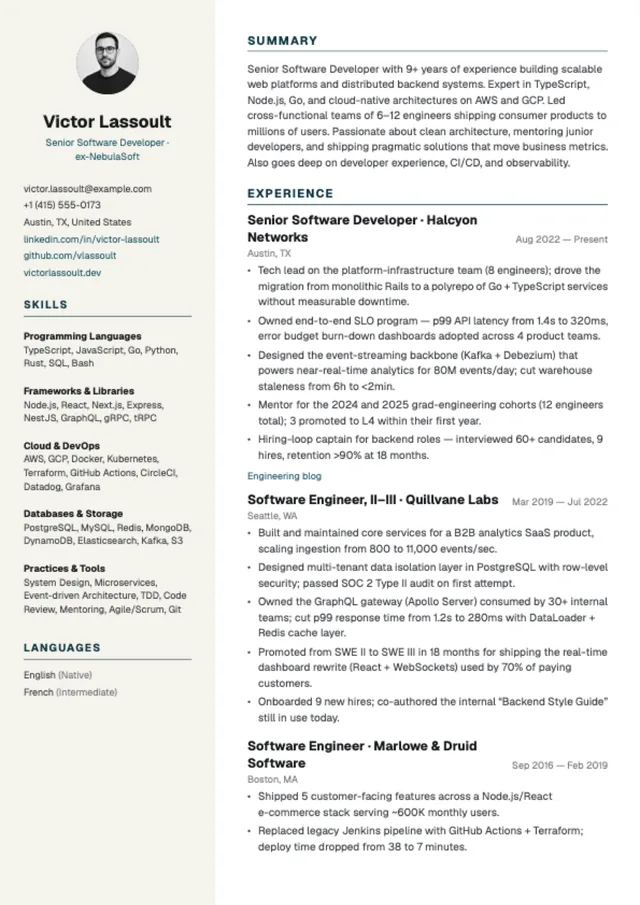
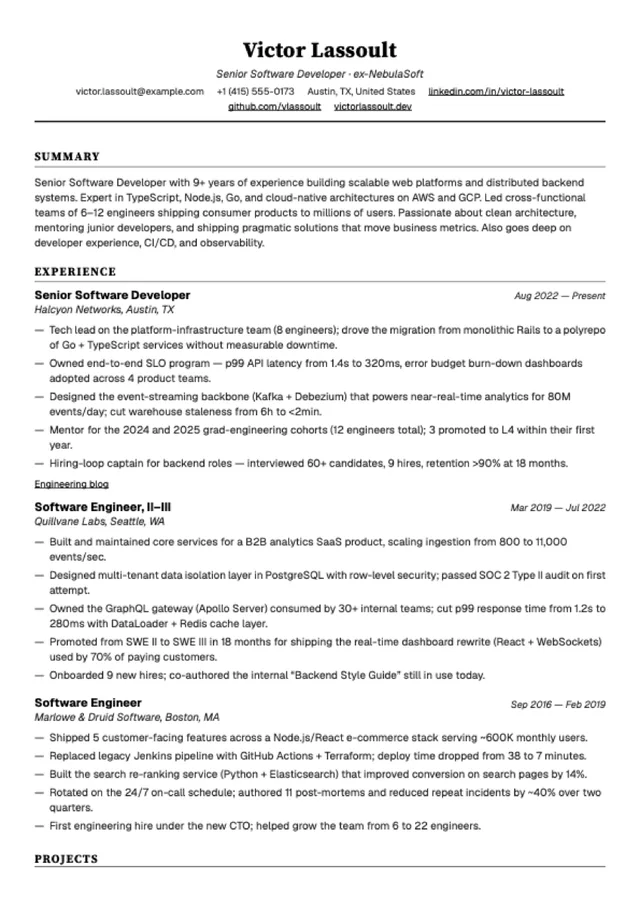
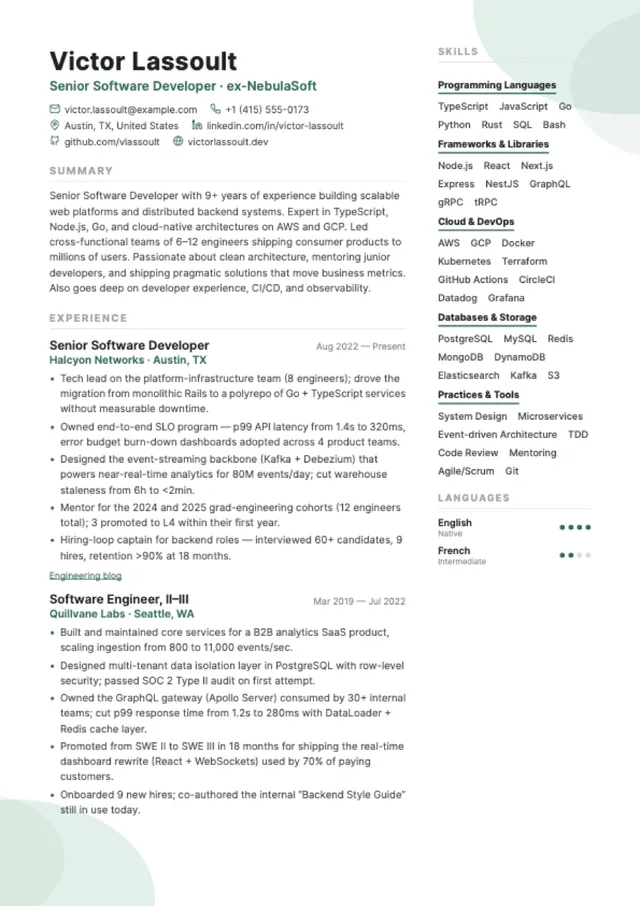
Chef resume FAQ
Do I need culinary school to be a chef?
No — the classic path of dishwasher → prep → line → sous → chef is real, respected, and how a large share of working chefs got there. Experience plus ServSafe and ACF certifications can substitute for a degree. What culinary school actually buys is broader technique exposure and business skills (food cost, kitchen math) that are harder to pick up on the line. Many chefs do a hybrid — work first, school later — and name-brand schools (CIA, Johnson & Wales) carry reputation weight, but frame any of it as an asset, not a gate.
What is a stage, and does it belong on my resume?
A stage (French stagiaire, “stahzh”) is a short working trial — a shift to a few weeks — where you cook in a real kitchen to learn technique or prove fit. It's traditionally unpaid, though the industry is shifting toward paid, structured stages partly for legal reasons. Staging at reputable or higher-end kitchens is absolutely a legitimate resume line: it signals ambition and broadens your pedigree, which fine-dining kitchens read before they read certificates.
How do I show food-cost management?
State the percentage against target with the levers you used: “held food cost at 29% against a 32% target through portioning discipline and vendor negotiation.” Food cost runs 28–35% of sales industry-wide (higher in fine dining), and holding it under target is the single strongest promotion signal a cook can put on paper — the back-of-house equivalent of a bartender's pour cost. Put it on any sous-and-up resume.
Is job-hopping a problem in kitchens?
Less than almost anywhere else — restaurant turnover is famously high and back-of-house runs around 43% a year, so short tenures are the norm and rarely penalized on their own. What actually stands out is longevity signals inside the churn: cooks who earned harder stations, opened or closed independently, trained new hires, or held the line through staffing gaps. Show staying power and growth, not just a list of kitchens.
How do I move up-market — casual to fine dining?
Tailor the target and build the pedigree. Stage at higher-end kitchens on your days off, name any upscale or hotel experience prominently, and lead with technique and consistency over volume. Fine dining weights hands-on experience and pedigree kitchens over paper certs, so the strongest move is getting real reps in the rooms you want to work in — a stage that turns into an offer is the classic path.
What can I do with kitchen experience besides cook?
Several ladders out, and some pay better than the line: food-service management, catering or a catering business, R&D / corporate chef (often the biggest salary jump), private cheffing, and culinary instruction. The management and R&D tracks reward the exact things you'd already be quantifying — food and labor cost, menu development, team leadership — so a resume built on those numbers doubles as your exit resume.
Which keywords matter most for kitchen resume screening?
ServSafe and HACCP, the stations you run (grill, sauté, garde manger), mise en place, knife skills, food cost / COGS, high-volume / covers per service, and inventory / FIFO — plus menu development and the kitchen-ops software for management roles. Mirror the posting's cuisine and volume. Run it against the actual listing — Resumap's ATS check scores the match and lists what's missing.
More resume examples
Your chef resume, done properly — free.
Unwatermarked PDF, ATS-safe templates, and a real score against any posting when you want it.
Build my resume