
Customer success manager resume examples that speak retention, not tickets.
The CSM resume lives or dies on one thing: it has to read as customer success, not customer service and not sales. Screeners at SaaS companies calibrate for it — net revenue retention, gross retention, churn avoidance, expansion, QBRs, health scores — and a resume built on “resolved tickets” or “hit quota” fails that filter, because CSM is a strategic, portfolio-owning retention-and-expansion role, not a call-center or a closing role. This guide shows the resume in SaaS's own language, with NRR leading, your book of business quantified, and the reframe career-changers need to cross over.
- Ideal length
- 1 page (2 for lead+)
- Headline metric
- NRR (then GRR)
- Language
- CS, not sales or support
- Bullets per role
- 3–5, metric-heavy
Marcus Bell
Enterprise Customer Success Manager · B2B SaaS
Remote (US) · linkedin.com/in/marcus-bell-cs
Summary
Enterprise CSM with 6 years owning retention and expansion for B2B SaaS. Manage a $12M-ARR book of 28 enterprise accounts at 118% net revenue retention and 95% gross retention; drove $2.1M in expansion last year through adoption-led success plans and executive business reviews. Cut churn on at-risk accounts by flagging health-score decline 90 days pre-renewal. Gainsight and Salesforce daily; remote-native, QBR-fluent, and the CSM sales trusts with their biggest logos.
Experience
Enterprise Customer Success Manager (Remote) · Vantabase (B2B data platform)
2022 — Present
- Own a $12M-ARR portfolio of 28 enterprise accounts at 118% NRR and 95% GRR — both above the enterprise benchmark.
- Drove $2.1M in expansion revenue through adoption-led success plans and quarterly executive business reviews.
- Reduced at-risk churn by operationalizing health scores in Gainsight — flagging decline 90 days pre-renewal and running structured save plays.
- Cut time-to-value on new enterprise onboards from 60 to 38 days with a rebuilt onboarding playbook, lifting 90-day adoption 30%.
- Generated 9 customer references and 4 case studies that sales now uses in enterprise deals.
Customer Success Manager (Mid-Market) · Loopside (SaaS)
2020 — 2022
- Managed 55 mid-market accounts ($4.2M ARR) at 108% NRR; held a maintained health score above 75 across the book.
- Ran the renewal motion to a 94% retention rate and identified expansion that grew existing-customer revenue 25%.
- Partnered with product on the customer voice — three of my accounts' feature requests shipped and became retention wins.
Account Manager → CSM · Loopside
2018 — 2020
- Moved from account management into customer success as the company built the function — reframed a quota-carrying book into a retention-and-health portfolio.
- Co-led early QBRs and helped write the first onboarding playbook the CS team scaled.
Skills
Education
B.A. Business — Indiana University, 2018
Certifications
SuccessCOACHING CCSM Level 2 · Gainsight Associate Administrator
Languages
English (native)
Why this example works
NRR leads, GRR backs it
118% NRR and 95% GRR, both against the enterprise benchmark. NRR is the headline metric in customer success; stating it with GRR and the segment context is exactly what a SaaS recruiter reads for — and what career-changers most often omit.
The book of business is fully specified
$12M ARR, 28 enterprise accounts. “Managed a large portfolio” tells a recruiter nothing; account count plus ARR plus segment is the CSM's core credential — it sizes your scope instantly.
The language is CS, not sales or support
Retention, expansion, adoption, QBR, health score — never “tickets,” never “quota” or “closed-won.” ATS filters at SaaS companies are calibrated to catch the wrong vocabulary, and the AM-to-CSM reframe is stated on purpose.
Customer Success Manager resume summary examples
Three to four lines: scope, stack or specialism, one quantified win. Match the register to your seniority.
Entry / associate CSM
Associate CSM moving up from SaaS support, where I already did the work under a different name: proactive account outreach, escalation prevention, and driving adoption for a book of 40 SMB customers. Reframing “resolved tickets” into churn avoidance and product adoption — because that's what it was. Product-fluent, CCSM Level 1, and ready to own retention and health for a portfolio of my own.
Mid-market CSM
Mid-market CSM with 4 years owning retention and growth: a 60-account, $5M-ARR book at 106% NRR, a renewal motion at 93%, and the expansion instinct to spot upsell before the renewal conversation starts. QBR cadence, health-score discipline in ChurnZero, and the balance of efficiency and relationship depth that managing volume at this segment demands.
Enterprise CSM
Enterprise CSM with 6 years and both retention numbers to show: 118% NRR and 95% GRR across a $12M-ARR book of 28 strategic accounts. C-suite EBRs, multi-stakeholder success plans in Gainsight, and the executive relationships that turn a renewal into an expansion. Fewer accounts, higher stakes — the CSM sales wants on their biggest, most complex logos.
Technical CSM
Technical CSM with 5 years bridging product and customer for developer-facing SaaS: API and integration guidance, implementation troubleshooting, and translating technical depth into business outcomes. Boosted usability and adoption through an integration toolkit I helped design; the CSM engineers respect and executives understand. Retention through technical trust — and a salary that reflects the specialty.
CS team lead / manager
Customer success leader with 8 years, now running a 7-CSM team: lifted team NRR to 112%, cut new-hire ramp from 5 months to 3 with a rebuilt playbook, and designed the health-scoring and digital-touch motions that scaled coverage without adding headcount. I coach the individual saves and own the portfolio number — people development and retention outcomes in the same job.
Career-changer into CS
Customer success manager transitioning from B2B account management, bringing the relationship depth and revenue instinct CS runs on. The reframe is the whole story: my quota-carrying book becomes a retention portfolio, my renewals become NRR and health, my upsells become expansion. CCSM in progress, QBRs co-led, and a clear grasp of why proactive adoption beats reactive firefighting. The pool of AM-to-CS movers is large — and I've done the translation.
Skills that belong on a customer success manager resume
Retention & growth
- Net revenue retention (NRR)
- Gross revenue retention (GRR)
- Churn reduction & avoidance
- Expansion / upsell / cross-sell
- Renewals
- Advocacy (references, case studies)
Success motions
- Onboarding & time-to-value
- Product adoption
- QBRs / executive business reviews
- Customer health scoring
- Success plans & playbooks
- Escalation & at-risk management
Platforms & partnership
- Gainsight / Totango / ChurnZero
- Salesforce / HubSpot
- Cross-functional (product, sales)
- Stakeholder & executive management
- SaaS metrics (ARR, ACV, TTV)
- Digital / scale CS motions
Bullet point formulas that get interviews
Fill the brackets with your numbers — the structure does the selling.
- Owned a $[ARR] book of [n] accounts at [NRR]% NRR — e.g. “$12M ARR, 28 enterprise accounts, 118% NRR.”
- Held [GRR]% gross retention — e.g. “95% GRR, above the enterprise benchmark.”
- Drove $[amount] in expansion — e.g. “$2.1M expansion through adoption-led success plans.”
- Reduced churn from [x] to [y] — e.g. “monthly churn 2.0% → 0.5% by flagging risk 90 days pre-renewal.”
- Cut time-to-value [x] — e.g. “onboarding 60 → 38 days; 90-day adoption +30%.”
- Maintained health score above [n] — e.g. “75+ across a $4.2M book.”
- Ran renewals to [x]% — e.g. “94% retention rate on the mid-market book.”
- Lifted NPS / CSAT [a→b] — e.g. “NPS from 30 to 75 across the portfolio.”
- Generated [n] references / case studies — e.g. “9 references and 4 case studies sales uses in enterprise deals.”
- Led a [n]-CSM team to [team metric] — e.g. “7 CSMs to 112% team NRR; ramp cut 5 months to 3.”
ATS keywords for customer success manager roles
Filters match tokens from the posting. These are the terms worth mirroring — verbatim — when they appear in the job ad.
| Keyword | Priority |
|---|---|
| Net Revenue Retention (NRR) — the headline metric | High |
| Gross Revenue Retention (GRR) | High |
| churn reduction / churn avoidance (proactive) | High |
| expansion / upsell / expansion ARR | High |
| renewals / renewal rate | High |
| onboarding / time-to-value (TTV) | High |
| product adoption / feature adoption | High |
| QBR / EBR (quarterly & executive business reviews) | High |
| customer health scores | High |
| Gainsight (the dominant CS platform) | High |
| Salesforce (CRM) | High |
| CS platforms: Totango, ChurnZero, Catalyst, Vitally (name-match the JD) | Medium |
| customer lifecycle / escalation / at-risk accounts | Medium |
| cross-functional (product, sales) / stakeholder management | Medium |
| SaaS metrics: ARR, ACV, playbooks, book of business | Medium |
Don't guess — score your resume against the specific posting and see exactly which terms are missing.
How to write a customer success manager resume
Lead with NRR — and give GRR and segment context
Net revenue retention is the metric customer success is judged on, so it goes first. Pair it with gross retention at enterprise level, and contextualize against your segment: an SMB CSM holding 100%+ NRR is strong, an enterprise CSM should be showing 110%+. A recruiter who sees “118% NRR, 95% GRR across 28 enterprise accounts” knows your scope and your performance in one line.
Specify the book of business — accounts, ARR, segment
“Managed a large portfolio” is invisible. Always state account count, total ARR and the ACV band or segment: “$12M ARR across 28 enterprise accounts” or “55 mid-market accounts, $4.2M ARR.” The book of business is the CSM's core credential — it sizes your responsibility instantly, and its absence reads as inexperience.
Speak customer success — not customer service, not sales
SaaS ATS filters are calibrated to the vocabulary. Use NRR, GRR, expansion, adoption, QBR, health score, time-to-value. Avoid support language (tickets, queue, average handle time) and pure-sales language (quota, pipeline, closed-won) unless the posting explicitly asks — on a CS resume they signal you don't understand the role. This is the single biggest tell recruiters watch for.
Reframe your path if you're crossing over
Career-changers are the majority of the CSM applicant pool, and the whole game is translation. From account management: a quota book becomes a retention portfolio, renewals become NRR and health. From support: resolved tickets become proactive churn avoidance and adoption. From sales: relationship and revenue instinct stay, quota language goes. Signal an active transition — QBRs co-led, CCSM in progress — and the pivot reads as an asset.
Put certifications after the metrics, and lead with results
Certifications (CCSM, Gainsight) are secondary signals — useful for career-changers as structured credibility, near-worthless as a substitute for outcomes for experienced CSMs. A resume that leads with a cert but shows no NRR, GRR or book-of-business numbers loses to one with metrics and no cert. Keep certs in a short section below your experience, and never inflate a number a recruiter will probe in the interview.
Skip the blank page.
Build this resume in Resumap — free templates, unwatermarked PDF, and an ATS check against the exact posting when you're ready.
Start freeMistakes that filter customer success managers out
Customer-service or sales language on a CS resume
“Resolved tickets” and “hit quota” both fail the filter. Translate to retention, adoption, expansion, health — the vocabulary the role actually uses.
No quantifiable retention metrics
“Responsible for onboarding and renewals” proves nothing. NRR, GRR, churn, expansion, adoption — with numbers — are the whole case.
Omitting the book-of-business size
Account count, ARR and segment size your scope. Without them a recruiter can't tell an SMB generalist from an enterprise strategist.
Confusing churn reduction with churn avoidance
Reactive fixes and proactive prediction are different skills — and metrics without a timeframe or benchmark mean little. State which, and against what benchmark.
Relationship skills only, no product knowledge
CS is retention through value, and value needs product fluency. Show where you used product expertise to solve a customer problem.
Burying relevant CS experience
If a recruiter reads past three bullets without hitting CS-relevant work, they move on. Lead with the transferable retention wins.
Inflated metrics or claimed tool fluency
Recruiters probe NRR and health-score methodology in the interview — fabrication is exposed fast. Use real numbers and tools you've actually run.
Customer Success Manager salary ranges (US)
United States market. Absolute figures differ by country — the gaps between levels travel better than the numbers.
| Associate / entry CSM | $55K–$70K base · $65K–$85K OTE |
| CSM (mid) | $80K–$105K base · $95K–$140K OTE |
| Senior / enterprise / technical CSM | $105K–$140K base · $140K–$185K OTE |
| CS team lead / manager | $120K–$150K base · $150K–$200K OTE |
| Director / VP of CS | $150K–$300K+ base · to $410K total |
There's no BLS category for CSM — it's a SaaS-native title. The cleanest anchor is RepVue's verified comp: ~$105K median base, ~$140K median OTE, top performers past $245K. CSMs carry OTE with retention/expansion-tied variable (typically 70/30 to 80/20 base/variable), which structurally separates them from salaried customer-service reps who earn roughly a third as much. Technical and enterprise CSMs command a premium.
Primary source: U.S. Bureau of Labor Statistics (OEWS/OOH). Self-reported aggregator figures are labelled as such.
Certifications worth listing
- Metrics and book-of-business results beat certifications every time — put certs after your experience, never lead with them
- SuccessCOACHING CCSM (Levels 1–4) — the most recognized vendor-neutral CSM credential; most valuable for career-changers and early-career as structured credibility
- Gainsight certifications (Administrator) — high value only if your target company runs Gainsight; platform-specific, limited transfer otherwise
- For experienced CSMs a certification is near-zero substitute for real NRR/GRR and expansion numbers — the outcomes are the credential
- The CSM path is metrics-first: a resume with retention numbers and no cert outperforms a certified one with no numbers
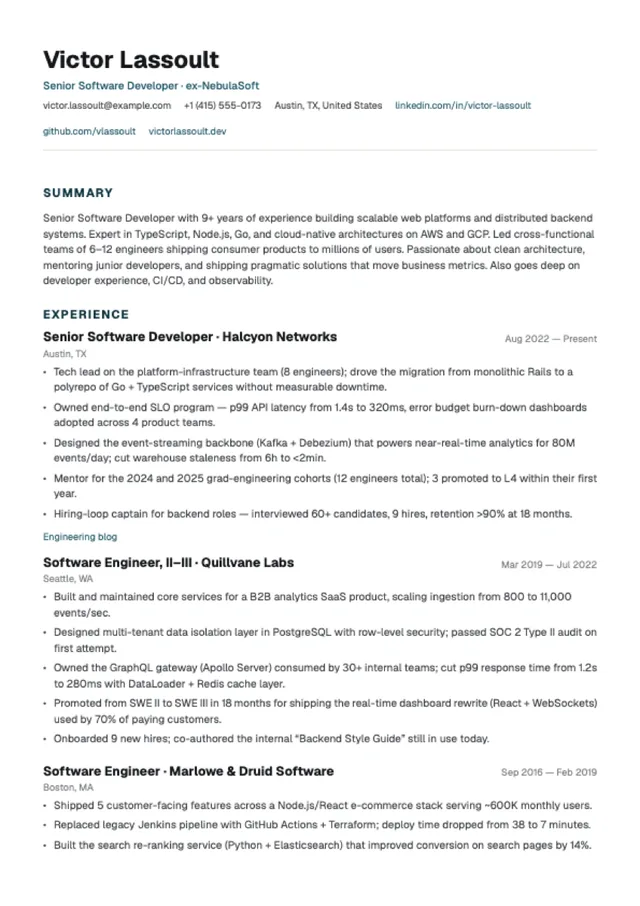
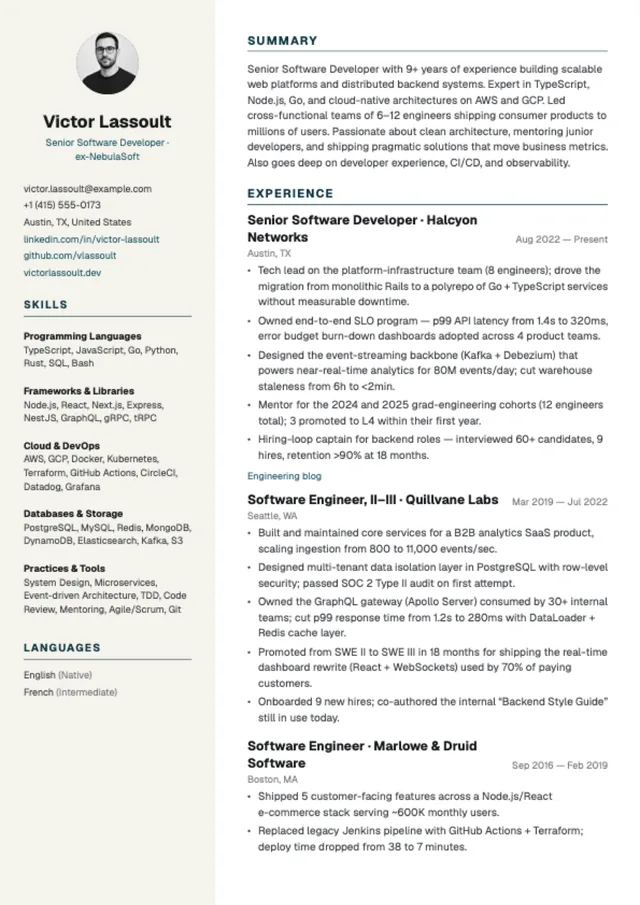
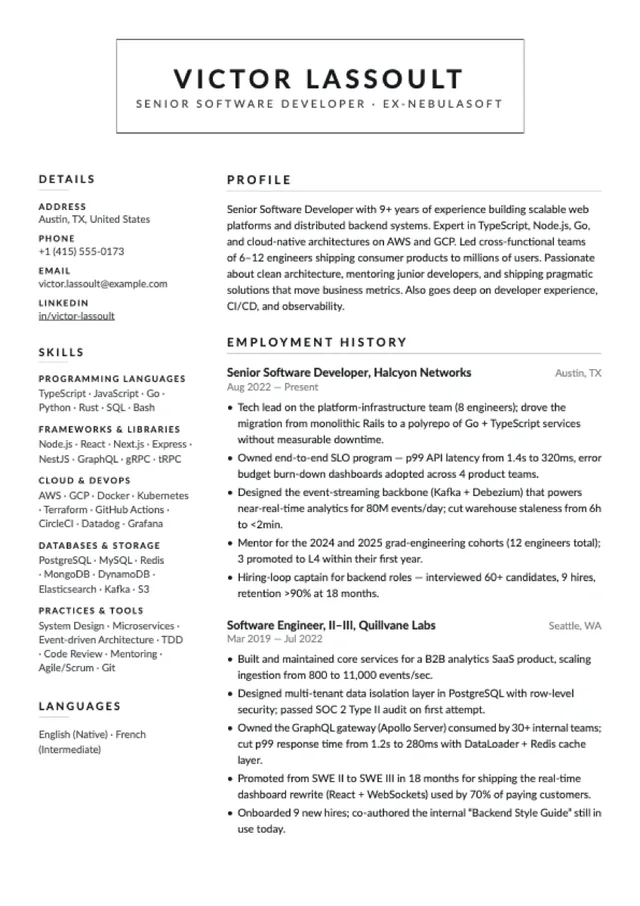
Templates that fit customer success manager resumes
Customer Success Manager resume FAQ
How do I break into customer success?
Three well-worn paths, and the key to each is translation. From support, you already do proactive outreach and escalation prevention — reframe “resolved tickets” as churn avoidance and adoption. From sales or SDR/AE work, your relationship and revenue instinct transfer; drop the quota language. From account management, the closest adjacency, reframe your book of business into retention, health and expansion metrics. Career-changers are the majority of the applicant pool, so a clean reframe is expected, not a red flag.
What's the difference between a CSM, an account manager, and a customer service rep?
A customer service rep is reactive — resolves inbound tickets, hourly, no portfolio — and earns roughly a third of a CSM. An account manager is revenue-first: hunts upsell and renewal, carries a quota, negotiation-heavy. A CSM is proactive: owns a portfolio and drives retention and expansion through adoption, health scores and QBRs, with OTE tied to retention outcomes. At some SaaS companies the CSM owns the renewal number; at others the AM does — read each posting to see which model applies.
Which metrics matter most on a CSM resume?
Net revenue retention is king — it's the number CS leaders are measured on, so it leads. Gross retention is the floor and belongs alongside it at enterprise level. Then churn (avoidance, not just reduction), expansion revenue, product adoption, time-to-value, renewal rate, and NPS/CSAT. Contextualize your NRR against your segment: an SMB CSM at 100%+ is strong, an enterprise CSM should be past 110% — stating the benchmark shows you understand the number, not just recite it.
How do I frame my book of business?
Always with three numbers: account count, total ARR, and the ACV band or segment. “$4.2M ARR across 40 mid-market accounts” beats “large portfolio” every time — it instantly tells a recruiter your scope, your segment, and whether your experience matches their role. The book of business is the CSM's core credential, and omitting its size is one of the most common ways an otherwise-strong resume reads as junior.
Is CS a good remote career?
It's among the most remote-native roles in B2B tech — the whole model runs on health-score monitoring and structured digital touchpoints rather than in-person presence, so fully-remote CSM roles are common. The tradeoff: remote openings draw heavy applicant volume and lean harder on ATS and AI filtering before a human reads you, which makes keyword precision matter more. Get the CS vocabulary and your metrics exactly right, because the screen is stricter.
Technical CSM or relationship CSM — which should I position as?
Match it to the product and the posting. A technical CSM leads with integration and implementation depth, API guidance, and translating technical complexity into business value — a hybrid resume, and a real salary premium. A relationship CSM leads with stakeholder and executive engagement, QBR/EBR cadence, and advocacy. Neither is better in the abstract; the one that fits the role's product and buyer wins the screen.
Which keywords matter most for CSM screening?
NRR and GRR first, then churn (reduction and avoidance), expansion, renewals, onboarding and time-to-value, adoption, QBR/EBR, health scores, and the CS platform by name — Gainsight above all, plus Salesforce. Keep support and pure-sales language off the page unless the posting asks. Run it against the actual listing — Resumap's ATS check scores the match and lists exactly what's missing.
More resume examples
Your customer success manager resume, done properly — free.
Unwatermarked PDF, ATS-safe templates, and a real score against any posting when you want it.
Build my resume