
Flight attendant resume examples that get you into training.
Almost everyone applying to be a flight attendant has never worked as one — and that's fine, because airlines hire for personality and a customer-service background, then train you for six or seven weeks. So the resume can't come from flight experience you don't have; it comes from the service jobs you do have, reframed the way airlines screen: safety-first, service-second, calm under pressure, ready to relocate. One catch to know up front — you can't get FAA-certified before you're hired, since the certificate is earned during airline training. The resume's only job is to get you into that training. This guide shows how.
- Ideal length
- 1–2 pages
- The resume's job
- Get you into training
- Screened for
- Customer service, safety
- No photo
- US commercial resumes
Elena Reyes
Aspiring Flight Attendant · Hospitality & Guest Service
Atlanta, GA · open to any base · willing to relocate
Summary
Customer-service professional with 5 years in hotel and restaurant hospitality, seeking a flight-attendant role and ready to train. Served 200+ guests a shift with a 96% satisfaction score, de-escalated complaints without a manager callout, and stayed composed through the busiest rushes. CPR/First Aid certified, fluent in English and Spanish, and available for reserve duty and any base. Safety-minded, service-driven, and calm when it counts.
Experience
Front Desk & Guest Services Lead · Peachtree Grand Hotel
2022 — Present
- First point of contact for 150+ guests a day; held a 96% guest-satisfaction score on post-stay surveys.
- De-escalated booking and billing complaints calmly and to resolution, reducing escalations to management by roughly a third.
- Coordinated with housekeeping, valet and the restaurant as a team under pressure — the front desk stayed calm because I did.
- Trained 4 new front-desk staff on service standards, safety procedures and difficult-guest handling.
Server · Copperline Kitchen (high-volume restaurant)
2020 — 2022
- Served 200+ guests a shift at pace, at 98% order accuracy, on weekend doubles.
- Upsold specials and add-ons, and handled cash and card transactions with a clean, balanced till.
- Kept a full section calm and cared-for during rushes — the same composure a cabin needs on a delayed flight.
Retail Associate · Marlow's Department Store
2018 — 2020
- Served 100+ customers a shift, resolved returns and complaints, and hit the store's top attach-rate tier two years running.
- First customer-facing job — where I learned I'm at my best with people on the worst day of their trip.
Skills
Education
A.A. Hospitality Management — Georgia State University, 2018
Certifications
CPR / First Aid (American Red Cross, current) · TIPS Alcohol Service
Languages
English (native) · Spanish (fluent)
Why this example works
Safety-first, service-second — not a server's resume
CPR/First Aid up top, composure and de-escalation foregrounded. Airlines screen for safety aptitude before anything, so a resume that reads like a restaurant server's fails — the same experience, framed toward safety and calm, passes.
The customer-service story does the work
No flight experience — and none is needed. 200+ guests at 96% satisfaction, complaints de-escalated, composure under rushes: the exact evidence airlines hire on. Every prior job is reframed as proof you can care for a cabin.
Languages, relocation, and no photo
Bilingual (a real Language-of-Destination pay premium and more international hours), “willing to relocate / any base” (a screened signal), and no photo — US commercial convention, unlike corporate or international carriers. No age, height or weight either.
Flight Attendant resume summary examples
Three to four lines: scope, stack or specialism, one quantified win. Match the register to your seniority.
Aspiring / no experience
Customer-focused hospitality professional seeking a flight-attendant role and ready to train. Five years serving guests in high-pressure hotel and restaurant settings — 200+ guests a shift, 96% satisfaction, complaints handled calmly — plus CPR certification and fluency in English and Japanese. No flight experience yet, and none required: I bring the composure, the service instinct and the safety mindset airlines train around. Available for reserve and any base.
Experienced flight attendant
Flight attendant with 9 years across narrow- and wide-body aircraft: 200+ passengers a flight, an incident-free safety record, and lead-cabin stints on international routes. Managed a mid-flight medical emergency to a company commendation and de-escalated a three-hour delay while keeping 150+ passengers calm. Fluent in English and French, senior enough to hold a line, and ready for a purser track.
Career-changer (nursing / military / hospitality)
Registered nurse of 6 years pivoting to the cabin, bringing exactly what airlines value most in an emergency: clinical calm, CPR and medical-response credibility, and the composure to lead a room through a crisis. Add years of patient-facing service and the teamwork of a hospital floor, and the transferable half of the job is already done. Ready to train, relocate, and turn bedside steadiness into cabin safety.
Bilingual / international-focus
Bilingual customer-service professional (fluent English and Mandarin) seeking a flight-attendant role on international crews. Five years in luxury hospitality serving a global clientele, cultural fluency across markets, and the language skills airlines staff preferentially on long-haul routes — which means a Language-of-Destination premium and more flight hours. Composed, service-driven, and ready to train.
Corporate / private-jet FA
Corporate flight attendant with 4 years on Part 135 charters serving UHNW and C-suite passengers: bespoke catering and provisioning, discretion under NDA, ground-transport coordination, and 100% safety compliance across 200+ flights. Silver-service standard, audit-ready documentation, and the polish private aviation demands. The cabin runs seamlessly because everything behind it was handled before the door closed.
Lead / purser
Senior flight attendant and purser with 11 years: cabin-lead override, crew mentoring, cockpit and manifest coordination, and service-standard enforcement across full narrow-body cabins. De-escalation at scale, an incident-free record, and the calm authority a crew follows when a flight goes sideways. Fluent in English and Spanish, and the lead junior crew ask to fly with.
Skills that belong on a flight attendant resume
Service & safety
- Customer service / guest experience
- Cabin & in-flight service
- Safety & emergency procedures
- CPR / First Aid / AED
- Conflict de-escalation
- Situational awareness
Under pressure
- Calm under pressure
- Multitasking / high-volume service
- Teamwork / crew coordination
- Cash handling / onboard sales
- Adaptability / reserve-ready
- Reliability & punctuality
Differentiators
- Second language / bilingual
- Cultural awareness
- Professional appearance & demeanor
- Willing to relocate (any base)
- Reach requirement met
- Flexibility / travel-ready
Bullet point formulas that get interviews
Fill the brackets with your numbers — the structure does the selling.
- Served [n]+ guests/passengers a shift/flight — e.g. “200+ passengers on a long-haul flight.”
- Held a [x]% satisfaction score — e.g. “96% on post-stay surveys.” / “98% on post-flight surveys across 320 flights.”
- De-escalated [situation]; [outcome] — e.g. “managed a 3-hour delay, kept 150+ passengers calm, complaints −78%.”
- Maintained an incident-free safety record — e.g. “no accidents across two years with a 6-person cabin team.”
- Upsold / sold $[amount] onboard — e.g. “$500 in in-flight sales per flight, up 30% in nine months.”
- Handled an emergency — e.g. “led an evacuation for 180+ passengers within FAA's 90-second standard.”
- Absorbed [n] schedule changes — e.g. “took on 30+ unexpected duties over 12 months.”
- Spotted / reported a safety issue — e.g. “caught a cabin equipment fault on pre-flight check, avoiding a cancellation.”
- Coordinated a team of [n] — e.g. “led a cabin crew of 6 through a mid-flight medical emergency.”
- Served in [n] languages / on [routes] — e.g. “bilingual service on international crews; 120+ segments.”
ATS keywords for flight attendant roles
Filters match tokens from the posting. These are the terms worth mirroring — verbatim — when they appear in the job ad.
| Keyword | Priority |
|---|---|
| customer service / in-flight service / passenger comfort | High |
| safety / safety protocols / emergency procedures / evacuation | High |
| FAA regulations (FARs) / compliance | High |
| CPR / AED / First Aid | High |
| conflict de-escalation / unruly passengers (a 2026 buzzword) | High |
| cabin service / galley management | High |
| calm under pressure / multitasking / high-volume service | High |
| second language / bilingual / multilingual (the biggest differentiator) | High |
| flexibility / reserve duty / on-call · willing to relocate | High |
| cash handling / onboard sales / upselling | Medium |
| cultural awareness / cultural sensitivity | Medium |
| professional appearance / demeanor | Medium |
| teamwork / crew resource management (CRM) | Medium |
| reach requirement met / aircraft type (737/A320) | Medium |
| the right title for the market: “Flight Attendant” (US), “Cabin Crew” (Europe/ME) | Medium |
Don't guess — score your resume against the specific posting and see exactly which terms are missing.
How to write a flight attendant resume
Frame the whole resume safety-first, service-second
Airlines screen for safety aptitude before anything else, so a resume that reads like a restaurant server's will fail. Put CPR/First Aid up top, foreground composure, de-escalation and emergency-readiness, and cast your service experience as evidence you stay calm and take charge when things go wrong. Same jobs, safety-forward framing — that's the difference between a screen-out and a callback.
Build it from customer service — you don't need flight experience
No prior flight-attendant experience is required; airlines hire on personality and a customer-service background and train you for six or seven weeks. So mine your real jobs — retail, hospitality, restaurants, care work — for the evidence they want: guests served at volume, satisfaction scores, complaints de-escalated, teamwork under pressure. Every prior role becomes proof you can care for a cabin.
Don't claim the FAA certificate — the resume gets you into training
You cannot become FAA-certified before you're hired: the Certificate of Demonstrated Proficiency is issued only after you complete the airline's own training program. Listing it when you've never flown is a red flag. Understand what the resume is actually for — clearing the first application gate and framing your transferable experience so an airline invites you into training, where the certificate is earned.
Feature a second language, relocation, and flexibility
A second language is the single biggest differentiator: airlines qualify you as a Language-of-Destination speaker, pay a language premium, and staff you preferentially on international routes for more hours. State it prominently. And say “willing to relocate / open to any base” and “available for reserve” — flexibility on base and schedule is a screened signal, because new hires start on reserve at whatever base has openings.
Know where the resume matters — and leave off the photo
The hiring funnel runs application (often ATS-scanned) → video interview → group assessment → in-person day, and roughly 90% of applicants are cut at the first gate — so the resume is load-bearing at the start and for career-changers translating prior work. On a US commercial resume, no photo (it invites bias and breaks parsing), and no age, height or weight — the exceptions are corporate/private aviation and many international carriers, where headshots are expected.
Skip the blank page.
Build this resume in Resumap — free templates, unwatermarked PDF, and an ATS check against the exact posting when you're ready.
Start freeMistakes that filter flight attendants out
A service-only resume that reads like a server's
Safety is the job's core. Lead with CPR, emergency-readiness and composure; frame service as calm-under-pressure evidence, not just food and drinks.
Generic phrasing
“Provided excellent customer service,” “hardworking team player” tell recruiters nothing. Name the volume, the satisfaction score, the situation you handled.
No quantification
No numbers means no proof of impact. Guests served, satisfaction percentage, complaints reduced, schedule changes absorbed — quantify from your real jobs.
Passive verbs and vague duty lists
“Helped passengers,” “responsible for…” read weak. Use action verbs — delivered, coordinated, de-escalated, led — with an outcome attached.
Claiming the FAA certificate before being hired
It's issued during airline training, so you can't have it as an applicant. Listing it is a red flag; the resume's job is to get you into that training.
The wrong title for the market
US postings say “Flight Attendant,” Europe and the Middle East say “Cabin Crew,” private aviation says “Corporate Flight Attendant.” Mirror the exact one.
A photo (and age/height/weight) on a US resume
US convention is no photo — it invites bias and breaks parsing. Corporate and international carriers are the exception. Never list age, height or weight.
Flight Attendant salary ranges (US)
United States market. Absolute figures differ by country — the gaps between levels travel better than the numbers.
| Regional (new hire) | $28K – $38K (~$20–25/hr) |
| Major / legacy (first year) | $31K – $45K (~$37/hr) |
| Median (BLS) | $67,130 |
| Senior (major) | $84 – $100/hr |
| Top 10% | $138K+ |
BLS median for flight attendants is $67,130 (May 2024; 10th–90th $34,030–$138,040), with +9% growth to 2034. Pay is per flight hour — the clock generally starts when the aircraft door closes, not at report time — plus per diem and, increasingly, boarding pay. New hires start on reserve (on-call) and majors run ~$37/hour first year rising past $80–100 senior; regionals start lower (~$20–25). A second language earns Language-of-Destination premium pay.
Primary source: U.S. Bureau of Labor Statistics (OEWS/OOH). Self-reported aggregator figures are labelled as such.
Certifications worth listing
- The FAA Certificate of Demonstrated Proficiency is earned DURING airline training, not before — you cannot list it as an applicant, and the resume's job is to get you into that training
- Airline-run initial training (6–7 weeks) is where certification happens; it's paid at some carriers (Delta) and unpaid-with-stipend at others (American, United) — a stipend and completion bonus are common
- CPR / First Aid / AED — a genuine pre-application asset that signals safety-readiness; list it with the issuer
- A second language qualifies you as a Language-of-Destination speaker after the airline's proficiency test — a pay premium and more international hours; feature it prominently
- Requirements to know: reach an overhead bin at roughly 80–82 inches (a safety standard, not a height rule), vision correctable to 20/40, minimum age 18–21+ by carrier, valid passport and right to work
Templates that fit flight attendant resumes
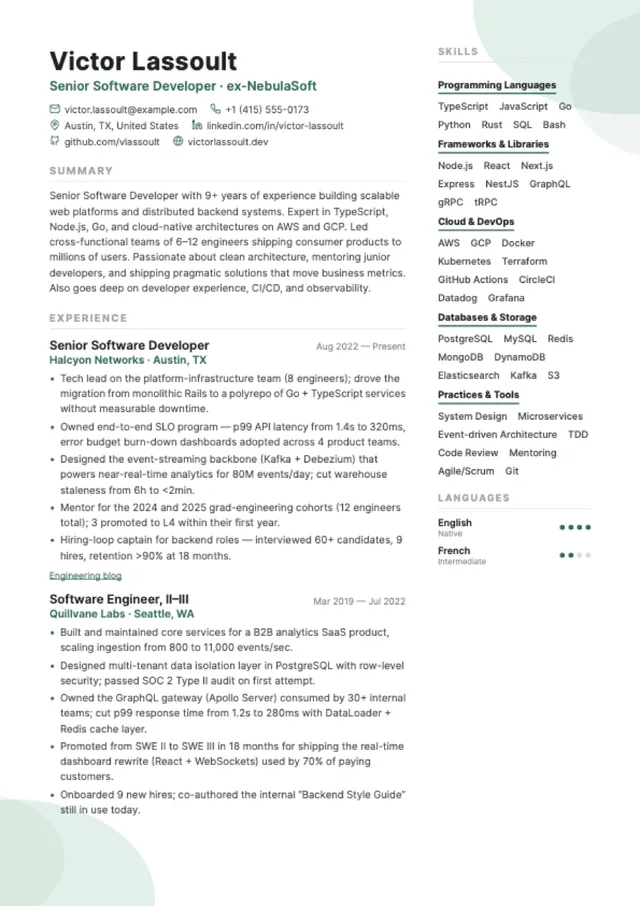
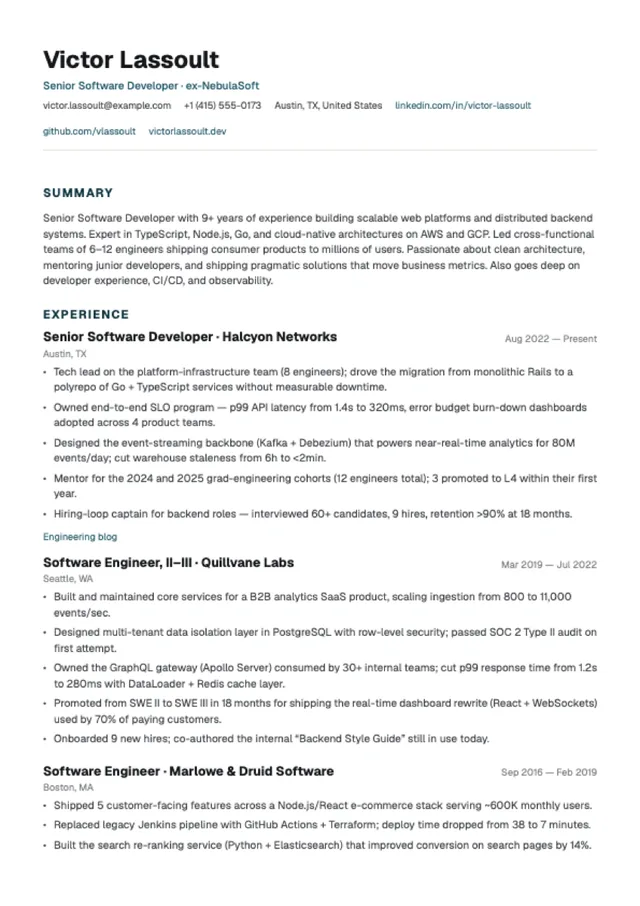
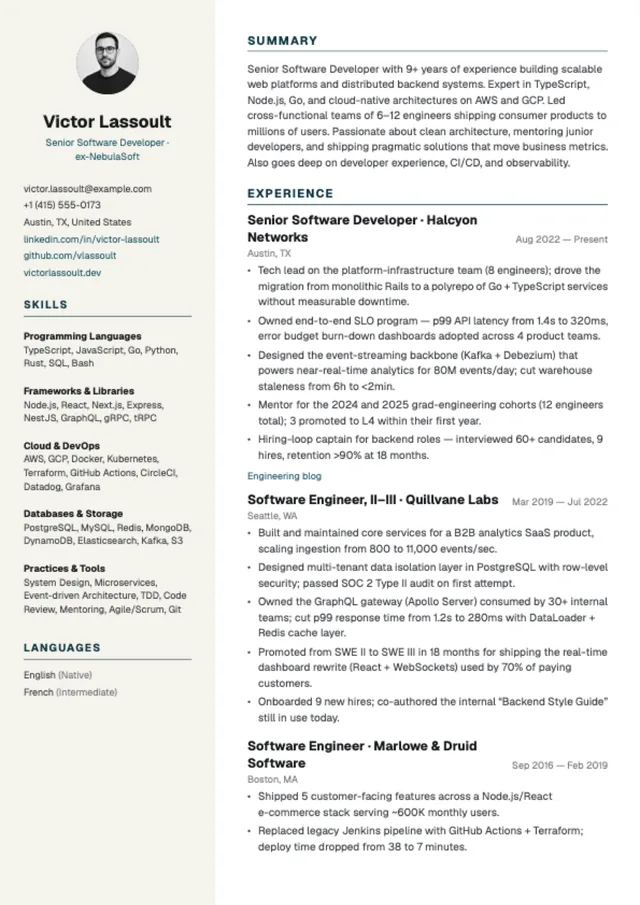
Flight Attendant resume FAQ
Can I apply with no flight experience?
Yes — it's the norm, and it's exactly how the role works. Airlines require no prior flight-attendant experience; they hire on personality and a customer-service background and then train you for six or seven weeks. Your job is to build the resume from the service work you do have — retail, hospitality, restaurants, care — and frame it as proof you stay calm, care for people at volume, and can handle a safety-critical role. The airline supplies the rest.
What are the physical requirements, honestly?
The main one is reach: you must be able to reach an overhead bin at roughly 80–82 inches (it varies by carrier), usually on tiptoes — and airlines frame it as a safety requirement for unaided access to emergency equipment, not a height rule. Vision must be correctable to at least 20/40. Minimum age is 18 by statute but many majors want 20–21+, and you'll need a valid passport, right to work, and to pass a background check and drug screen. There's no weight requirement, and you should never put weight (or age or height) on the resume.
Does a resume even matter if the hiring is video interviews and group assessments?
It matters at the front. The funnel runs application → online assessment → recorded video interview → group assessment → in-person day, and roughly 90% of applicants are cut at that first application stage, where many majors run a keyword scan. So the resume is load-bearing exactly where most people get filtered — and it's doubly important for career-changers, whose whole task is translating unrelated experience into the customer-service-and-safety story airlines screen for.
How much does a second language help?
A lot, and concretely. After you pass the airline's proficiency test you're qualified as a Language-of-Destination speaker, which comes with premium pay (commonly a few dollars an hour) and — the bigger lever — preferential staffing on international routes, which means more flight hours and therefore more annual earnings. It's the single strongest differentiator on a flight-attendant application, so if you're bilingual, feature it prominently rather than tucking it at the bottom.
How competitive is it, really — and what's the reserve lifestyle like?
Very competitive: the majors report acceptance rates in the low single digits (often cited as under 1%, though those figures are reported rather than audited), with thousands of applicants per opening. And the honest lifestyle note: new hires start on reserve — on-call, must be reachable within a call-out window, unpredictable schedule, at whatever base has openings — for months or even years before seniority lets them hold a fixed line. Seniority governs your schedule, base and routes, so the first stretch takes real flexibility.
What do airlines actually screen for above everything?
Customer service, first and hardest — the ability to make passengers feel cared for, especially when things go wrong — followed by safety aptitude, composure under pressure, communication, teamwork, adaptability and languages. That's why the resume should read as a customer-service story with a safety spine, not a list of duties. Show the moments you kept people calm, resolved a conflict, or took charge in chaos, and you're speaking the language airlines hire in.
Which keywords matter most for a flight-attendant application?
Customer service and passenger comfort, safety and emergency procedures, CPR/First Aid, conflict de-escalation, cabin service and calm-under-pressure — plus a second language, flexibility/reserve-readiness and willingness to relocate, which are genuinely screened. Use the market's exact title (“Flight Attendant” in the US). Run it against the actual posting — Resumap's ATS check scores the match and lists what's missing.
More resume examples
Your flight attendant resume, done properly — free.
Unwatermarked PDF, ATS-safe templates, and a real score against any posting when you want it.
Build my resume