
Graphic designer resume examples — the data document your portfolio deserves.
Design hiring runs on a triangle: the portfolio is king (a panel of design hiring leaders put it exactly that bluntly), the resume is the data document that gets you parsed and priced, and the screening software between them can't read the beautiful Photoshop-exported PDF you were tempted to send. The designers who win keep the roles straight: ruthlessly curated portfolio linked in the header, a clean parsable resume with tools named individually and business numbers attached, and the visual flexing saved for where it counts. This guide shows how.
- Ideal length
- 1 page
- Portfolio link
- Header, clickable
- The resume's job
- Data doc, not showcase
- Bullets per role
- 3–5
Nadia Osei
Senior Graphic Designer · Brand & Digital
Richmond, VA · nadiaosei.design · behance.net/nadiaosei
Summary
Senior graphic designer with 8 years across brand identity and digital campaigns — portfolio at nadiaosei.design. Led the rebrand rolled out across 60+ employees and every customer touchpoint; master templates in InDesign and Figma cut team production time 30%. Campaign assets tied to $500K in attributed revenue last year. Photoshop, Illustrator, InDesign daily; Figma for everything that ships to a screen.
Experience
Senior Graphic Designer · Harbor & Pine Creative (brand agency)
2022 — Present
- Lead designer on 6 client rebrands — the largest adopted company-wide across 60+ employees, 3 product lines and every customer touchpoint, with brand guidelines I authored.
- Built master template systems in InDesign and Figma that cut team production time ~30% and ended the off-brand-deck era for two clients.
- Designed 40+ campaign asset sets last year; the top campaign drove a 22% email CTR lift and $500K in client-attributed sales over two quarters.
- Mentor two junior designers; run the studio's weekly critique.
Graphic Designer · Bluewater Outfitters (in-house, e-commerce)
2019 — 2022
- Produced 50+ digital assets a week across email, social and site — on deadline through three peak seasons.
- Redesigned the email template system: click-through rate up 25% and design-to-send time cut by 20 minutes per campaign.
- Co-led the product-page visual refresh in Figma; bounce rate down 17% post-launch.
Freelance Graphic Designer · Independent practice
2017 — 2019
- Designed logos and identity systems for 20+ small-business clients; 60% returned with repeat work.
- Ran full project cycles solo — scoping, contracts, revisions, print-ready delivery with zero reprint errors.
Skills
Education
B.F.A. Graphic Design — Virginia Commonwealth University, 2017
Certifications
Adobe Certified Professional: Illustrator (2021)
Languages
English (native) · French (conversational)
Why this example works
Portfolio link where nobody has to hunt
In the header, next to the name, as a short custom domain. Design hiring leaders are unanimous that the portfolio is the primary evaluation artifact — the resume's job is to make sure they reach it with your scope and numbers already in mind.
Tools named individually, attached to outcomes
Photoshop appears in 63% of design postings and InDesign in 54% as separate tracked keywords — “Adobe Creative Suite” alone under-matches. And every named tool here has an outcome next to it, because listing software you can't discuss confidently is a documented screening trap.
Business numbers on creative work
CTR +22%, production time −30%, $500K attributed, bounce −17%. Recruiters say employers now expect designers to connect design to business outcomes — the portfolio proves craft; these numbers prove impact.
Graphic Designer resume summary examples
Three to four lines: scope, stack or specialism, one quantified win. Match the register to your seniority.
Junior designer
Junior graphic designer (B.F.A. 2026) with a portfolio of 10 curated projects — two shipped for real clients during my agency internship, where I produced 15+ social and email assets a week and never missed a deadline. Fluent across Photoshop, Illustrator, InDesign and Figma. Portfolio: linaross.design — the work says the rest.
Brand / identity designer
Brand designer with 6 years building identity systems that survive contact with real organizations: 8 full identities shipped, guidelines adopted company-wide at a 200-person client, rebrand that lifted unaided brand recall in the client's own tracking study. Logo systems, typography and the discipline to say no to the eleventh accent color.
Digital / marketing designer
Digital designer with 5 years inside marketing teams — 50+ assets a week across email, paid social and landing pages. Template system cut production time 30%; email redesign lifted CTR 25%; A/B-test regular with the growth team. Figma and the Adobe trio daily, Canva when the brand kit needs to scale to non-designers.
Print / production designer
Production designer with 7 years in print: press-ready files across offset and digital, preflight and color management for runs to 500K units, packaging dielines for 3 national retail lines. Zero reprint errors in four years; average turnaround 20% under studio standard. InDesign expert; the person the printer calls back to say thanks.
Motion designer
Motion designer with 4 years in After Effects: 60+ shipped pieces from 6-second social bumpers to 90-second explainers. Motion-graphics package for a product launch drove 2.1M views organically; built the animated-template kit the social team now runs itself. Cinema 4D basics; storyboards that get approved on round one.
Freelance → full-time
Graphic designer with 5 years of independent practice (30+ clients, 60% repeat rate) ready to trade context-switching for depth on one brand. Full-cycle ownership — scoping, design, revisions, delivery — means I've already made every deadline conversation your PM dreads. Identity, campaign and web work in the portfolio; references who rehired me on request.
Skills that belong on a graphic designer resume
Design craft
- Brand identity & guidelines
- Typography
- Layout & composition
- Art direction
- Design systems & templates
- Print production / prepress
Tools — named individually
- Photoshop
- Illustrator
- InDesign
- Figma
- After Effects
- Canva (alongside, never instead)
Delivery & collaboration
- Creative briefs & critique
- Asset production at volume
- Stakeholder presentation
- Vendor / print coordination
- AI-assisted exploration (Firefly, Midjourney)
- Deadline & version management
Bullet point formulas that get interviews
Fill the brackets with your numbers — the structure does the selling.
- Redesign that moved a business metric — e.g. “Email template redesign lifted CTR 25% and cut design-to-send time 20 minutes per campaign.”
- Template/design system; production time saved — e.g. “Master templates in InDesign and Figma cut team production time 30%.”
- Asset volume + revenue attribution — e.g. “40+ campaign assets driving $500K in attributed sales over two quarters.”
- Rebrand rollout with adoption scope — e.g. “Identity system adopted company-wide across 60+ employees and 3 product lines.”
- Web/UX result — e.g. “Product-page refresh in Figma cut bounce rate 17%.”
- Social growth tied to your assets — e.g. “Graphics program grew followers 25% and engagement 40% year over year.”
- Print reliability — e.g. “Press-ready files for runs to 500K units; zero reprint errors in four years.”
- Volume + deadline proof — e.g. “50+ assets a week across email, social and site through three peak seasons.”
- Freelance business metrics — e.g. “20+ identity clients; 60% repeat-work rate.”
- Budget/cost result — e.g. “Brought presentation design in-house, saving ~$40K a year in agency fees.”
ATS keywords for graphic designer roles
Filters match tokens from the posting. These are the terms worth mirroring — verbatim — when they appear in the job ad.
| Keyword | Priority |
|---|---|
| graphic design (in 71% of postings) / marketing (70%) | High |
| Photoshop (63%) — name it, don't hide it in “Adobe Creative Suite” | High |
| InDesign (54%) / Illustrator — the trio, individually | High |
| Adobe Creative Cloud (as the posting phrases it) | High |
| branding / brand identity (45%) | High |
| typography (38%) | High |
| Figma — the default for digital/UI-leaning roles | High |
| layout / social media graphics (34%) | High |
| After Effects / motion graphics (postings rising ~10% year over year) | Medium |
| web design / UI design | Medium |
| print production / prepress / packaging | Medium |
| presentation design | Medium |
| art direction / design systems | Medium |
| Canva (marketing-designer roles — alongside Adobe, never instead) | Medium |
| photography / retouching / video editing | Medium |
Don't guess — score your resume against the specific posting and see exactly which terms are missing.
How to write a graphic designer resume
Put the portfolio link in the header — it's the real interview
Design hiring leaders are blunt: “portfolio will always be king,” and the work gets you in the door. Short custom-domain URL next to your name, clickable, loading fast on mobile. Behance or Dribbble is acceptable; your own domain is better. Then curate ruthlessly — expert consensus runs 6–12 strongest projects, with process shown, not just finals.
Treat the resume as the data document — and keep it parsable
The resume's job is scope, tools and numbers, machine-readably. Never export it from Photoshop or as a Canva image — screening software reads text, and columns, text boxes and graphics garble parsing (systems rarely auto-reject, but they do mis-read). Default to a clean single-column version; bring the designed version only when a studio explicitly asks.
Name tools individually and re-weight them per posting
Photoshop (63% of postings), InDesign (54%) and Illustrator are tracked as separate keywords — “proficient in Adobe CC” under-matches all three. Lead with Figma for digital/UI-leaning roles, InDesign for print and editorial, After Effects where motion appears. Same portfolio, different emphasis.
Attach business numbers to creative work
Recruiters report that employers now expect designers to connect design to business outcomes: CTR lifts, production time saved by your template system, adoption scope of the rebrand, revenue attributed to campaign assets. Can't get a number? Volume and reliability count — “50+ assets a week, zero missed deadlines” is a metric too.
Consolidate freelance work under one real title
One entry — “Freelance Graphic Designer,” with dates, marquee clients (respect the NDAs) and 2–4 metric bullets covering repeat rate and delivery discipline. Never “Self-Employed.” If freelancing is most of your career, it's your primary experience block and deserves the same outcome-driven bullets as any staff job.
Skip the blank page.
Build this resume in Resumap — free templates, unwatermarked PDF, and an ATS check against the exact posting when you're ready.
Start freeMistakes that filter graphic designers out
The resume exported as an image or Photoshop PDF
Screening software reads text. Build the resume in a document tool, export a text-layer PDF, and save the visual proof for the portfolio — where it actually gets judged.
Portfolio link buried or missing
It's the single most important line on the page. Header, next to your name, short URL, tested the day you apply.
Over-designed layout fighting readability
Skill-meter graphics, headshots and three-column layouts are documented red flags to design hiring managers — creativity shouldn't overshadow the message. A restrained, typographically sharp page IS the design flex.
Tool lists with no craft evidence
Don't list software you can't discuss confidently. Attach each core tool to an outcome — the template system, the rebrand, the CTR lift.
No metrics anywhere
Even qualitative results beat none: assets per week, on-time delivery streak, clients retained, stakeholders served. The portfolio shows the craft; the resume proves the reliability.
Vague title and buried specialty
“Designer” tells a screener nothing. “Senior Graphic Designer — Brand & Digital” in the headline, specialty-relevant work first. Freelancers: never “Self-Employed.”
One resume for print, digital and motion postings alike
Each lane screens on its own tokens — InDesign/prepress vs Figma/CTR vs After Effects. Re-weight tools and the top bullets per posting.
Graphic Designer salary ranges (US)
United States market. Absolute figures differ by country — the gaps between levels travel better than the numbers.
| Junior designer | $38K – $52K |
| Graphic designer | $52K – $80K |
| Senior designer | $75K – $103K+ |
| Art director | $83K – $123K |
| UX / product designer (adjacent) | $97K – $158K |
BLS median for graphic designers is $61,300 (May 2024; +2% growth to 2034 — mostly replacement openings). Robert Half 2026 bands are starting salaries. The UX adjacency is stark: UX designer 25th percentile ($96.5K) exceeds the graphic designer 75th ($79.5K). Freelance rates typically run $25–$65/hour, $75+ for senior specialists.
Primary source: U.S. Bureau of Labor Statistics (OEWS/OOH). Self-reported aggregator figures are labelled as such.
Certifications worth listing
- No certificate substitutes for the portfolio — it's the primary evaluation artifact in design hiring, full stop
- Adobe Certified Professional — the recognized tool credential; most useful early-career as proof behind the software claims
- A bachelor's degree is the BLS-typical entry credential, but hiring panels say real-world work trumps formal education
- Figma fluency — effectively a requirement for digital/UI-leaning roles (82% usage share among interface designers)
- AI-tool fluency (Firefly, Midjourney) — woven into workflow bullets with judgment language, never as your headline identity
Templates that fit graphic designer resumes
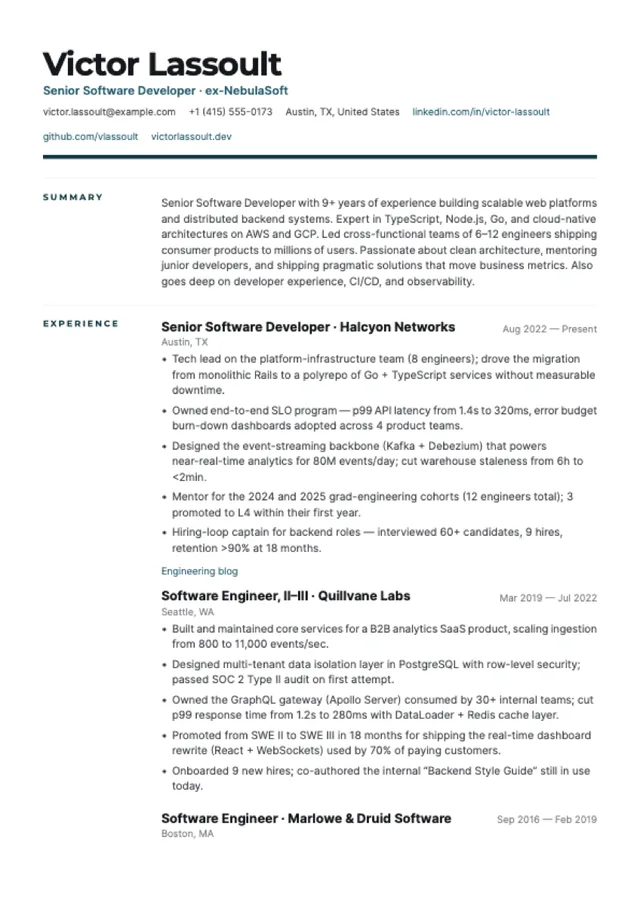
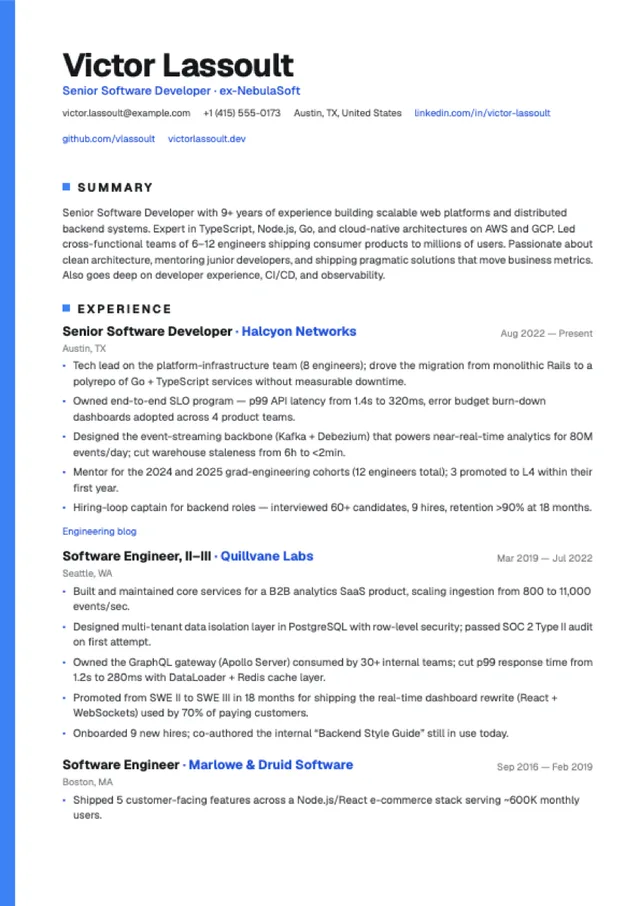
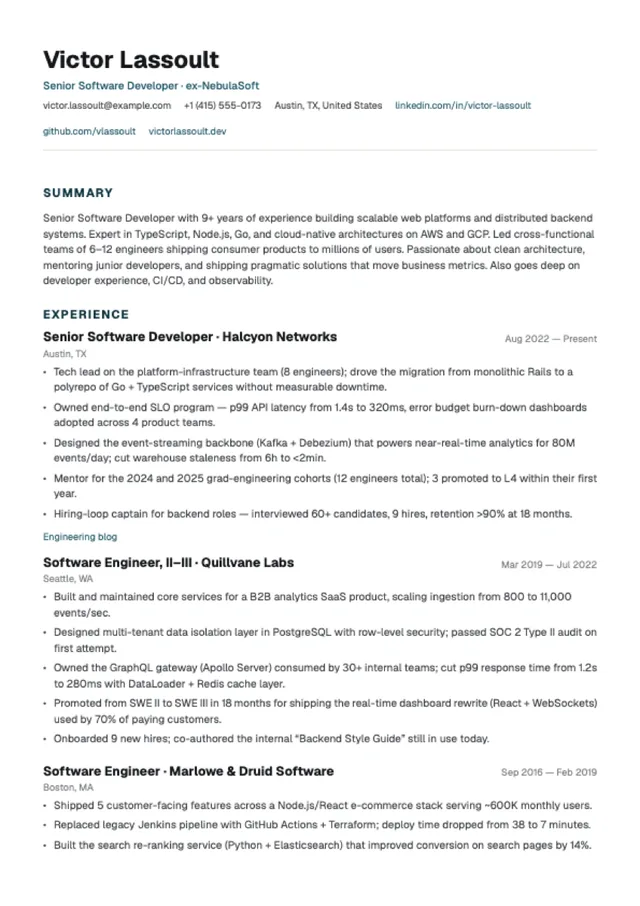
Graphic Designer resume FAQ
Should my resume itself be a design showcase?
No — and this is the consensus of both resume experts and design hiring managers. The resume is the data document: parsable, restrained, typographically clean (that IS the sample of your judgment). The portfolio is the showcase. Keep an ATS-safe version as your default upload, and bring a designed version only when a studio explicitly requests one or you're emailing a human directly.
Behance, Dribbble or my own site — and how many projects?
Your own short domain reads most professional and gives you analytics; Behance/Dribbble are perfectly acceptable and sometimes where recruiters already are. Either way: link in the resume header, mobile-fast, and ruthlessly curated — expert consensus is 6–12 strongest projects, with process (sketches, iterations) shown, not just final frames. Your weakest project sets the impression, not your best.
How do I put freelance work on my resume?
One consolidated entry titled “Freelance Graphic Designer” with dates, notable clients (NDA-permitting) and metric bullets: client count, repeat rate, delivery record. It's real experience — full-cycle ownership of scoping, revisions and deadlines is exactly what teams struggle to teach. If freelancing dominates your history, it leads the page.
Do I need a design degree?
BLS lists a bachelor's as the typical entry credential, but design hiring leaders say it plainly: real-world experience trumps formal education, and the portfolio decides. Self-taught designers compete on equal footing with a strong body of work — what the degree usually buys is the first internship that seeds that portfolio. Spend your energy on the work, not the worry.
Are AI tools an asset or a liability on a design resume?
Asset — when framed as workflow, not identity. “AI-assisted concept exploration in Firefly, refined in Illustrator” shows you've absorbed the tools without surrendering the craft; a resume that leads with Midjourney invites the question of what you contribute. For brand-side roles, knowing Firefly's commercially-safe training story is itself a professional signal.
How does a designer quantify work that isn't sales?
Four reliable veins: performance of what you designed (CTR, conversion, bounce, engagement), efficiency you created (template systems, production time, turnaround), adoption of your work (guidelines rolled out org-wide, teams using your kit), and reliability at volume (assets per week, deadline streaks, zero reprint errors). Ask the marketing team for the campaign numbers — they have them and nobody ever asks.
Which keywords matter most for design ATS screening?
Graphic design itself (~71% of postings), then the tools individually: Photoshop (63%), InDesign (54%), Illustrator, Figma for anything digital — plus branding (45%), typography (38%) and social media graphics. Name each tool you'd survive an interview on, and mirror the posting's phrasing. Run it against the actual listing — Resumap's ATS check scores the match and lists what's missing.
More resume examples
Your graphic designer resume, done properly — free.
Unwatermarked PDF, ATS-safe templates, and a real score against any posting when you want it.
Build my resume