
Medical billing and coding resume examples that lead with the credential and the accuracy rate.
In medical billing and coding, two things clear the screen before anyone reads a bullet: your certification and your numbers. Employers filter on CPC, CCS, ICD-10-CM and CPT, and they want proof you code accurately and get claims paid — a 98% accuracy rate, a denial rate you cut, AR days you shortened. This guide shows how to break in with a CPC-A and no experience (the field's hardest first job), how to write a coder resume versus a biller resume, how to signal you can hit quota remotely, and how to quantify accuracy honestly even before you had formal metrics.
- Ideal length
- 1 page
- Top keyword
- ICD-10-CM · CPT
- The proof
- Accuracy % + clean claims
- Remote-friendly
- ~65% work remote
Renata Cruz
Certified Medical Coder & Biller (CPC, CPB)
Denver, CO (open to remote) · CPC, CPB (AAPC)
Summary
Certified medical coder and biller (CPC, CPB) with 4 years across outpatient coding and revenue-cycle billing: ICD-10-CM, CPT and HCPCS at a sustained 98% accuracy rate, plus the denials and AR work that gets claims paid. Fluent in Epic and 3M Encoder, sharp on payer rules and modifiers, and productive unsupervised — my last role was fully remote. I code it right the first time and follow the dollar until it's collected.
Experience
Medical Coder & Biller · Front Range Health Partners (remote)
2023 — Present
- Code outpatient E/M and procedures in ICD-10-CM, CPT and HCPCS at a 98% audited accuracy rate, ~40 charts a day against a 35-chart benchmark.
- Cut medical-necessity denials on high-volume procedures by tightening modifier and documentation review with providers.
- Worked denials and appeals across Medicare, Medicaid and commercial payers, helping shorten average denial resolution time.
- Maintained full remote productivity and a HIPAA-compliant home workspace, no on-site supervision.
Billing Specialist · Cherry Creek Medical Group
2021 — 2023
- Submitted and scrubbed ~300 weekly claims (CMS-1500) through the clearinghouse, lifting the clean-claim rate.
- Posted payments from EOB/ERA and reduced AR days by prioritizing the highest-dollar aging accounts.
- Built a denial-trend view that flagged recurring errors for the revenue-cycle manager.
Medical Records Clerk · Cherry Creek Medical Group
2020 — 2021
- Started in records and charge entry while earning my CPC, then moved into billing — the adjacent role that got my foot in the door.
Skills
Education
Medical Billing & Coding Certificate — Denver, CO, 2020
Certifications
CPC (AAPC), 2021 · CPB (AAPC), 2022 · apprentice status removed
Why this example works
Credential and accuracy up front
CPC and CPB in the headline, a 98% accuracy rate in the first bullet. Certification is a golden ATS keyword and a hiring gate; accuracy is the flagship metric. Together they answer the two questions a coding manager screens on.
Honest about coder vs biller scope
The resume claims coding (assigning ICD-10-CM/CPT) AND billing (claims, denials, AR) because this candidate did both. If you only posted payments and worked denials, don't claim you assigned codes — interviews and audits expose scope inflation.
Remote-readiness made visible
“Fully remote, no on-site supervision, HIPAA-compliant workspace” plus productivity-vs-benchmark proves you hit quota unsupervised — exactly what a remote coding employer needs to see in a role where ~65% work from home.
Medical Biller and Coder resume summary examples
Three to four lines: scope, stack or specialism, one quantified win. Match the register to your seniority.
Entry / CPC-A, no experience
Motivated CPC-A coder ready for a first coding role, with ICD-10-CM, CPT and HCPCS studied to exam standard and 600+ real-world cases completed through AAPC Practicode at high accuracy. Strong in medical terminology and anatomy, plus front-desk and records experience that taught me the revenue cycle from the intake side. Remote-ready and eager to remove the apprentice “A” on the job — I know the codes; I need the reps.
Experienced coder (CPC)
CPC-certified medical coder with 5 years assigning ICD-10-CM, CPT and HCPCS across outpatient specialties at a sustained 98% accuracy rate, ~40 charts a day against benchmark. Fluent in Epic and 3M Encoder, sharp on modifiers and NCCI edits, and comfortable querying providers to get documentation right. Looking for a coding team that rewards accuracy and speed.
Medical biller (CPB, denials/AR focus)
CPB-certified medical biller focused on the money: clean-claim rate, denial reduction and AR days. Over 4 years I've scrubbed and submitted CMS-1500 and UB-04 claims, posted EOB/ERA payments, and overturned denials across Medicare, Medicaid and commercial payers. I read a remittance fast, prioritize the highest-dollar aging accounts, and turn recurring denials into fixes upstream.
Specialty coder (surgical / inpatient / HCC)
Specialty coder credentialed in risk adjustment (CRC), coding HCC and Medicare Advantage encounters at high accuracy and volume. Deep on documentation specificity, provider queries and the compliance rules that keep risk-adjustment coding audit-proof. The specialty depth that commands the top of the pay band — and the query discipline that keeps it clean.
Remote coder
Fully remote medical coder with 3 years hitting quota unsupervised: 98% accuracy, ~40 charts a day, and a HIPAA-compliant home setup I've run since day one. Self-managing, fast on a new encoder or EHR, and used to communicating with a distributed revenue-cycle team over ticketing and chat. If you need a credentialed coder who's productive from home without hand-holding, that's exactly my track record.
Coding auditor / lead / CDI
Certified medical auditor (CPMA) with a coding background, auditing charts for accuracy and compliance, mentoring coders, and driving clinical-documentation-improvement queries that protect revenue integrity. I find the error patterns, quantify the exposure, and coach the team so the fix sticks. Ready to own audit and CDI for a practice or RCM group.
Skills that belong on a medical biller and coder resume
Coding
- ICD-10-CM
- ICD-10-PCS
- CPT
- HCPCS Level II
- Modifiers / NCCI edits
- E/M · surgical · HCC coding
Billing & revenue cycle
- Claims submission (CMS-1500 / UB-04)
- Denial management / appeals
- Accounts receivable (AR)
- Payment posting (EOB/ERA)
- Clearinghouse
- Prior authorization
Systems & compliance
- Epic / Cerner
- 3M Encoder / EncoderPro
- HIPAA
- Medical terminology & anatomy
- Payer rules (Medicare/Medicaid)
- Audit / compliance
Bullet point formulas that get interviews
Fill the brackets with your numbers — the structure does the selling.
- Code at a [x]% accuracy rate — e.g. “ICD-10-CM/CPT at a 98% audited accuracy rate.”
- Code [n] charts/day vs benchmark — e.g. “~40 charts a day against a 35-chart benchmark.”
- Cut denial rate [x]% — e.g. “reduced medical-necessity denials 28% by tightening modifier review.”
- Lift clean-claim / first-pass rate — e.g. “raised the clean-claim rate on ~300 weekly claims.”
- Reduce AR days / resolution time — e.g. “cut average denial resolution from 9 days to 6.”
- Recover / collect $[amount] — e.g. “secured $150K+ by activating aging accounts” (defensible figures only).
- Overturn denials / appeals — e.g. “overturned denials across Medicare, Medicaid and commercial payers.”
- Audit [n] records — e.g. “audited 315 charts for coding accuracy and HIPAA compliance.”
- Name the code sets + system — e.g. “assigned ICD-10-CM and CPT in Epic with 3M Encoder.”
- Train / mentor [n] coders — e.g. “coached 4 junior coders on CPT and modifier practice” (lead roles).
ATS keywords for medical biller and coder roles
Filters match tokens from the posting. These are the terms worth mirroring — verbatim — when they appear in the job ad.
| Keyword | Priority |
|---|---|
| ICD-10-CM (include 'ICD-10' too — postings vary) | High |
| CPT (or CPT-4) · HCPCS Level II | High |
| medical coding | High |
| medical billing / claims submission | High |
| denial management / appeals | High |
| revenue cycle management (RCM) / accounts receivable (AR) | High |
| certification — CPC / CCS / CPB / CCA: spell out + abbreviate | High |
| HIPAA | High |
| medical terminology & anatomy | High |
| EHR/EMR — name it (Epic, Cerner) · encoder (3M, EncoderPro) | Medium |
| clearinghouse · EOB / ERA · charge entry · payment posting | Medium |
| CMS-1500 / UB-04 · modifiers · DRG · prior authorization | Medium |
| payer knowledge — Medicare, Medicaid, commercial | Medium |
| NCCI edits · CMS/OIG guidelines · physician query · CDI | Medium |
| specialty — E/M, surgical, inpatient, outpatient, risk adjustment / HCC | Medium |
| audit · compliance | Medium |
Don't guess — score your resume against the specific posting and see exactly which terms are missing.
How to write a medical biller and coder resume
Put the certification and accuracy rate up top
Two things clear the screen first: your credential and your accuracy. Put CPC, CCS or CPB in your headline and a dedicated block — spelled out and abbreviated (“Certified Professional Coder (CPC)”) since recruiters search the abbreviation. Then lead your experience with the flagship metric: “code ICD-10-CM and CPT at a 98% accuracy rate.” Certification is a golden ATS keyword and a hiring gate; burying it costs you the match before anyone reads the rest.
Write a coder resume or a biller resume — not a blur
Coding and billing are different jobs. A coder assigns codes from documentation (ICD-10-CM, CPT, HCPCS); a biller submits claims, posts payments and works denials and AR. Decide which the posting wants and lead with those keywords and metrics — accuracy and charts-per-day for coding, clean-claim rate and denial/AR reduction for billing. If you genuinely did both (common in small practices), show both, but keep the claims honest for each.
Quantify the money and the accuracy
This field has real numbers, so use them: coding accuracy rate, charts or claims per day versus benchmark, clean-claim or first-pass rate, denial rate reduction, AR-days shortened, dollars recovered, audit pass rate. “Reviewed ~300 weekly claims at 99% accuracy” beats “responsible for claims.” If you don't have a formal metric yet, use externship or Practicode case counts and coursework accuracy — an honest estimate you can defend beats a vague duty.
Signal you can hit quota remotely
About two-thirds of coders work fully remote, and employers need proof you'll be productive unsupervised. If you've coded remotely, say so and pair it with the numbers — sustained accuracy, charts-per-day, a HIPAA-compliant home workspace. Even without prior remote experience, foregrounding self-management and your throughput metrics tells a remote-first employer you can carry the load from home. It's one of the strongest work-from-home roles in healthcare — use it.
Name the code sets and systems, and skip the ATS myth
Generic “coding software” fails a literal keyword match — name ICD-10-CM, CPT, HCPCS, Epic, Cerner, 3M Encoder. Use current code sets (ICD-10, never ICD-9), spell certifications both ways, and match the posting's exact terms. Keep the layout clean and single-column, and don't buy the “75% of resumes are auto-rejected” scare (see the FAQ) — an ATS ranks and surfaces you; precise, keyword-matched text just ranks you higher.
Skip the blank page.
Build this resume in Resumap — free templates, unwatermarked PDF, and an ATS check against the exact posting when you're ready.
Start freeMistakes that filter medical biller and coders out
Listing duties instead of outcomes
“In charge of claims submission” says nothing. Write “reviewed ~300 weekly claims at 99% accuracy” — the number is the proof.
No accuracy or productivity metrics
Accuracy rate, charts per day, denials overturned, AR days — these are exactly what coding managers screen for. Leaving them off flattens you.
Missing or burying the certification
CPC/CCS/CPB is a hiring gate and a golden keyword. Put it in the headline and a dedicated block, not the last line.
Not naming code sets or software
“Coding software” fails a literal ATS match. Name ICD-10-CM, CPT, HCPCS, Epic, Cerner, 3M Encoder.
Using dated code sets (ICD-9)
ICD-9 signals you're out of date in a field defined by current codes. Always write ICD-10-CM.
Over-claiming coder scope when you were a biller
If you posted payments and worked denials, don't claim you assigned ICD-10-CM/CPT from documentation. Scope inflation surfaces in interviews and audits.
Typos in code-set or system names
This is a precision job — a garbled “EncorderPro” or a mistyped code reads as careless. Proofread the technical terms twice.
Medical Biller and Coder salary ranges (US)
United States market. Absolute figures differ by country — the gaps between levels travel better than the numbers.
| Median (BLS 29-2072, May 2024) | $50,250/yr (~$24/hr) |
| 10th percentile | ~$35,780/yr |
| 90th percentile | ~$80,950/yr |
| Certified premium (AAPC, self-reported) | ~21% above non-certified |
| Specialty (inpatient/HCC, self-reported) | Top of the range |
Medical billers and coders fall under BLS “Medical Records Specialists” (SOC 29-2072): median $50,250/year in May 2024 (about $24/hour), ranging from under $35,780 to over $80,950, with +7% projected growth through 2034 (~14,200 openings a year). Entry is a postsecondary nondegree award; certification is the practical gate. Certified coders earn roughly 21% more and about 65% work fully remote — both from AAPC's self-reported member salary survey, not government data.
Primary source: U.S. Bureau of Labor Statistics (OEWS/OOH). Self-reported aggregator figures are labelled as such.
Certifications worth listing
- Certification is effectively required for coding and the biggest documented pay lever (certified coders self-report ~21% more) — get one before or while you apply
- AAPC CPC (Certified Professional Coder) — the most recognized coding credential in the physician/outpatient market; CPB is the billing credential; CRC/COC/CIC specialize (risk adjustment, outpatient, inpatient)
- AHIMA CCA (entry) → CCS (experienced) — the hospital/inpatient authority; RHIT adds an accredited HIM associate degree and a path toward management
- New CPC holders carry the apprentice 'A' (CPC-A): remove it with 2 years of documented coding experience, or 1 year plus AAPC Practicode / Project Xtern — but note most employers still don't count Practicode as work experience
- CPC vs CPB: CPC for a coding path and widest recognition, CPB for billing/RCM, both for a combined biller-and-coder profile; add CPMA later for the auditor track
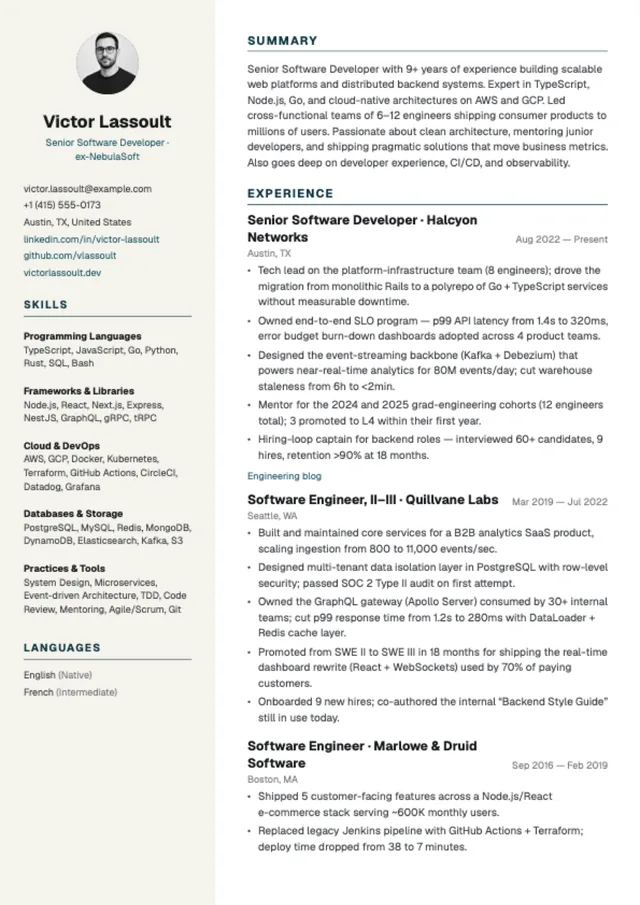
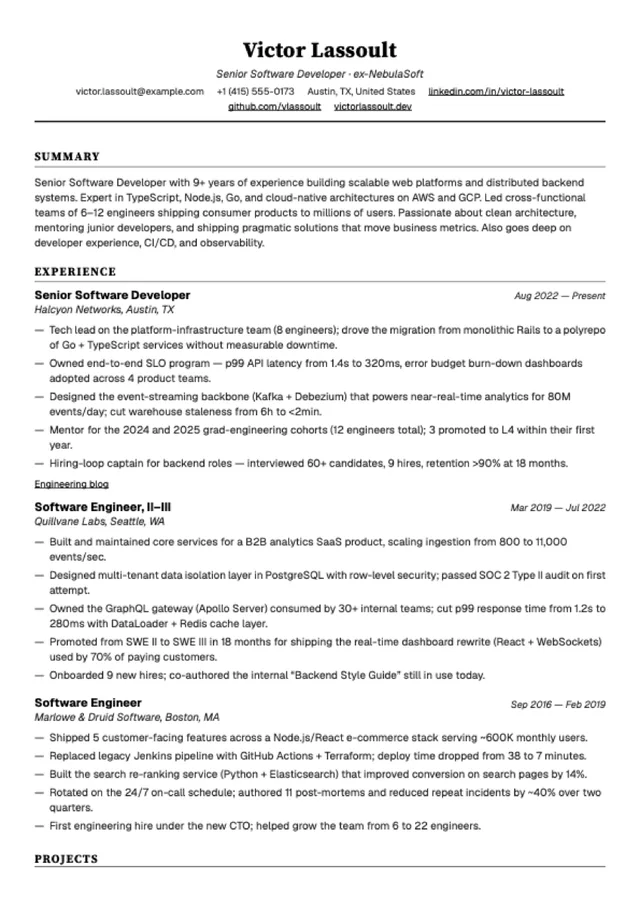
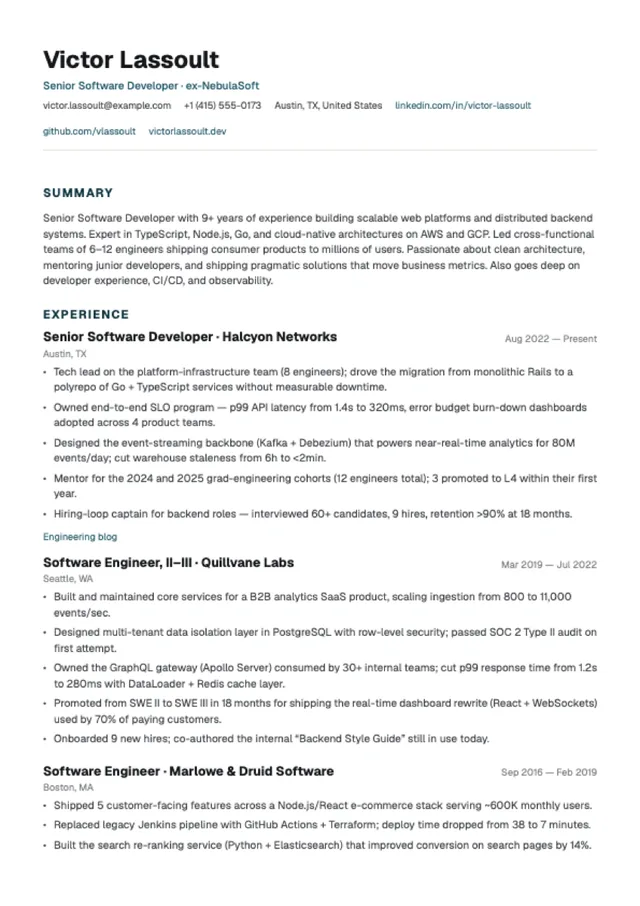
Templates that fit medical biller and coder resumes
Medical Biller and Coder resume FAQ
I have a CPC-A and no experience — how do I actually break in?
This is the field's hardest first step, and the catch-22 is real: most roles want experience you can't get without a first role. What works: apply to postings that say “CPC-A welcome”; use AAPC Practicode or Project Xtern to build documented case volume (it also removes a year of your apprentice status); take an adjacent role — payment posting, charge entry, medical records, prior authorization — and move into coding internally; target newly opened or expanding facilities; and network through your local AAPC chapter. Be honest that Practicode helps remove the “A” but many employers don't count it as work experience — so pair it with real adjacent experience where you can.
Do I need certification, and which one?
For coding, effectively yes — it's both a hiring gate and the single biggest pay lever, with certified coders self-reporting around 21% more. Get the AAPC CPC or the AHIMA CCA (then CCS) for coding; the AAPC CPB for billing; and a specialty credential like CRC (risk adjustment), CIC (inpatient) or COC (outpatient facility) to move up the pay band. If you're aiming at physician/outpatient work, CPC is the most recognized; for hospital and inpatient coding, AHIMA's CCS is the authority. For a combined biller-and-coder role, CPC plus CPB is a strong pairing.
What's the difference between a medical biller, a coder, and a combined role?
A coder reads clinical documentation and assigns the diagnosis and procedure codes — ICD-10-CM, CPT, HCPCS — that drive reimbursement. A biller takes those codes, generates and submits claims (CMS-1500, UB-04), posts payments from EOBs and ERAs, and works denials, appeals and accounts receivable. Many small-practice jobs combine both under a “biller and coder” title, while large hospitals and revenue-cycle firms split them. Match your resume — title, keywords and metrics — to what the posting actually wants, and don't claim coding work if your real experience was billing (or vice versa).
Is medical billing and coding really a remote job?
Yes — it's one of the strongest legitimate work-from-home roles in healthcare, because the work is records- and screen-based rather than hands-on. Around two-thirds of coders in AAPC's member survey report working fully remote. The caveat is that many employers require a few months of on-site training first, while large revenue-cycle firms hire credentialed coders remote from day one. To land a remote role, foreground your certification, your accuracy and productivity numbers, and any prior remote tenure — employers need to trust you'll hit quota without someone looking over your shoulder.
How is this different from being a medical assistant?
They're different career families. Medical billing and coding is administrative and records-based — you work with documentation, codes, claims and payer rules, largely at a screen and often from home. A medical assistant is a clinical role with direct patient contact: rooming patients, vitals, assisting the provider chairside, sometimes drawing blood. If you prefer working with data, rules and reimbursement over hands-on patient care, coding and billing is the fit — and you shouldn't cross-apply the same resume between the two, because the skills and keywords barely overlap.
How do I move up from a coding or billing role?
The ladder runs from coder to senior or specialty coder, then into auditing (with a CPMA), clinical documentation improvement (CDI), and on to coding or revenue-cycle management. Specializing — risk adjustment, inpatient, surgical — raises pay without leaving coding, while adding an HIM degree (RHIT or RHIA) opens the management track. On your resume, the things that carry you up are the same ones that sell you now: accuracy, specialty depth, dollars recovered, audit findings, and any coder you've mentored or trained.
Is it true that ATS software auto-rejects most resumes?
No — the “75% of resumes are auto-rejected” claim is a myth from a 2012 sales pitch by a company that folded the next year and never published a methodology. Applicant tracking systems parse, store and rank resumes so recruiters can search them; they don't blanket auto-reject on content, and the large majority of applications are seen by a human. The real effect is ranking: if your certification, code sets and systems aren't in searchable text, you rank lower and get surfaced less often. So use a clean single-column layout, name your credentials and code sets, and mirror the posting. Resumap's ATS check scores your parse and keyword match against a specific job.
More resume examples
Your medical biller and coder resume, done properly — free.
Unwatermarked PDF, ATS-safe templates, and a real score against any posting when you want it.
Build my resume