
Product manager resume examples that show outcomes, not features.
The product-manager resume that lands interviews doesn't list what shipped — it shows what moved. “Owned the roadmap” says nothing; “cut onboarding drop-off 18% and lifted activation across a 2M-user segment” says you have product judgment. Screeners look for roadmap, discovery, experimentation and metrics, but the hire is decided by outcomes you can defend. This guide shows how to quantify impact (even without a revenue number you own), how to keep your resume off the project manager's turf so you're screened as a PM, and why shipped products beat any certificate.
- Ideal length
- 1 page (2 at 10+ yrs)
- The differentiator
- Outcome metrics
- Bullet pattern
- Action → Method → Result
- Owns
- The what & why
Daniel Okafor
Product Manager · Growth & Activation
Seattle, WA · linkedin.com/in/danielokafor · danokafor.pm (case studies)
Summary
Product manager with 5 years owning growth and activation for consumer products. I run discovery to find the real problem, prioritize with RICE, and prove the outcome with experiments — onboarding funnels that convert, retention loops that hold, launches measured in activated users rather than features shipped. Data-informed (SQL, Amplitude), comfortable leading eng and design without authority. I decide what's worth building and show you it moved the metric.
Experience
Product Manager, Growth · Riverpath (consumer fintech)
2022 — Present
- Found a 23% onboarding drop-off through funnel analysis, redesigned the flow with design, and lifted activation ~18% in one quarter.
- Own the growth experimentation roadmap: 30+ A/B tests, including a referral loop that added a five-figure count of new users annually.
- Reprioritized the roadmap around a Jobs-to-be-Done insight, cutting churn for the core segment ~14% over two quarters.
- Partner with data to define activation and retention as the team's north-star metrics, replacing a vanity signup KPI.
Associate Product Manager · Riverpath
2020 — 2022
- Owned the onboarding funnel end to end and improved completion ~12% — my first metric as an individual owner.
- Ran weekly user interviews and turned the themes into a prioritized backlog the whole squad worked from.
- Shipped four features via tight PRDs and sprint planning, one of which drove a measurable lift in premium conversion.
Customer Support Lead → APM · Riverpath
2019 — 2020
- Bridged into product from support: turned recurring ticket themes into a discovery doc that shaped the next quarter's roadmap — the work that earned the APM role.
Skills
Education
B.A. Economics — University of Washington, 2019
Certifications
Reforge — Product Strategy (2023)
Why this example works
Outcomes, not a feature log
Every bullet names the metric it moved — activation, churn, new users, conversion. “Shipped four features” is a delivery log; “found a 23% drop-off and lifted activation 18%” is product judgment. That's the difference between reading as a PM and reading as a project manager.
Discovery → decision → result
The bullets show the whole PM loop: a data-found problem, a prioritization call, and a measured outcome. It signals you decide what's worth building, not just that you kept a backlog moving.
A believable break-in story
Support → APM → PM, with each step earned by product-shaped work (ticket themes → discovery doc → roadmap). Most PMs come from adjacent roles — the resume reframes that path in product terms instead of hiding it.
Product Manager resume summary examples
Three to four lines: scope, stack or specialism, one quantified win. Match the register to your seniority.
APM / breaking in from an adjacent role
Aspiring product manager moving from customer support, with a track record of product-shaped work: turned recurring ticket themes into a discovery doc that shaped a roadmap, and owned an onboarding-funnel improvement of ~12%. Fluent in the PM loop — discovery, prioritization, measuring outcomes — and building it into every project I touch. I don't have the title yet; I have the judgment and a case study to prove it.
Mid-level PM (2–5 yrs)
Product manager with 5 years owning growth and activation end to end. Discovery to find the real problem, RICE to prioritize, experiments to prove it — onboarding funnels that convert and retention loops that hold. Data-informed (SQL, Amplitude), leads eng and design without authority. Measures success in activated users and retained revenue, not features shipped.
Senior PM (10+ yrs)
Senior product manager with 12 years and a record of strategy that paid off: a 3-year platform vision that opened an enterprise market, multi-team roadmaps, and mentoring the PMs under me. I translate ambiguous business problems into products that move ARR, align stakeholders from eng to sales, and keep the team honest about outcomes over output. Equally comfortable in a strategy review and a discovery interview.
Growth PM
Growth product manager focused on activation, retention and the experimentation velocity behind them. I live in the funnel — onboarding conversion, referral loops, retention curves — and run the A/B program that vets every change. Recent wins: an onboarding redesign that lifted activation ~18% and a referral loop that added a five-figure annual user count. I make the metric move and can show which experiment did it.
Technical PM
Technical product manager bridging engineering and product: I came from software engineering and still read the system. APIs, integrations, data models and feasibility tradeoffs are where I add the most value, translating between what's technically possible and what's worth building. I write the PRD engineers actually want to build from and own outcome metrics on platform and developer-facing products.
AI / ML PM
Product manager for AI-powered features: I've shipped ML-backed product, defined success metrics for probabilistic systems, and made the hard calls on model tradeoffs and guardrails. Comfortable with evaluation, hallucination risk and the “when is it good enough to ship” judgment AI products demand. I pair product instinct with enough ML literacy to keep the roadmap grounded in what the models can actually do.
Skills that belong on a product manager resume
Strategy & discovery
- Product strategy & vision
- Product roadmap
- User research / discovery
- Prioritization (RICE, MoSCoW, JTBD)
- Competitive analysis
- Go-to-market (GTM)
Execution
- PRDs / user stories
- Agile / scrum
- Backlog management
- Stakeholder management
- OKRs / KPIs
- Figma (prototyping)
Data & measurement
- A/B testing / experimentation
- Product metrics (activation, retention, NPS)
- SQL
- Amplitude / Mixpanel
- Funnel analysis
- Revenue / MRR / churn
Bullet point formulas that get interviews
Fill the brackets with your numbers — the structure does the selling.
- Found a [x]% drop-off / gap via [analysis], and lifted [metric] [y]% — e.g. “23% onboarding drop-off → activation +18% in a quarter.”
- Ran [n] experiments / A/B tests, one of which [outcome] — e.g. “30+ tests; a referral loop added a five-figure annual user count.”
- Reprioritized the roadmap around [insight], moving [metric] — e.g. “a JTBD insight that cut churn ~14%.”
- Owned [product area] and improved [metric] [x]% — e.g. “onboarding funnel; completion +12%.”
- Shipped [feature] that drove $[amount] / [x]% — e.g. “a pricing experiment that raised LTV 22%.”
- Defined [metric] as the north-star, replacing [vanity KPI] — shows outcome thinking over output.
- Led eng + design (no authority) to [outcome] — e.g. “launched X, growing activation across a 2M-user segment.”
- Cut [cycle/process] from [x] to [y] — e.g. “release cycle 6 → 3 weeks,” a scale/process metric when % is sensitive.
- Set a [horizon] strategy that [business outcome] — e.g. “3-year platform vision opening a $50M ARR market” (senior tier).
- Turned [adjacent-role signal] into [product artifact] — e.g. “ticket themes into a discovery doc that shaped the roadmap” (break-in tier).
ATS keywords for product manager roles
Filters match tokens from the posting. These are the terms worth mirroring — verbatim — when they appear in the job ad.
| Keyword | Priority |
|---|---|
| product roadmap / roadmapping | High |
| product strategy & vision | High |
| prioritization — RICE, MoSCoW, Jobs-to-be-Done (JTBD) | High |
| user research / product discovery | High |
| A/B testing / experimentation | High |
| product metrics — activation, retention, NPS, MRR/ARR, churn | High |
| stakeholder management / cross-functional leadership | High |
| agile / scrum (sprint planning, backlog) | High |
| go-to-market (GTM) / product launch | High |
| PRD (product requirements document) — spell out both forms | High |
| OKRs (objectives and key results) | High |
| SQL · Amplitude / Mixpanel (data-informed) | Medium |
| wireframing / prototyping (Figma) | Medium |
| competitive analysis / teardowns | Medium |
| tooling — Jira, Confluence, Productboard, Aha! | Medium |
| pricing / monetization (growth & monetization PMs) | Medium |
Don't guess — score your resume against the specific posting and see exactly which terms are missing.
How to write a product manager resume
Lead with outcomes, not features shipped
The most-cited PM resume failure is a feature log — “launched X, Y, Z” with no result. Use Action → Method → Result: what you did, how, and the metric it moved. “Redesigned onboarding (method) and lifted activation 18% (result)” beats “owned the onboarding flow.” Features are output; the metric they moved is the outcome, and outcomes are what get you hired.
Keep it off the project manager's turf
If your bullets are about schedule, scope, budget and deliverables, you'll be screened as a project manager — a different job. Foreground the product work: discovery, prioritization calls, experiments, and product-outcome metrics (activation, retention, revenue). A project manager ships the plan on time; a product manager decides what's worth building and proves it moved a number. Write as the second one.
Quantify even when you don't own a revenue number
Junior PMs rarely own revenue — so use the leading metrics you did influence: activation, onboarding completion, task success, engagement, experiment results, feature adoption, cycle time. “Owned the onboarding funnel; completion +12%” is a real, defensible outcome. An individual leading metric you actually moved beats a borrowed company revenue figure you didn't.
Show the whole discovery-to-outcome loop
Product judgment shows in the arc, not the verb. The strongest bullets name a data-found problem, the prioritization decision, and the measured result: “found a 23% drop-off → reprioritized → activation +18%.” That signals you find the right thing to build and prove it worked — the judgment the title actually pays for — rather than that you kept a backlog moving.
Mirror the posting's terms, and skip the cert padding
Screening software often matches literal tokens, so use the posting's exact language and spell out both forms once: “A/B testing,” “product requirements document (PRD),” “objectives and key results (OKRs).” Weave keywords into outcome bullets rather than a stuffed list. And don't pad with certifications — most successful PMs hold none; shipped products with metrics are the proof (see the FAQ).
Skip the blank page.
Build this resume in Resumap — free templates, unwatermarked PDF, and an ATS check against the exact posting when you're ready.
Start freeMistakes that filter product managers out
Listing features shipped without outcomes
A feature log shows delivery, not judgment. Attach each launch to the metric it moved — activation, retention, revenue, adoption.
“Responsible for the product roadmap”
The most-cited PM antipattern: responsibility-speak with no result. Name what the roadmap decision changed and by how much.
Writing like a project manager
Schedule, scope and budget bullets get you screened as a project manager. Lead with strategy, discovery and product-outcome metrics instead.
No metrics at all
Even a leading metric you influenced (activation, completion, engagement) beats “improved the product.” Name the KPI and the movement.
Tool lists instead of decisions
Jira and Figma prove nothing about product sense. Show the tradeoffs you made and what resulted, not the software you opened.
“We launched X” — hiding your contribution
Team credit erases your judgment. Say what you decided, prioritized or owned so the reader sees your individual impact.
Buzzword density without evidence
Jargon isn't judgment. Cut the synergy-speak and let a data-found problem and a measured outcome do the talking.
Product Manager salary ranges (US)
United States market. Absolute figures differ by country — the gaps between levels travel better than the numbers.
| Marketing Managers proxy (BLS, May 2024) | ~$161,030 median |
| APM / entry (self-reported) | $120K – $160K total comp |
| Mid PM | $160K – $250K total comp |
| Senior PM | $250K – $425K+ total comp |
| Big-tech senior (self-reported, equity-heavy) | $400K – $1M+ |
The US Bureau of Labor Statistics does not classify product managers as a separate occupation — the SOC committee declined to create one, and code 13-1082 is “Project Management Specialists” (a different role). The closest official benchmark is Marketing Managers (median ~$161,030, May 2024), which undercounts tech-PM pay. Big-tech PM total comp runs far higher because it's equity-heavy — those figures (Levels.fyi, Pave) are self-reported, not government wages.
Primary source: U.S. Bureau of Labor Statistics (OEWS/OOH). Self-reported aggregator figures are labelled as such.
Certifications worth listing
- No certification is required and none is a differentiator on its own — most successful PMs hold none; the resume is won on shipped products with outcome metrics
- An MBA is not expected and not a gate — PMs come from engineering, design, business, marketing, support and data; a portfolio of product thinking matters more than the degree
- If you list one: Reforge carries the most weight with tech hiring managers (senior/practitioner level); Product School's CPM is aimed at career-changers; Pragmatic Institute reads well in enterprise/B2B
- Scrum certs (CSPO, SAFe) signal agile fluency but can read as delivery/process — don't let them tilt your resume toward the project-manager lane
- A 1–2 case-study portfolio (problem → discovery → decision → outcome) substitutes for a missing PM title better than any cert, especially for APMs and career-changers
Templates that fit product manager resumes
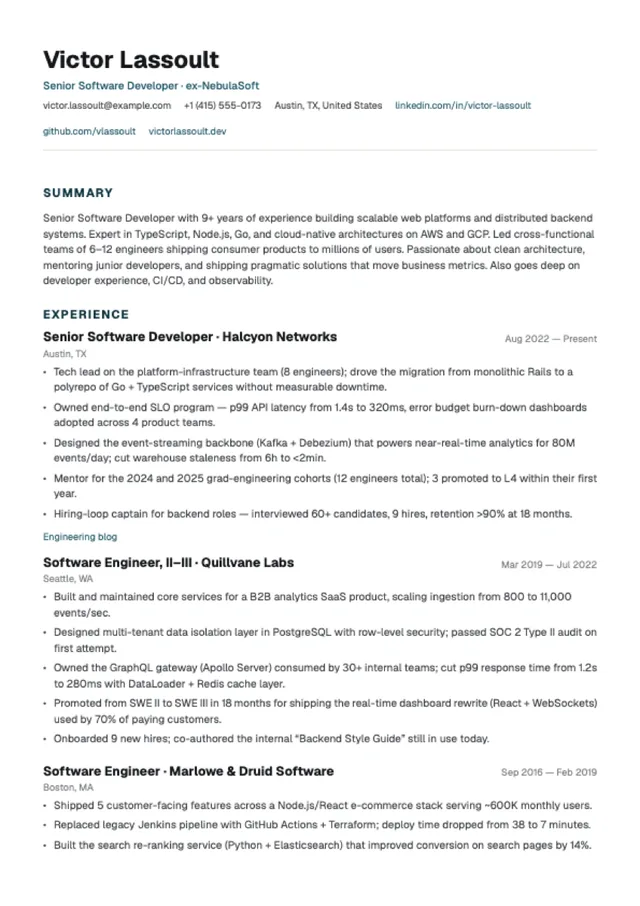
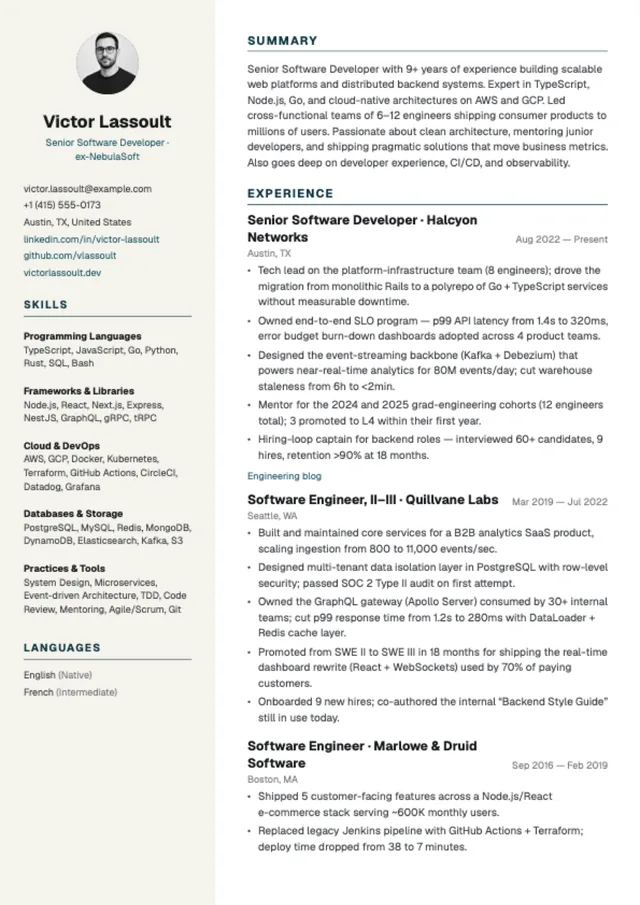
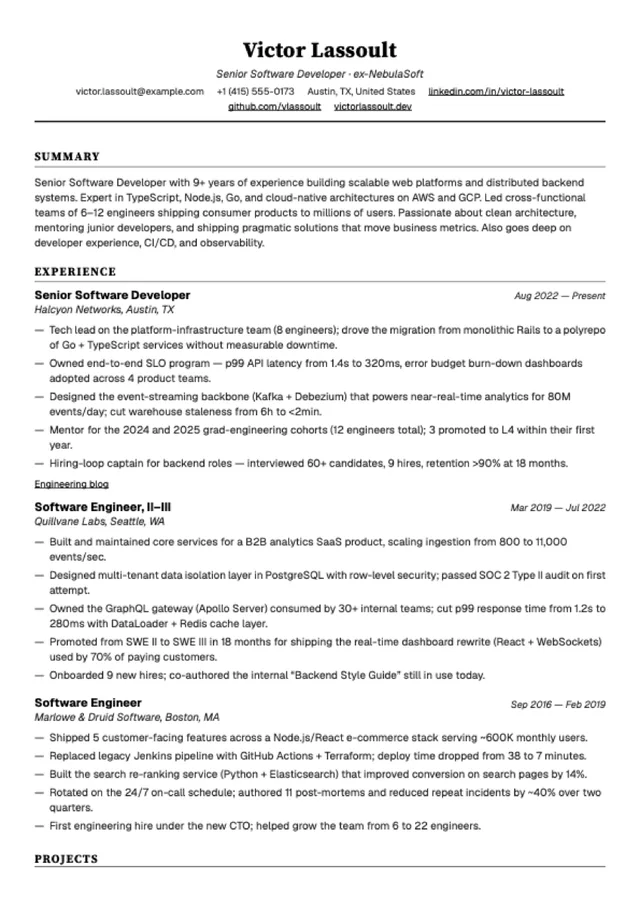
Product Manager resume FAQ
What's the difference between a product manager, a project manager and a program manager?
A product manager owns the what and why — vision, strategy, roadmap, discovery, prioritization and product-outcome metrics like activation, retention and revenue; they influence the outcome of the product. A project manager owns the how and when — schedule, scope, budget, resources and deliverables; they influence the output of a process. A program manager coordinates multiple related projects toward a broader business goal. The one-liner: a project manager ships the plan on time and on budget, a product manager decides what's worth building and proves it moved a metric. Make sure your resume reads as the role you're applying for.
Is there really no BLS salary for product managers?
Correct — and most resume sites get this wrong. The US Bureau of Labor Statistics does not classify product managers as a distinct occupation; when asked to create one for the 2018 standard, the committee declined, because PMs are spread across many roles depending on their actual duties. The code often cited, 13-1082, is “Project Management Specialists” — a different job. The closest official benchmark is Marketing Managers (median ~$161,030, May 2024), but it undercounts tech-PM pay, which is equity-heavy. For total comp, crowdsourced sources like Levels.fyi and Pave are more representative — just remember those are self-reported, and a headline “$400K PM” is big-tech total compensation, not a base-salary norm.
How do I break into product management without a PM title?
Reframe adjacent work in product terms and build a bridge. Volunteer for product-shaped work in your current role — discovery, specs, launches — then describe those wins as problem → decision → outcome rather than task lists. Engineering-to-technical-PM is the smoothest path; support-to-PM leverages your customer-discovery instinct; consulting and marketing translate well too. A 1–2 case-study portfolio does a lot of the work here: it demonstrates product thinking directly and stands in for the title you don't have yet.
Do I need an MBA or a CS degree to be a product manager?
No to both. Product managers come from varied backgrounds — engineering, design, business, marketing, support, data — and no single credential dominates. A CS degree helps credibility for technical and AI-focused PM roles but isn't required. An MBA can accelerate networking and recruiting access, especially for career-switchers, but it's neither necessary nor sufficient. What hiring managers actually weight is demonstrated product judgment: shipped products, measurable outcomes, and how you reason about tradeoffs.
How do I show outcomes without exposing confidential numbers?
Use relative metrics instead of absolutes: “+18% activation,” “−15% churn,” “raised LTV 22%.” A percentage and a direction convey the impact without revealing the underlying revenue. If even the percentage is sensitive, quantify the scale (“across a 2M-user segment”) or the process (“cut the release cycle from six weeks to three”). Name the metric you influenced, its starting point, and the movement — and balance the hard numbers with a qualitative win where a figure would breach an NDA.
Is it true that ATS software auto-rejects most resumes?
No — the “75% of resumes are auto-rejected” claim is a myth from a 2012 sales pitch by a company that folded the next year and never published a methodology. Applicant tracking systems parse, store and let recruiters search and rank by keyword; they don't blanket auto-reject on content, and research interviewing recruiters at large tech firms found the vast majority don't auto-reject at all. The real risk is being mis-parsed or ranked low, so use a clean single-column layout and mirror the posting's language. Resumap's ATS check scores your parse and keyword match against a specific job.
Should a product manager resume be one page or two?
One page is the default and the right call for APM through mid-level. Extend to two pages only at roughly 10+ years, when senior scope and portfolio-level outcomes genuinely need the room — and keep the most critical content on page one either way. Length is never the point; a tight page of defensible outcomes beats two padded ones. If a bullet doesn't name a decision or a metric, it's probably taking up space a stronger one deserves.
More resume examples
Your product manager resume, done properly — free.
Unwatermarked PDF, ATS-safe templates, and a real score against any posting when you want it.
Build my resume