
Truck driver resume examples written for the people who pull your MVR.
Trucking hiring runs on verification: before anyone believes your resume, they pull your MVR, your PSP record and the Clearinghouse — so the resume's job is to state, up front and accurately, exactly what those pulls will confirm. CDL class in the first line, endorsements in a scannable section (carriers filter for H, N and T before reading anything else), and the gold metric of the trade: accident-free miles. This guide shows the format, the licensing codes, and the pay economics by route type that recruiting ads round up.
- Ideal length
- 1 page
- CDL class
- First line of summary
- Gold metric
- Accident-free miles
- Bullets per role
- 3–5
Dale Whitfield
OTR Driver · CDL-A · 480,000 Accident-Free Miles
Columbus, OH
Summary
CDL Class A driver (Ohio; H and N endorsements — X combination; no restrictions) with 9 years and 480,000 accident-free miles across local, regional and 48-state OTR. 118,000 miles a year at a 98.4% on-time rate; clean PSP — zero out-of-service violations across 14 roadside inspections; every ELD audit clean. DOT medical card current through 2027.
Experience
OTR Driver — 48 States · Ridgeline Transport (truckload, dry van & reefer)
2021 — Present
- Run 118,000 miles a year OTR in a 53' dry van and reefer at a 98.4% on-time delivery rate — mountain and winter lanes included.
- Zero preventable accidents in 350,000+ miles with this carrier; 14 roadside inspections, zero out-of-service violations (clean PSP).
- 100% clean HOS record across four ELD audits (Samsara); trip planning that turns detention time into legal drive time.
- Mentored 4 new drivers through their first 90 days — all four still driving, all four accident-free.
Regional Driver — Midwest lanes · Hartline Freight Systems
2018 — 2021
- Covered a 7-state Midwest region, ~2,400 miles a week, 85% drop-and-hook; home weekly without a missed dispatch in three years.
- Hauled temperature-controlled loads (Thermo King) with zero cargo claims across ~$18M of freight.
Local Delivery Driver (Class B → Class A) · Metro Supply Co.
2016 — 2018
- Ran 18–22 stop city routes with liftgate and pallet-jack touch freight; zero at-fault incidents in daily dock and street maneuvering.
- Upgraded to Class A through an FMCSA-registered training program while working full-time.
Skills
Education
High school diploma · FMCSA-registered CDL training program, 2016
Certifications
CDL Class A — Ohio, Endorsements: H, N (X combination), no restrictions, exp. 2028 · DOT Medical Card (exp. 2027) · TWIC
Languages
English (native) · Spanish (basic)
Why this example works
The license block reads like the filter works
Class, state, endorsements with codes, restrictions status, expirations — carriers filter for H/N/T endorsements and the E restriction before reading anything else. “No restrictions” is a sellable line: automatic-only drivers are locked out of manual fleets.
Accident-free miles, then clean PSP — the right vocabulary
Miles without a preventable accident is the trade's gold metric; the inspection record is stated as PSP (the driver-facing record), not CSA — CSA scores belong to carriers. Getting this phrasing right reads as fluency to any safety manager.
Nothing here will contradict the application
The DOT application legally requires 3 years of all employment plus 7 more of CMV work, gaps accounted for. The resume can be selective — but every date and claim on it must survive the MVR, PSP and Clearinghouse pulls that follow.
Truck Driver resume summary examples
Three to four lines: scope, stack or specialism, one quantified win. Match the register to your seniority.
New CDL graduate
CDL Class A graduate of an FMCSA-registered (ELDT) training program — 240 hours including range and road, tanker endorsement already passed, manual-transmission tested (no E restriction). Clean MVR, clean Clearinghouse, DOT medical card current. Three years of delivery driving before school: 20-stop routes, zero incidents. Ready to run OTR and learn from a finishing program.
Local / delivery driver
Local Class A driver with 6 years running 18–24 stop metro routes: liftgate and pallet-jack touch freight, tight-dock city backing, zero at-fault incidents across ~140,000 city miles. Customers know me by name; dispatch knows my paperwork is right the first time. Home daily, every delivery scanned, sealed and signed.
Regional driver
Regional CDL-A driver with 7 years on Midwest and Southeast lanes — ~2,400 miles a week, 85% drop-and-hook, home weekly without a missed dispatch in four years. 320,000 accident-free miles; zero out-of-service violations across 11 roadside inspections. Reefer-experienced (Thermo King), zero cargo claims.
OTR driver
OTR driver with 9 years and 480,000 accident-free miles across 48 states — 118K miles a year at 98.4% on-time. Clean PSP, every ELD audit clean, H and N endorsements (X), no restrictions. Mountain passes and winter runs are routine, not stories. Looking for a fleet that rewards a verifiable record.
Specialized (flatbed / tanker / hazmat)
Flatbed and tanker driver (CDL-A, X endorsement) with 8 years hauling steel, machinery and bulk liquid: securement and tarping on 2,000+ flatbed loads with zero cargo claims, liquid-surge handling at 45,000 lbs, hazmat placarding with TSA clearance current. Oversize/permit-load experience with pilot-car coordination. The freight that pays more, because fewer drivers can carry it.
Owner-operator → company driver
Former owner-operator (5 years, own authority, DOT audit-clean) returning to a company seat: 600,000 lifetime accident-free miles, 7.4 MPG fleet-beating fuel discipline, 100% dispatch acceptance, zero claims. Ran my truck like a business — cost per mile, maintenance intervals, clean books — and I'll run yours the same way. Freight market did the deciding; the record speaks either way.
Skills that belong on a truck driver resume
Operation & equipment
- Class A combination vehicles
- 53' dry van / reefer / flatbed
- Drop and hook
- Manual transmission (no E restriction)
- City docking & backing
- Mountain & winter driving
Compliance & safety
- HOS compliance / ELD (Omnitracs, Samsara)
- Pre-trip & post-trip inspections
- FMCSA / DOT regulations
- Load securement & tarping
- Hazmat placarding
- Clean MVR / PSP record
Delivery & service
- Trip & route planning
- On-time performance
- Detention & dock communication
- Touch freight (liftgate, pallet jack)
- BOL & paperwork accuracy
- Mentoring new drivers
Bullet point formulas that get interviews
Fill the brackets with your numbers — the structure does the selling.
- [n] accident-free miles — e.g. “480,000 accident-free miles across local, regional and OTR.” The gold metric; 1M is the industry badge.
- [n] miles/year across [n] states at [x]% on-time — e.g. “118,000 miles a year, 48 states, 98.4% on-time.”
- Clean PSP: [n] inspections, zero OOS — e.g. “14 roadside inspections, zero out-of-service violations.”
- Zero HOS violations across [n] ELD audits — e.g. “Four consecutive ELD audits clean (Samsara).”
- Hauled $[value] of freight with [claims record] — e.g. “~$18M of temperature-controlled freight, zero cargo claims.”
- [n]-stop routes with [handling] — e.g. “18–22 stop metro routes, liftgate and pallet-jack touch freight, zero at-fault incidents.”
- Fuel discipline: [MPG] vs fleet average — e.g. “7.4 MPG against a 6.8 fleet average; idle time under 15%.”
- Mentored [n] drivers; [outcome] — e.g. “4 new drivers through first 90 days — all still driving, all accident-free.”
- Securement/specialty volume — e.g. “2,000+ flatbed loads tarped and secured, zero cargo claims.”
- Reliability streak — e.g. “No missed dispatch in four years; home-time schedule kept both ways.”
ATS keywords for truck driver roles
Filters match tokens from the posting. These are the terms worth mirroring — verbatim — when they appear in the job ad.
| Keyword | Priority |
|---|---|
| CDL Class A (or B) + years of verifiable experience — the first filter | High |
| clean MVR (postings specify: no DUI in 7 yrs, ≤3 moving violations in 3 yrs) | High |
| endorsements by code: Hazmat (H), Tanker (N), Doubles/Triples (T), X combo | High |
| DOT medical card / Medical Examiner's Certificate | High |
| Hours of Service (HOS) compliance / ELD | High |
| pre-trip / post-trip inspections | High |
| accident-free record (stated in miles) | High |
| FMCSA / DOT compliance | High |
| no-touch freight / drop and hook (match the posting's freight handling) | Medium |
| on-time delivery % | Medium |
| no E restriction / manual transmission (locked-out fleets filter on it) | Medium |
| ELD brands: Omnitracs, Samsara, PeopleNet | Medium |
| trailer types: dry van, reefer, flatbed, tanker — as hauled | Medium |
| load securement / tarping (flatbed) · temp control, Thermo King (reefer) | Medium |
| TWIC card (port work) | Medium |
| customer service / detention handling / dock communication | Medium |
Don't guess — score your resume against the specific posting and see exactly which terms are missing.
How to write a truck driver resume
Put the CDL in the first line and the codes in their own section
Summary line one: class, years, the headline miles. Then a dedicated licenses section: “CDL Class A — Ohio, Endorsements: H, N (X), no restrictions, exp. 2028” plus the DOT medical card. Carriers filter for endorsements and the E restriction before reading prose — make the filter's job instant.
Lead with accident-free miles, phrased the way safety managers phrase it
Miles without a preventable accident is the trade's ranked metric — 350K reads solid, 500K strong, a million is a badge carriers literally give awards for. For inspections, cite your PSP: “14 roadside inspections, zero out-of-service violations.” (CSA scores belong to carriers, not drivers — using the right term signals fluency.)
Write only what the verification stack will confirm
Every carrier pulls your MVR, your PSP (5-year crash, 3-year inspection history) and queries the FMCSA Clearinghouse before an offer. An accident hidden on the resume surfaces in the pull and kills the application; an accident stated with context (“one non-preventable, weather-related, 2019”) survives. Verifiable honesty is the whole strategy.
Know the difference between the resume and the DOT application
Federal rule 391.21 requires the employment application to list 3 years of all employment plus 7 more of any CMV driving, gaps accounted for. The resume can be selective — highlight your best carriers and metrics — but every date on it must match what the application will show. A contradiction between the two is a failed verification, not a style choice.
Match the segment and name the equipment
Local postings screen on touch freight, liftgate and stop counts; regional on lanes and drop-and-hook; OTR on miles and home-time flexibility; specialized on securement, surge handling and placards. Name the trailers and the ELD brand you actually ran. And note where resumes matter most: big carriers screen via structured applications (Tenstreet's IntelliApp), but private fleets, LTL and local jobs on the boards read resumes the classic way.
Skip the blank page.
Build this resume in Resumap — free templates, unwatermarked PDF, and an ATS check against the exact posting when you're ready.
Start freeMistakes that filter truck drivers out
CDL class buried below the fold
It's the first thing every recruiter scans for. Summary line one, plus the dedicated license section with codes and expirations.
Endorsements missing or spelled out without codes
Carriers filter H, N, T and X before reading anything else. Codes plus expansion once: “Hazmat (H), Tanker (N) — X combination.”
“Drove trucks for 8 years”
Tells a recruiter nothing. “Zero preventable accidents over 350,000 miles at 98% on-time” tells them everything. Miles, percentages, inspections.
Hiding an accident or violation
The MVR and PSP pulls surface it anyway — and the discovered version costs you the job where the disclosed version wouldn't have. State it with context and what changed after.
Resume dates that contradict the DOT application
The application legally carries your full 3+7-year history with gaps explained. The resume may be selective, but any mismatch reads as falsification during verification.
Omitting equipment and system specifics
Trailer types, ELD brand, temp-control units, transmission type — postings name them and screeners match them. “No E restriction” alone opens doors automatic-tested drivers can't.
Fancy layouts and graphics
Driver recruiting values scan speed and compliance discipline. Single column, standard headings, license block up top — the format is part of the safety signal.
Truck Driver salary ranges (US)
United States market. Absolute figures differ by country — the gaps between levels travel better than the numbers.
| Local driver | $63K – $66K |
| Regional driver | $55K – $76K |
| OTR (company) | $65K – $90K |
| LTL linehaul / private fleet | $80K – $95K |
| Owner-operator (net) | $65K – $88K |
BLS median for heavy and tractor-trailer drivers is $57,440 (May 2024; ~237,600 openings a year). ATA's 2023 compensation study puts the truckload median at $76,420, LTL linehaul at $94,525. Trailer-type premiums (flatbed, tanker, hazmat +$0.10–0.15/mile) are advertised ranges, not statistics. Owner-operator “$200K” claims are gross revenue — ATBS client data averages ~$72K net.
Primary source: U.S. Bureau of Labor Statistics (OEWS/OOH). Self-reported aggregator figures are labelled as such.
Certifications worth listing
- The CDL block is the credential: class, state, endorsement codes, restrictions status, expiration — formatted for the filter, verified against state records
- Endorsements are the pay levers: hazmat adds roughly $0.10–0.15/mile in advertised rates; tanker and flatbed freight consistently posts above dry van
- DOT medical card — valid up to 24 months (shorter with certain conditions); list the expiration
- ELDT (since Feb 2022): new Class A/B applicants and first-time H endorsements must train with an FMCSA-registered provider — name yours
- TWIC ($125.25/5 yrs) — for port access only, and separate from the hazmat security check; list it only if you actually run ports
Templates that fit truck driver resumes
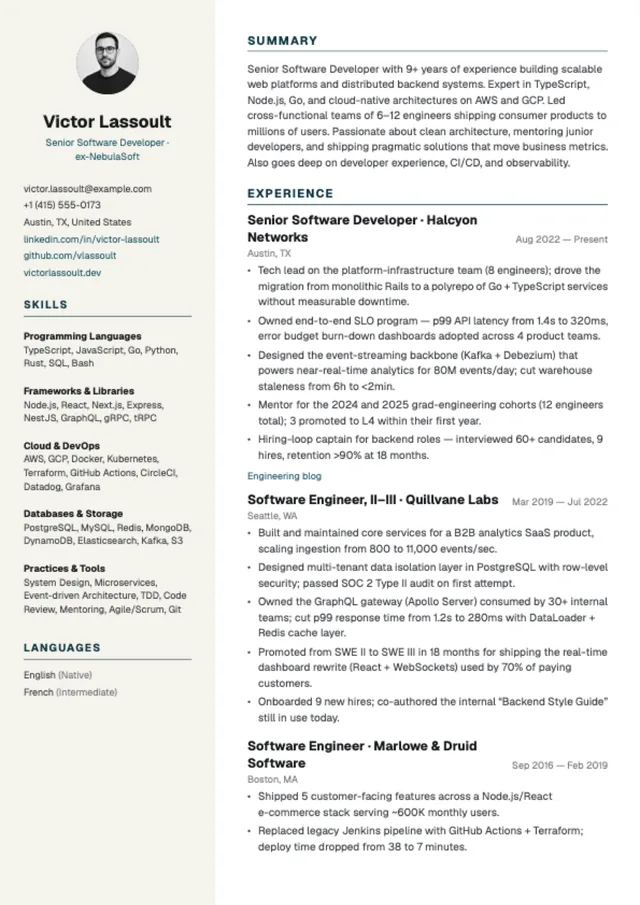
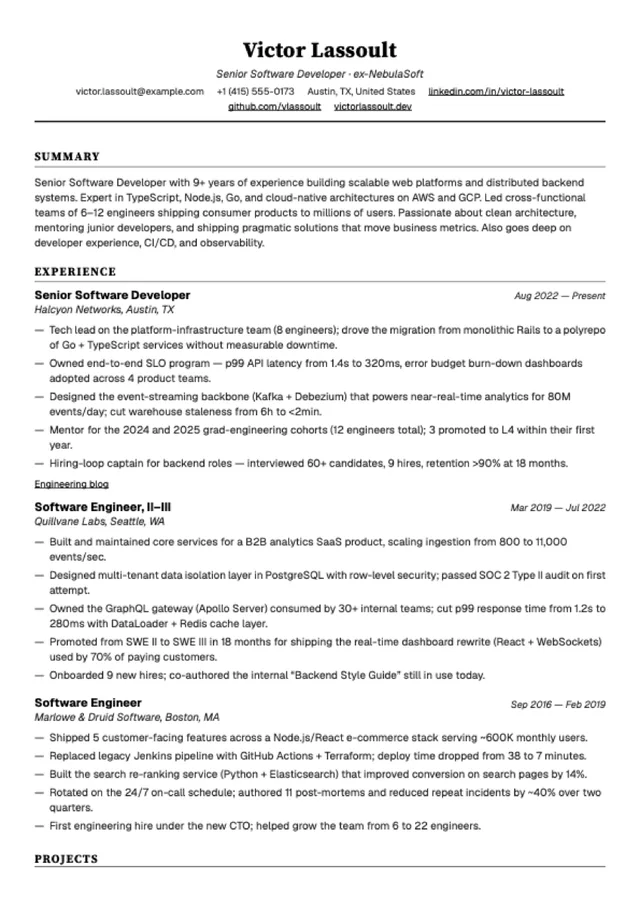
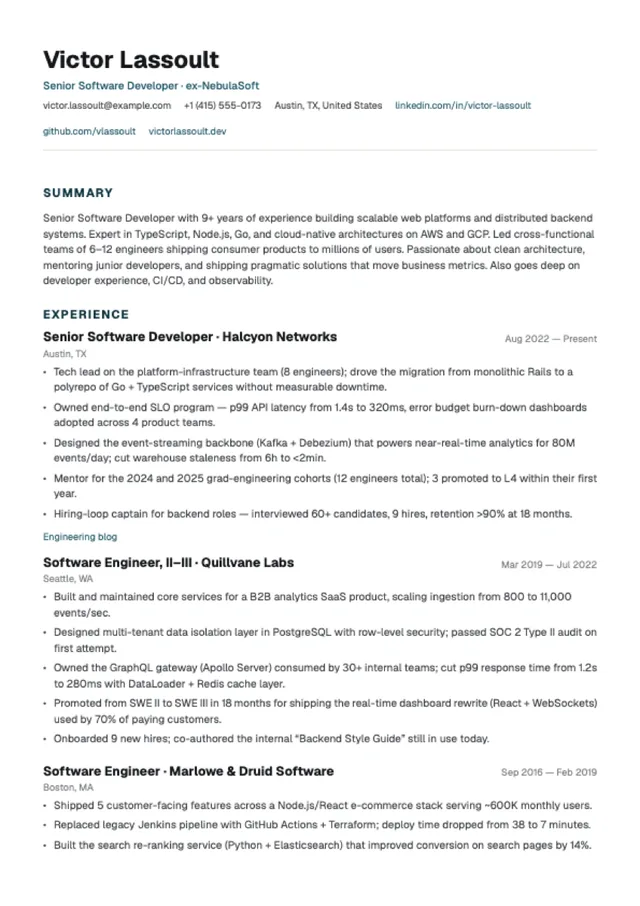
Truck Driver resume FAQ
How do I list my CDL and endorsements?
A dedicated section near the top: “CDL Class A — [State], Endorsements: H, N (X combination), no restrictions, exp. 2028,” plus your DOT medical card with its date. Repeat the class in the summary's first line. Spell each code out once — Hazmat (H) — so both the human and the parser match it. If you tested on a manual (no E restriction), say so explicitly; it's a real differentiator.
I have an accident or violation on my record — do I hide it?
No — carriers pull your MVR, your PSP (five years of crashes, three of inspections) and query the Clearinghouse before any offer, so hiding it just means they find it without your framing. State it honestly with context: preventable or not, when, and what changed in your driving since. A disclosed incident with three clean years after it survives screening; a discovered one doesn't.
How do employment gaps work — the application asks for 10 years?
The DOT application (rule 391.21) requires 3 years of all employment plus 7 more of any commercial driving, with gaps accounted for — that's the application, not the resume. Your resume can be selective and lead with your strongest carriers and metrics. The one iron rule: resume dates must never contradict the application, because both land on the same recruiter's desk.
Is job-hopping a killer in trucking?
Partially normalized — the industry knows new drivers often switch carriers early, and large-truckload turnover runs famously high. But hard limits exist: some carriers auto-reject more than 3 changes in 12 months or 5 in 36. Show a reason per move (better lanes, home time, carrier shutdown) and read sign-on bonus contracts before jumping — most pay in installments and claw back the full pre-tax amount if you leave early.
I just got my CDL — how do I get hired with no miles?
Lead with what's verifiable: FMCSA-registered (ELDT) school with hours completed, endorsements already passed, manual-transmission testing, clean MVR and Clearinghouse, DOT card current. Then any driving-adjacent work quantified — delivery routes, forklift, military. Target carriers with finishing programs (Schneider, Roehl, Knight, Prime and peers hire graduates); most better jobs unlock at 6–12 months of verifiable experience.
I was an owner-operator — how do I apply for company jobs?
Reframe business metrics as reliability: lifetime accident-free miles, fuel discipline (MPG vs typical), 100% dispatch acceptance, zero claims, DOT audit-clean authority. Address the why directly — the 2023–25 freight market pushed thousands of good operators back to company seats, and recruiters know it. And keep the numbers honest: “$200K a year” was your gross; the fleet manager knows what nets look like.
Do trucking companies even read resumes?
Depends on the door. Big carriers screen through structured DOT applications (Tenstreet's IntelliApp is the industry standard) plus the MVR/PSP/Clearinghouse pulls — there the resume's job is to be consistent with the application and give the recruiter a fast, verifiable summary. Private fleets, LTL and local jobs posted on Indeed and ZipRecruiter read resumes the classic way, keywords and all. Resumap's ATS check scores yours against a specific posting and lists what's missing.
More resume examples
Your truck driver resume, done properly — free.
Unwatermarked PDF, ATS-safe templates, and a real score against any posting when you want it.
Build my resume