
Web developer resume examples with links recruiters can actually click.
Web-dev hiring — especially remote — runs on proof you can verify without a room: a couple of deployed projects with live links, a curated GitHub, and metrics attached to the work. The resumes that die are the tech-soup skill dumps with no links and no numbers. Screeners filter hard on the stack (JavaScript is in ~73% of postings, React is the front-end default), and remote teams read for a second signal on top: can you communicate async and ship without a manager over your shoulder. This guide shows that resume, plus the honest read on a brutal junior market and where the pay actually is.
- Ideal length
- 1 page (2 for senior)
- Proof
- Live links + GitHub
- Top keyword
- JavaScript (73%)
- Bullets per role
- 3–5, metric each
Sam Okonkwo
Full-Stack Web Developer · React / Node
Remote (US, CT) · github.com/samokonkwo · samokonkwo.dev · linkedin.com/in/samokonkwo
Summary
Full-stack web developer with 6 years shipping React/Node products, remote-first for the last four. Re-architected a multi-page app into a React SPA that lifted annual revenue $1.1M; cut page-load time 30% across browsers and raised a Lighthouse performance score from 62 to 94. TypeScript, Next.js, PostgreSQL and AWS daily; RFC-and-async workflow that kept design and backend aligned across time zones. Live projects and source at samokonkwo.dev.
Experience
Full-Stack Developer (Remote) · Loomwork (B2B SaaS)
2022 — Present
- Re-architected a multi-page app into a React single-page app with a Node/Express API — annual revenue up $1.1M and bounce down 22%.
- Cut page-load time 30% and raised the Lighthouse performance score 62→94 by code-splitting, image optimization and caching (Core Web Vitals all green).
- Shipped 9 customer-facing features across 3 quarters on schedule, using RFCs and weekly async updates to keep a distributed team aligned.
- Built the CI/CD pipeline (GitHub Actions → Vercel) that took deploys from weekly to on-merge; test coverage from 40% to 82% with Jest and Cypress.
Front-End Developer · Brightline Digital (agency)
2019 — 2022
- Built responsive React front-ends for 14 client sites; a checkout redesign lifted conversion 20% off a 40% load-time cut.
- Drove the accessibility pass to WCAG 2.1 AA across the agency's template library — keyboard, contrast and ARIA — opening two enterprise accounts.
- Introduced a shared component library that cut new-project setup from days to hours.
Junior Web Developer · Cedar Apps (startup)
2018 — 2019
- Shipped features across a JavaScript/jQuery codebase; migrated the highest-traffic pages to React.
- Entered via a coding bootcamp on the strength of two deployed portfolio projects (live links on my site).
Skills
Education
B.A. English — Rutgers University, 2016 · Full-Stack Web Dev bootcamp, 2018
Certifications
AWS Certified Cloud Practitioner (2023)
Languages
English (native)
Why this example works
Links in the header, live projects to click
GitHub and a portfolio domain in the contact line, echoed by “live projects at…” in the summary. For remote roles especially, deployed links and a curated GitHub are the biggest differentiator — async proof substitutes for the in-person signal.
A number on every bullet — including performance
Revenue +$1.1M, load time −30%, Lighthouse 62→94, coverage 40→82%. Web dev quantifies cleanly on performance and conversion; Core Web Vitals and Lighthouse scores are the metrics most resumes leave off.
Remote and async signals, stated plainly
“Remote-first,” RFCs, weekly async updates, time-zone alignment. Remote teams screen for distributed-work capability before the bullets — say it, and name the artifacts (RFCs, design docs), not adjectives.
Web Developer resume summary examples
Three to four lines: scope, stack or specialism, one quantified win. Match the register to your seniority.
Junior / bootcamp grad
Junior web developer (bootcamp, 2026) with three deployed, non-tutorial projects solving real problems — a full-stack expense tracker (React/Node/Postgres), a live-data dashboard, and an open-source contribution merged into a popular CLI. Live links and GitHub on my site. Fluent in JavaScript, React and Git; hungry, coachable, and building in public daily. The projects are the proof the market is tough — mine ship and stay up.
Front-end developer
Front-end developer with 5 years in JavaScript/TypeScript and React, focused on performance and accessibility. Shipped responsive UIs that pass Core Web Vitals, drove products to WCAG 2.1 AA, and cut load times that moved conversion double digits. Comfortable owning the browser end-to-end — from Figma handoff to a green Lighthouse score. Portfolio and GitHub linked.
Back-end developer
Back-end developer with 6 years in Node/Express and Python, building APIs that hold up at scale. Designed REST and GraphQL services behind products serving millions of requests a day at sub-200ms p95; owned Postgres schema, auth and caching. The engineer who's paged at 2 a.m. and usually isn't, because the system was built not to. Load-tested, documented, deployed.
Full-stack developer
Full-stack web developer with 7 years shipping end-to-end in React and Node — feature ownership from database to deployed UI. Re-architected the app that lifted revenue seven figures, built the CI/CD that made deploys boring, and raised test coverage past 80%. I speak product with PMs and systems with backend, and I close the loop from idea to a metric that moved.
Freelance web developer
Freelance web developer with 5 years and 30+ delivered client projects — React/Next.js builds, headless CMS integrations, and performance rescues on slow legacy sites. Upwork Top Rated, 98% on-time delivery, repeat rate above 60%. Live portfolio of shipped client work (with permission), clear async communication, and the business sense to scope before I code. I make sites that load fast and clients who come back.
Senior / lead
Senior web developer with 9 years and a lead's instincts: architected the front-end platform three teams build on, mentored 5 developers, and set the standards (testing, accessibility, performance budgets) that kept quality up as the org scaled. Still ships the hard flow when it needs someone who's done it. Distributed-team leadership by RFC and code review, not meetings.
Skills that belong on a web developer resume
Languages & frameworks
- JavaScript / TypeScript
- React / Next.js
- Node.js / Express
- HTML / CSS
- Vue / Angular (as relevant)
- SQL
Build, test & deploy
- Git / GitHub
- REST / GraphQL APIs
- Testing (Jest, Cypress)
- CI/CD (GitHub Actions)
- Docker
- Webpack / Vite
Platform & quality
- AWS / Vercel / Netlify
- PostgreSQL / MongoDB
- Responsive design
- Accessibility (WCAG)
- Performance / Core Web Vitals
- Async / distributed collaboration
Bullet point formulas that get interviews
Fill the brackets with your numbers — the structure does the selling.
- Re-architected [app] to [tech]; [revenue/engagement result] — e.g. “multi-page to React SPA; revenue +$1.1M, bounce −22%.”
- Cut page-load time [x]% / raised Lighthouse [a→b] — e.g. “load time −30%, Lighthouse 62→94, Core Web Vitals green.”
- Improved conversion [x]% via [change] — e.g. “checkout redesign lifted conversion 20% off a 40% load-time cut.”
- Shipped [n] features on schedule (remote) — e.g. “9 features across 3 quarters, RFC-and-async workflow.”
- Built CI/CD; [deploy/coverage result] — e.g. “GitHub Actions → Vercel; deploys weekly to on-merge, coverage 40→82%.”
- Scaled to [n] users/requests at [latency] — e.g. “APIs behind a 100M-user product at sub-200ms p95.”
- Reduced bugs/security incidents [x] — e.g. “attack surface from 2.3% to 0.02% after a security refactor.”
- Drove product to WCAG [level] — e.g. “WCAG 2.1 AA opened two enterprise accounts.”
- Delivered [n] client projects (freelance) — e.g. “30+ projects, 98% on-time, 60%+ repeat rate.”
- Mentored [n] devs / set standards — e.g. “mentored 5 developers; owned testing and performance budgets.”
ATS keywords for web developer roles
Filters match tokens from the posting. These are the terms worth mirroring — verbatim — when they appear in the job ad.
| Keyword | Priority |
|---|---|
| JavaScript (in ~73% of postings) | High |
| HTML (62%) / CSS (65%) / responsive design | High |
| React — the front-end default | High |
| Git / GitHub | High |
| REST APIs | High |
| Node.js | High |
| TypeScript (rising fast, ~44% dev usage) | High |
| SQL | High |
| Next.js (the fastest-rising React meta-framework) | Medium |
| Vue / Angular — only if the posting names them | Medium |
| testing: Jest, Cypress | Medium |
| CI/CD | Medium |
| cloud: AWS, Vercel, Netlify | Medium |
| MongoDB / PostgreSQL | Medium |
| accessibility (WCAG / a11y) | Medium |
| performance optimization / Core Web Vitals / Lighthouse | Medium |
| remote / async / distributed-team signals (for remote roles) | Medium |
Don't guess — score your resume against the specific posting and see exactly which terms are missing.
How to write a web developer resume
Put live links and GitHub in the header — they're the proof
For web dev, and doubly for remote roles, deployed project links plus a curated GitHub are the single biggest differentiator: async proof stands in for the in-person signal. Header contact line, alongside LinkedIn; deployed links inline on each project. One well-documented, live, pinned repo beats ten random ones — and test every URL the day you apply, because a dead portfolio link is worse than none.
Put a metric on every bullet — including performance
Web dev quantifies cleanly: page-load and Lighthouse/Core Web Vitals improvements, traffic and users served, conversion and revenue lifts, test coverage, bugs reduced, features shipped. “Improved website speed” with no number reads as filler; “cut load time 30%, Lighthouse 62→94” reads as an engineer. Performance metrics are the ones most resumes forget to include.
Match the stack exactly — and spell the tech names right
Screeners filter on JavaScript, React, Node, TypeScript, Git. Mirror the posting's stack (list Vue or jQuery only if it names them; jQuery reads legacy otherwise). And capitalize correctly — “JavaScript,” not “Javascript”; “React,” not “React JS” — because a technical reviewer reads a misspelled framework as sloppiness.
Signal remote capability before the bullets
Remote teams screen for it up front: async communication, distributed/cross-time-zone work, self-direction, documentation-driven delivery. State your overlap hours, name the tools (Slack, Notion, Jira, Loom), and show artifacts — RFCs, design docs, weekly async updates — instead of claiming “great communicator.” It's often the difference between two equally skilled candidates.
Know the title effect on pay — and target accordingly
BLS puts web developers around $91K and software developers around $133K, and many “full-stack” product roles are classified as software engineering. If your work is genuinely full-stack product engineering, title and position for the software-engineer band, not the web-developer one — the classification, not just the seniority, moves the comp.
Skip the blank page.
Build this resume in Resumap — free templates, unwatermarked PDF, and an ATS check against the exact posting when you're ready.
Start freeMistakes that filter web developers out
The tech-soup skill dump
Listing every framework you touched once gets discounted. Show the stack you'd defend in an interview, and prove the core ones in bullets with outcomes.
No live links, no GitHub
An imperfect live project beats a perfect one nobody can see. Header links, deployed demos, one documented repo — the proof is the point for remote hiring.
Zero metrics
“Built and maintained websites” is invisible. Load time, Lighthouse, conversion, users, coverage — attach a number to the work.
Broken or stale links
A dead portfolio or GitHub link is worse than none — it reads as careless. Triple-check every URL before you send.
Misspelled tech names
“Javascript,” “React JS,” “NodeJS” done inconsistently signal sloppiness to the technical reviewer who decides. Match the canonical casing.
Internal project names and acronyms
Outsiders can't parse “migrated PEGASUS to the new BFF.” Describe the work in terms a hiring manager at another company understands.
A two-column layout that breaks parsing
Multi-column and graphic-heavy resumes garble in screening systems. Single column, standard headings, real text — save the design for the portfolio.
Web Developer salary ranges (US)
United States market. Absolute figures differ by country — the gaps between levels travel better than the numbers.
| Junior / entry | $60K – $90K |
| Mid-level | $75K – $110K |
| Senior / lead | $90K – $150K+ |
| Full-stack (aggregator avg) | ~$132K |
| Freelance | $30/hr (Upwork median) – $150+/hr (Toptal) |
BLS median for web developers is $90,930 (May 2024; +8% growth, top decile above $162K). Note the title effect: software developers median $133,080 — many “full-stack” product roles are classified and paid as software engineering, so the title you target matters. Aggregator full-stack averages (~$132K) reflect that overlap. Freelance runs ~$30/hr median on Upwork, $60–150+/hr on Toptal. React (~45%) and TypeScript (~44%) lead 2026 stacks.
Primary source: U.S. Bureau of Labor Statistics (OEWS/OOH). Self-reported aggregator figures are labelled as such.
Certifications worth listing
- No certification substitutes for shipped, deployed projects — the portfolio and GitHub are the proof of work
- A CS degree is not required for web dev; bootcamp and self-taught paths are well-worn, and a strong project portfolio closes the credential gap
- AWS / cloud certifications (Cloud Practitioner, Developer Associate) — genuinely useful for back-end and DevOps-leaning roles
- Open-source contributions — direct, public evidence of real coding and collaboration; some contributors convert straight to hires
- The real credential is 3–5 deployed projects with live links and clean READMEs (quality over quantity)
Templates that fit web developer resumes
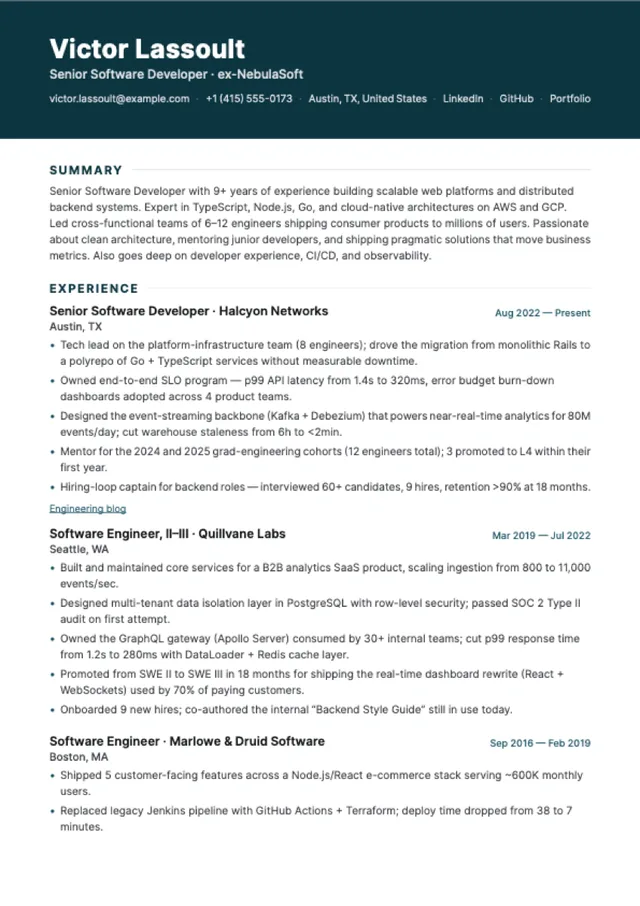
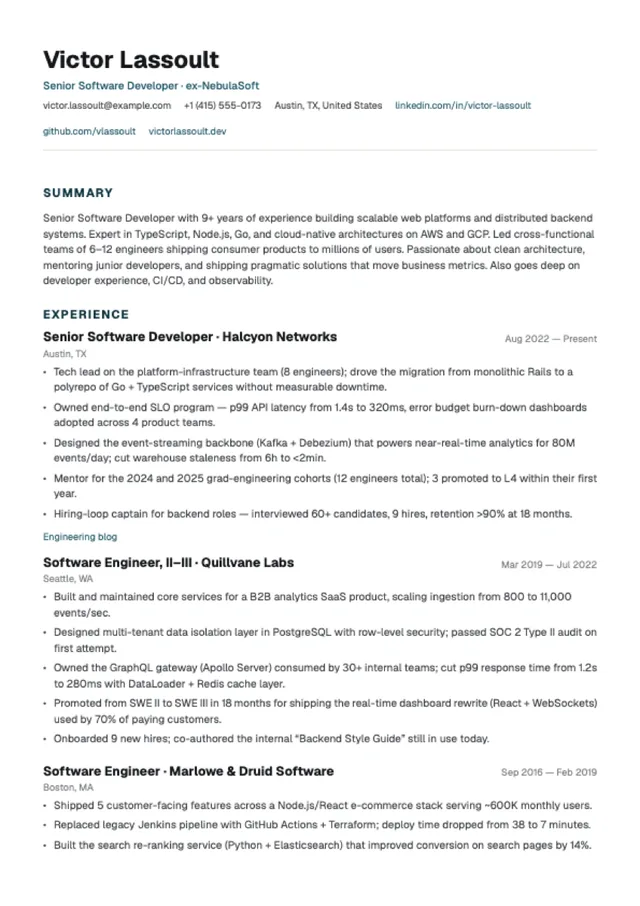
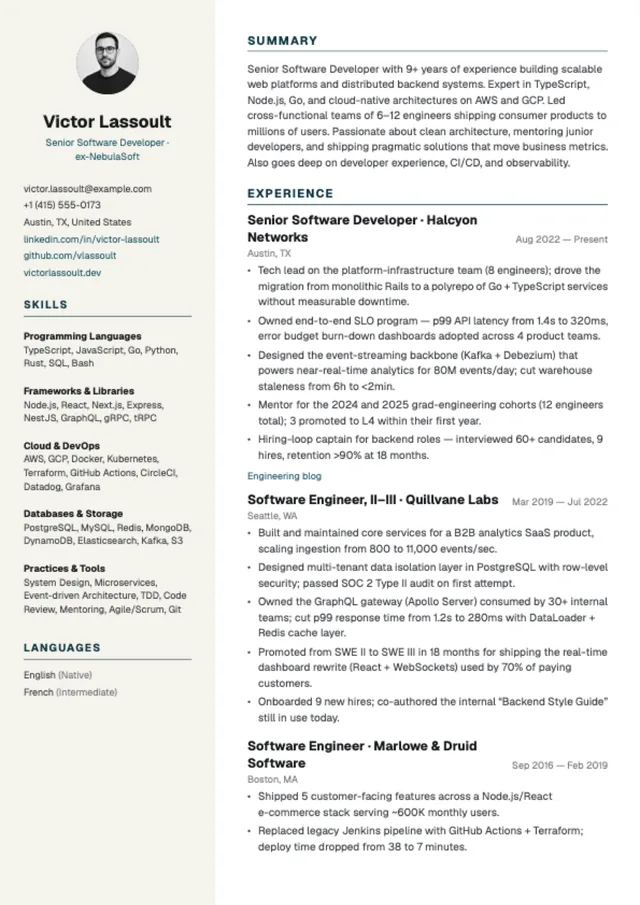
Web Developer resume FAQ
Bootcamp or a CS degree — does it matter?
For web dev, not much on its own — a degree isn't required, and bootcamp and self-taught developers land roles routinely, with reported bootcamp employment rates strong within six months (self-reported, but directionally consistent). What actually closes the gap is proof of work: two or three deployed, non-tutorial projects with live links. The degree question fades the moment a hiring manager can click on something you built.
Do employers really look at my GitHub and its green squares?
They look at GitHub — but the contribution graph is a weak proxy. Reviewers who check it read cadence and recency, not raw counts, and they know most real work is private. So don't grind green squares (it's trivially gamed); do keep one or two well-documented, deployed, pinned projects with clean READMEs. A completely empty profile raises questions; a curated one answers them. The projects matter far more than the graph.
How do I make my resume work for remote roles?
Signal distributed-work capability before the bullets, because that's what remote teams screen for: state your time-zone overlap, name your async tools (Slack, Notion, Loom, Jira), and show artifacts — RFCs, design docs, weekly async updates — rather than claiming you're a “great communicator.” Then let the live links and metrics carry the technical proof. Async, verifiable evidence is exactly what substitutes for an in-person interview signal.
Is the junior market really as bad as people say?
Honestly, it's the toughest entry market in years — graduate hiring at major tech is down sharply from pre-2020, and AI has absorbed a lot of classic junior tasks (boilerplate, unit tests, simple API maintenance), so day-one expectations now resemble old mid-level. The documented way through is real projects that solve actual problems (not tutorial clones) plus open-source contributions — concrete evidence you can build and collaborate. Strong juniors still land; it takes more proof and more patience than it used to.
How many portfolio projects should I show?
Three to five well-executed ones, quality over quantity — one or two flagship deployed projects with live links, clean code and a clear README will outperform a dozen half-finished repos. Each should solve a real problem (not a tutorial follow-along), name its stack, and ideally carry a metric or two. Pin your best on GitHub and feature them on your portfolio site.
How do I handle freelance work on my resume?
As a legitimate experience section — “Freelance Web Developer,” with dates, client outcomes and volume (projects delivered, on-time rate, repeat clients). Platform badges like Upwork Top Rated are third-party proof worth listing. Moving to full-time, emphasize collaboration and async delivery; moving to freelance, emphasize self-direction and a delivery track record. Freelance experience reads as real experience when you quantify the outcomes.
Which keywords matter most for web-dev screening?
JavaScript (in ~73% of postings), HTML and CSS, Git/GitHub, React, Node, TypeScript and REST APIs — plus Next.js, testing, CI/CD, cloud and accessibility as differentiators. Mirror the posting's exact stack and spell the names correctly. Run it against the actual listing — Resumap's ATS check scores the match and lists exactly what's missing.
More resume examples
Your web developer resume, done properly — free.
Unwatermarked PDF, ATS-safe templates, and a real score against any posting when you want it.
Build my resume