
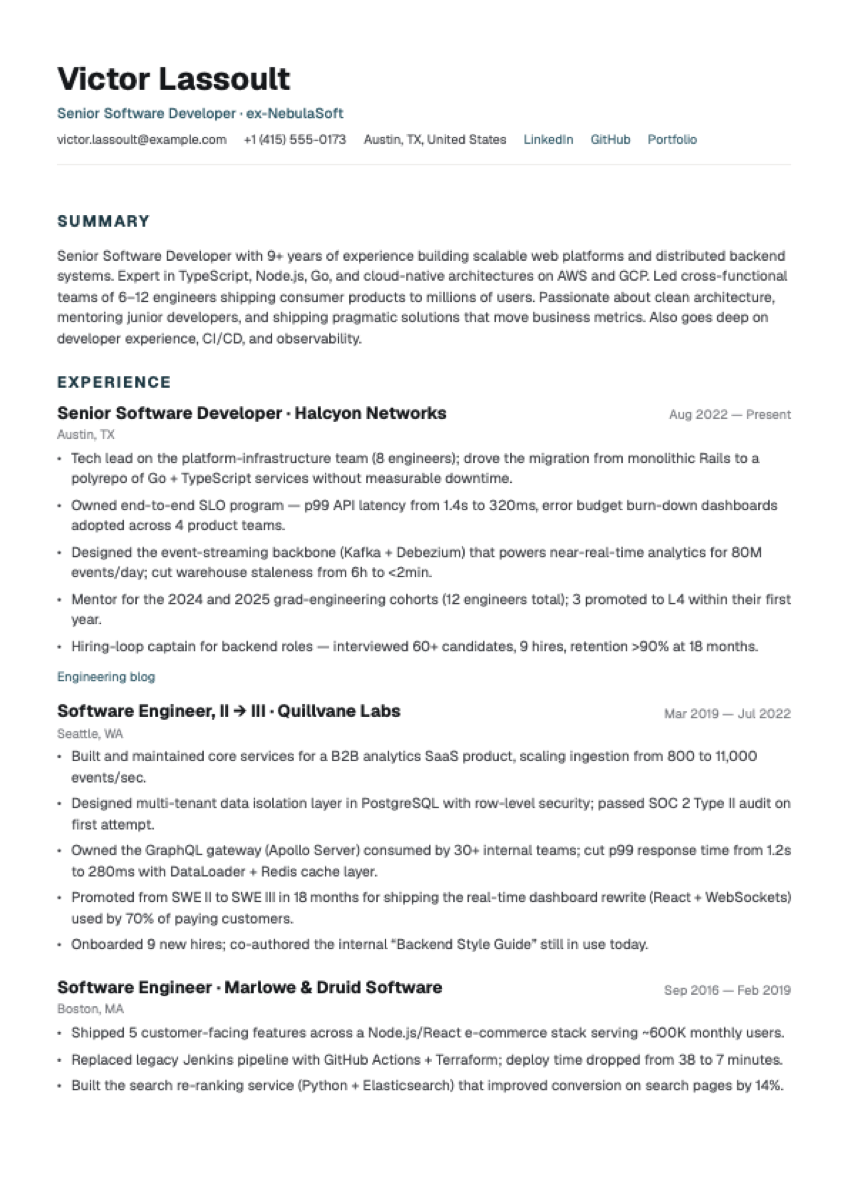
CV vs. resume: what the words actually mean
The first source of confusion is terminology, and it depends entirely on where you are.
In the United States and Canada, a "resume" is the standard one-to-two-page job-application document, and a "CV" (curriculum vitae, Latin for "course of life") refers specifically to a longer academic or research document listing publications, grants, and teaching.
In the UK, Ireland, Australia, New Zealand, India, and most of Europe, "CV" is simply the everyday word for the job-application document — what Americans call a resume. It is the standard document for almost every job, from a part-time retail role to a director-level position. An "academic CV" everywhere refers to the long, comprehensive scholarly record.
So if you're applying in London, Sydney, Bengaluru, or Berlin, you write a "CV" — and this guide explains exactly how each market expects it to look. The conventions differ in ways that matter: length, whether to include a photo or date of birth, the opening statement, spelling, and how much personal detail is expected. Get them wrong and you signal that you don't understand the local market.
The UK CV (primary focus)
The UK CV is the reference point for the Commonwealth-style CV, so we'll cover it in the most depth.
Length
Two pages is the standard for most candidates with a few years of experience. One page is appropriate for recent graduates and early-career candidates (under ~2–3 years). Three pages is occasionally acceptable for very senior or academic roles, but as a rule, if you're spilling onto a third page and you're not a senior leader or academic, the answer is to edit harder, not to add a page. A one-page CV can read as underprepared to a British employer reviewing an experienced candidate, while a bloated three-pager signals poor editorial judgment.
Format
Reverse-chronological is the overwhelming standard in the UK — most recent role first. Functional CVs are viewed with suspicion, just as in the US. Use British English spelling throughout: "organisation," "colour," "centre," "optimise," "programme." American spellings can read as careless errors to UK recruiters.
Sections, in order
- Contact details — full name, city (a full street address is unnecessary), phone, professional email, and an up-to-date LinkedIn URL. No photo.
- Personal statement (personal profile) — a short 3–5 line summary at the top stating who you are, your key strengths, and the role you're targeting. This is the UK equivalent of the professional summary, and crucially not a US-style objective. Write it last and tailor it to each job; keep it specific and evidence-led rather than a string of clichés like "hard-working team player."
- Key skills — 6–10 relevant skills matched to the job description, helping both recruiters and ATS.
- Work experience — reverse-chronological, with achievement-focused bullets and quantified results, not duty lists. (The achievement formula from our resume-writing guide applies identically.)
- Education — degrees and qualifications, most recent first. UK candidates can include A-levels and GCSEs, especially earlier in their careers.
- Certifications / training — where relevant.
- Optional extras — languages, professional memberships, volunteering, publications, if they add value.
- References — do not list referees' details. Either omit the section entirely or write "References available on request." Employers will ask at the appropriate stage.
What to leave out of a UK CV
This is where the UK diverges sharply from some other markets. Do not include a photo, date of birth or age, marital status, nationality (unless work authorisation is genuinely in question — e.g., noting settled/pre-settled status post-Brexit), gender, religion, or a full home address. UK employers actively avoid photos and personal characteristics to reduce the risk of discrimination claims under UK equality law, and including them signals unfamiliarity with local norms. This is a deliberate contrast with parts of continental Europe, where photos are standard — do not carry European habits into a UK application.
Do UK employers use ATS?
Yes. Many UK employers, especially larger ones and high-volume recruiters, screen CVs with applicant tracking software. The same ATS-friendly principles apply: single-column layout, standard headings, standard fonts (Arial, Calibri, Garamond), no text boxes or heavy graphics, and keyword alignment with the job description. Save and send as a PDF unless a Word document is requested. (For the full breakdown, see our complete guide to passing ATS.)
The Australia & New Zealand CV
Australia and New Zealand sit close to the UK model with a few twists.
- "Resume" and "CV" are used interchangeably in Australia for the standard job-application document; "resume" is the more common word on job boards like SEEK and Indeed Australia. A true academic/medical/research "CV" is a separate, longer document.
- Length: Australian resumes run longer than American ones. Two pages is standard for most professionals; entry-level candidates and graduates may use one to two pages; senior and executive candidates commonly run three to four pages, and academic/medical CVs have no strict limit. A one-page resume from an experienced Australian professional can look like it's missing detail.
- No photo, no date of birth, no marital status — Australia has age- and equal-opportunity discrimination laws, so leave these off, along with nationality/visa subclass and full street address (city and state suffice).
- Spelling: Australian English follows British conventions ("colour," "organise," "centre"). Spell-check in Australian English — local recruiters may read American spellings as errors.
- Career profile, not an objective, at the top — similar to the UK personal statement.
- References: "References available upon request" is standard; you needn't list referees on the document. (Note: for casual hospitality/retail roles, some Australian employers do like to see contactable references — read the posting.)
- Government roles often require a separate response to key selection criteria — structured written answers showing how you meet each listed criterion. Keep these separate from the resume itself.
- Format: A4 paper, reverse-chronological, DD/MM/YYYY or "Month Year" dates, standard fonts (Arial, Tahoma, Calibri), and the same ATS-friendly rules as elsewhere.
The India CV
India is the market in transition, and the right approach depends heavily on the employer.
Date of birth, gender, religion, marital status, a photo, and a signed self-declaration line at the end.
Streamlined, achievements-focused CV with personal details omitted — the stronger choice for multinational, tech, and modern corporate roles.
- Terminology: "CV," "resume," and even "biodata" are all used. Biodata is an older format heavy on personal particulars (date of birth, religion, marital status — and now mainly used for matrimonial purposes) and is largely inappropriate for professional applications today.
- Personal details — the key difference: Traditionally, Indian CVs include more personal information than Western ones: date of birth, gender, nationality, languages known, and sometimes marital status, and occasionally a photo. A self-declaration line and signature ("I hereby declare that the above information is true to the best of my knowledge") at the end is a traditional convention.
- The modernizing trend: This is changing fast, especially at multinational companies and modern firms in metro cities. By 2025, leading Indian career guidance increasingly recommends dropping marital status, date of birth, and photos to avoid bias and align with global standards. The practical rule: for traditional, domestic, or government employers, including some personal details (and sometimes a photo) is still common and expected; for multinational, tech, and modern corporate roles, a streamlined, achievements-focused CV with personal details omitted is the stronger, more contemporary choice. When in doubt, lean modern and skip the personal data.
- Length: Two pages is widely accepted and common in India, even for mid-level candidates; entry-level applicants can use one page. Education is weighted heavily — include institutions, degrees, and often percentages or CGPA, especially for recent graduates and technical roles.
- Objective vs. summary: Objective statements remain more common in India than in the West, though a modern professional summary is increasingly preferred for corporate roles.
- ATS: Large Indian employers and the Indian arms of multinationals use ATS extensively, so the same formatting and keyword rules apply.
The Europe / Europass CV
Continental Europe is not homogeneous, but there are strong shared conventions and one official standard.
Europass
Europass is the European Commission's standardised CV format, introduced in 2004 and revamped in 2020, recognised across all 27 EU member states plus EEA countries (Iceland, Liechtenstein, Norway) and Switzerland. It uses fixed sections (personal information, work experience, education, skills including the CEFR language grid and the DigComp digital-skills framework), an "About Me" summary added in the 2020 redesign, and is available in dozens of languages. It is most expected for EU institution roles, public-sector and academic positions, and applications in Eastern and Southern Europe (e.g., Romania, Bulgaria, Greece), and for Erasmus+ and EU mobility/visa contexts (it's used for EU Blue Card and EURES applications). For private-sector roles — startups, tech, consulting, marketing — a modern, tailored CV usually performs better and gives more control over design. The rule of thumb: if a posting says "Europass" or "EU format," use the official template; otherwise you have flexibility. Use the official EU Europass portal rather than third-party generators.
Photo, date of birth, and personal details by country
This is where Europe diverges most from the UK/Commonwealth model. Norms vary by country:
- Germany & Austria: A professional photo is standard and often expected; date of birth, nationality, and a full address are commonly included; CVs ("Lebenslauf") tend to run two to three pages and may include references.
- France: A photo, age, address, and sometimes marital status and number of children are common.
- Spain & Italy: A photo and birth date are common and add a personal touch.
- Netherlands & Scandinavia: Closer to the international/UK model — English is often the working language, and the international one-to-two-page CV is plenty; photos are less emphasised than in Germany/France.
GDPR shapes how personal data is handled, so be deliberate about what you share, and always check the specific country's expectations before adding a photo or personal details.
Photo: the rule that trips people up
UK · Ireland · Australia · NZ · US · Canada → no photo (bias risk, not expected). Germany · France · Spain · Italy → a professional photo is standard. India → optional and declining for modern roles. Never carry one market's habit into another.
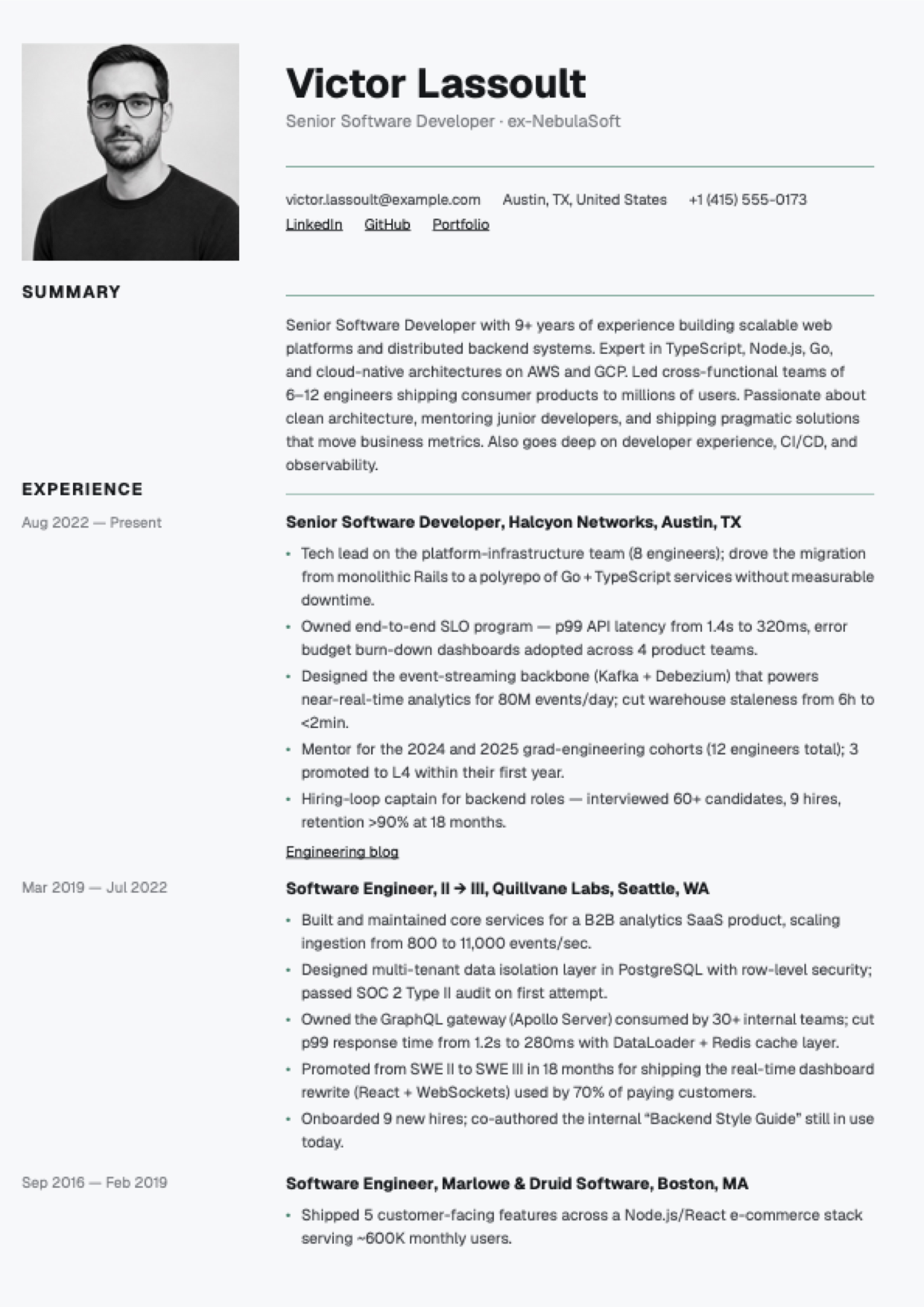
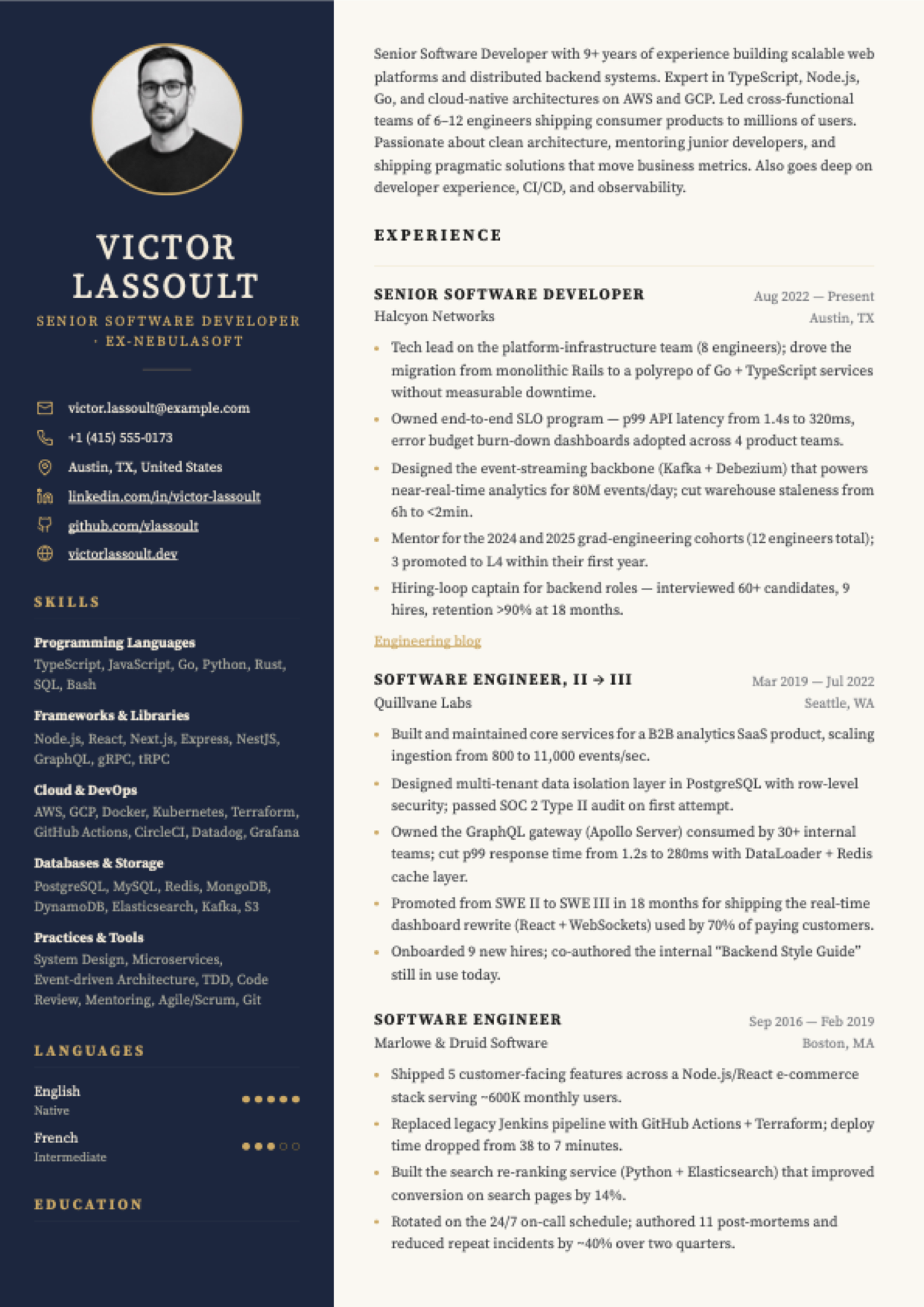
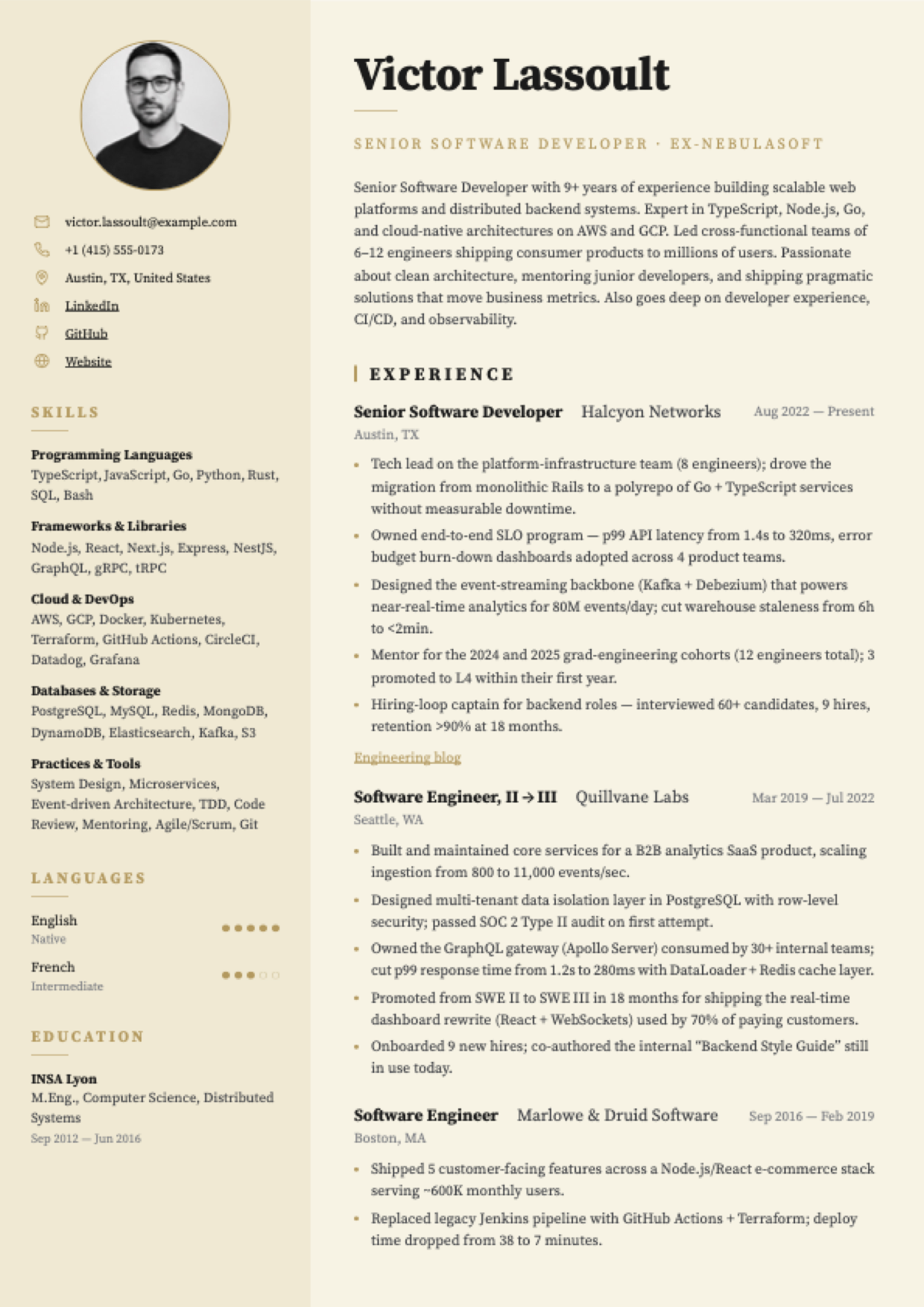
CEFR language levels
Across Europe, always describe language ability using the Common European Framework of Reference (CEFR) scale rather than vague words like "fluent" or "good." The six levels are: A1–A2 (basic user), B1–B2 (independent user), C1–C2 (proficient user). A hiring manager immediately understands "German B2" or "French C1." Europass even provides a detailed language grid breaking proficiency into listening, reading, spoken interaction, spoken production, and writing. Where you hold formal certifications (DELF, DELE, Goethe-Zertifikat, Cambridge, IELTS/TOEFL), note them alongside your self-assessment.
Languages: English (fluent), Spanish (good), French (basic)
English — Native · Spanish — C1 · French — B2 (DELF certified)
ATS in Europe
Many European multinationals use ATS, so even Europass CVs benefit from simplified, parser-friendly formatting, standard headings, and keyword alignment. Note that the strict official Europass layout can include tables and structured elements that some private-sector ATS parse imperfectly — another reason to use a streamlined custom CV for private-sector roles.
The academic CV
The academic CV is a different animal entirely, used worldwide (including in the US, where it's distinct from a resume) for faculty positions, postdocs, graduate admissions, fellowships, grants, and tenure.
- Length: No page limit. Completeness, not brevity, is the governing rule. A PhD candidate's CV runs ~2–4 pages; an early-career faculty CV ~3–6; mid-career associate professors often 8–12; full professors with extensive records 15–20+. Never truncate a publication list to save space.
- Structure (reverse-chronological within each section): contact details; (optional) research interests; education; professional/academic appointments; publications (the most-scrutinised section, sub-divided by type — peer-reviewed journal articles, books, book chapters, conference proceedings, manuscripts under review/in preparation — with your name bolded in author lists and DOIs included); grants and fellowships (funder, amount where field-appropriate, your role as PI/Co-PI, dates); awards and honours; invited talks and conference presentations (sub-divided into invited talks, conference talks, and posters); teaching experience (courses, levels, institutions, enrolment); research experience; service (institutional, disciplinary, community); professional memberships; and references (typically three, with full contact details — unlike a standard CV, references are included).
- Tailoring by institution: At research-intensive universities, lead with and emphasise publications, grants, and research impact. At teaching-focused or liberal-arts institutions, move teaching experience higher. Read the posting: if it leads with "excellence in teaching," restructure accordingly.
- Funder templates: Some grant bodies (NSF, NIH, ERC, Marie Curie, Wellcome) require their own prescribed CV/biosketch formats — follow them exactly.
- Keep a master CV with every publication, grant, talk, and course, and produce tailored versions from it.
- ATS-adjacent screening: Some high-volume faculty searches and university portals now parse uploads or search PDFs by keyword, so use standard section names and a clean layout even here.
Quick country comparison
| Element | UK | Australia/NZ | India | Germany/France/Spain | Academic |
|---|---|---|---|---|---|
| Document name | CV | Resume/CV (interchangeable) | CV/Resume | CV/Lebenslauf | Academic CV |
| Typical length | 2 pages | 2–4 pages | 2 pages | 2–3 pages | No limit |
| Photo | No | No | Sometimes (traditional roles) | Yes (DE/FR/ES) | No |
| Date of birth | No | No | Often (traditional) | Often | No |
| Top section | Personal statement | Career profile | Objective/summary | "About me" / personal data | Research interests |
| References | "On request" | "On request" | Sometimes listed | Sometimes included | Listed (3+) |
| Languages | If relevant | If relevant | Listed | CEFR levels | If relevant |
How to write your CV: the steps (UK-style baseline)
- Choose reverse-chronological format and the correct length for your country and seniority.
- Build a clean contact header (no photo for UK/AU; follow local norms elsewhere), with details in the body, not the header/footer.
- Write a tailored personal statement/profile (3–5 lines).
- Add a key-skills section matched to the job description.
- Write achievement-focused work-experience bullets with quantified results.
- Add education and any relevant certifications.
- Adjust personal details, photo, and language formatting to your target country's conventions.
- Use British/Australian spelling where appropriate; use CEFR for languages in Europe.
- Keep it ATS-friendly and save as PDF (or .docx if requested).
- End with "References available on request" (or full referees for academic CVs).
Where Resumap fits
You can build any of these formats — UK, Australian, Indian, Europass-style, or academic — with Resumap's free CV maker, which offers clean, ATS-friendly templates and free PDF export with no watermark and no subscription. Browse CV templates to find a layout that matches your target market, or use the PDF import tool to modernize an old CV. Applying to large UK or European employers that screen with software? Run it through the ATS checker against the specific job first.
Frequently asked questions
Is a CV the same as a resume?
It depends on the country. In the US/Canada, a resume is the standard 1–2 page job document and a CV is a long academic record. In the UK, Australia, India, and Europe, "CV" is the everyday word for the job-application document.
Should I put a photo on my CV?
No for the UK, Ireland, Australia, New Zealand, the US, and Canada — it invites bias and isn't expected. Yes in Germany, France, Spain, and much of continental Europe, where a professional photo is standard. In India it's optional and declining for modern/multinational roles.
How long should a UK CV be?
Two pages for most experienced candidates; one page for graduates and early-career applicants. Three pages only for senior or academic roles.
Do I include my date of birth, marital status, or nationality?
Leave them off in the UK, Australia, the US, and Canada (discrimination concerns). They're common in Germany and France, and traditional in India (though declining). Include nationality/work authorisation only where genuinely relevant.
How do I list languages on a European CV?
Use CEFR levels (A1–C2), not "fluent" or "basic." For example, "Spanish – C1." Europass provides a detailed grid; note formal certifications where you have them.
What's the difference between a UK CV and a US resume?
The UK CV is usually two pages (vs. one), uses British spelling, opens with a "personal statement" rather than an objective, and never includes a photo or personal details. The structure is otherwise similar.
When should I use the Europass format?
For EU institution jobs, public-sector and academic roles, and applications in Eastern/Southern Europe, or when a posting specifically requests it. For private-sector roles, a modern tailored CV usually performs better and is more ATS-flexible.
How is an academic CV different?
It has no page limit and is exhaustive — every publication, grant, talk, course, and committee. It leads with research/publications (or teaching, at teaching-focused institutions), includes full reference details, and grows throughout your career.