
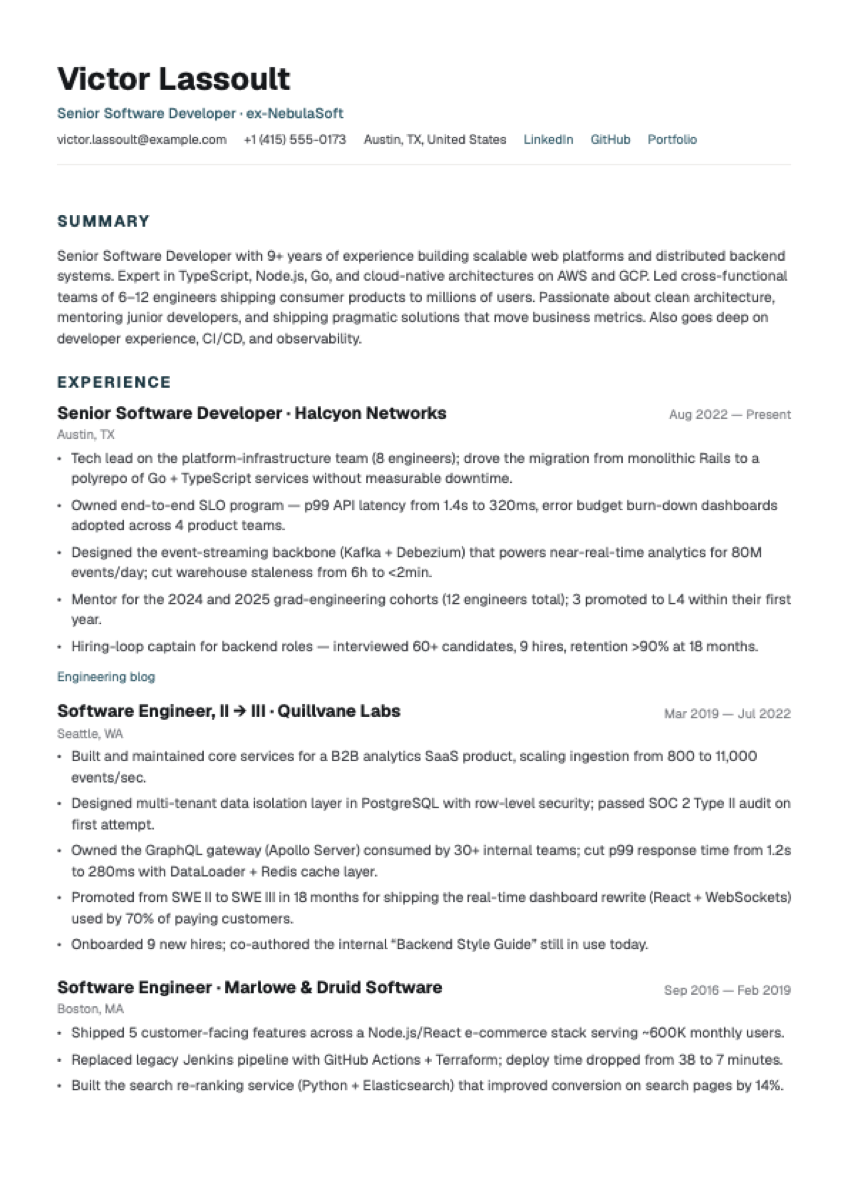
What a resume actually has to do in 2026
A resume has one job: to convince a busy stranger, in seconds, that you are worth a longer conversation. Everything else — the formatting, the verbs, the keywords — is in service of that single goal. The good news is that the rules for doing this well are knowable, evidence-based, and have not fundamentally changed even as the job market has become more automated and more competitive.
And it has become more competitive. According to Glassdoor, each corporate job opening attracts an average of 250 resumes — "Of these candidates, four to six will be called for an interview and only one will be offered a job" — and application volume has climbed roughly three-fold since 2021. Career-data site CareerSidekick reports that only about 3% of submitted resumes result in an interview, and Novoresume's 2025 job-search data found the average job seeker applies to 32 jobs and gets four interviews before being hired. Those numbers are not meant to discourage you — they are meant to focus you. When a recruiter is staring down 250 applications, the resume that wins is not the most decorated or the most creative. It is the one that is easiest to read and most obviously relevant.
Average resumes per corporate job opening (Glassdoor)
Candidates called for an interview
Person ultimately offered the job
Application volume increase since 2021
That last point is backed by the most-cited piece of research in the field. In its 2018 Eye-Tracking Study, the career site Ladders found that recruiters spend an average of 7.4 seconds on their initial scan of a resume — up from six seconds in its 2012 study. In those few seconds, recruiters look first at your name, current title and company, previous title and company, dates of employment, and education. Ladders found that resumes which performed best had simple layouts, clear section headings, bolded job titles, and lots of white space; resumes that performed worst were cluttered, used multiple columns, and lacked clear headers to guide the eye. The practical lesson: write for a skimmer first and a careful reader second.
The average time a recruiter spends on their first scan of a resume (Ladders, 2018 eye-tracking study) — up from 6 seconds in 2012. Whatever matters most has to land in those few seconds.
This guide walks through every part of a modern resume, with real before-and-after examples across industries, length rules by experience level, the words that help and the words that hurt, and the formatting principles that keep your resume readable by both humans and software.
Step 1: Choose the right format
There are three resume formats, and for the overwhelming majority of people in 2026, only one is correct.
Reverse-chronological
Lists your most recent job first and works backwards. The format recruiters expect, the most ATS-compatible, and the clearest at showing progression. Use it unless you have a specific, compelling reason not to.
Functional (skills-based)
Groups experience by skill instead of timeline. Recruiters are suspicious of it (it reads as hiding something) and many ATS parsers handle it poorly. Use it rarely, if ever.
Combination (hybrid)
Leads with a strong skills or summary section, then a reverse-chronological history. The sensible middle path when you want to foreground relevant skills without obscuring your timeline.
For most readers, the decision is simple: use reverse-chronological.
Step 2: Build the contact header
Your header should contain your name, a professional email address, a phone number, your city and region (a full street address is no longer expected and can be a minor privacy and bias risk), and a link to a comprehensive LinkedIn profile. That last item matters more than people think: ResumeGo found that candidates who include a link to an active, comprehensive LinkedIn profile receive 71% more interview requests than those who don't — yet fewer than half of job seekers include one. Recruiters also routinely cross-reference resumes against LinkedIn, so keep the two consistent.
A critical formatting rule: do not put your contact details in the document's header or footer. Many ATS parsers skip headers and footers entirely, which means your name and email can simply vanish. TopResume's testing found ATS were unable to identify contact information about 25% of the time when it was stored in headers or footers. Keep contact details in the main body, at the top.
Also: use a professional email address. By multiple recruiter surveys, roughly three in ten resumes are rejected for an unprofessional email address alone. Use some version of your name, not a nickname from 2009.
Step 3: Write a professional summary (not an objective)
The objective statement — "Seeking a challenging role where I can leverage my skills" — is dead. It is widely considered outdated by recruiters, it wastes prime space at the top of the page telling the employer what you want rather than what you offer, and surveys confirm they don't want it. Replace it with a professional summary: three to five lines, or two to four sentences, that state who you are, your most relevant strengths, and the value you bring, ideally with a quantified proof point.
Per TopResume data, resumes with a professional summary are about 36% more likely to result in an interview than those leading with an objective, and objective statements are considered outdated by the large majority of recruiters. Write the summary last, after you've drafted the rest of the resume and tailored it to the job, so you can distill the most relevant points.
Recent graduate seeking a marketing position to grow my career and develop new skills in a dynamic environment.
Marketing coordinator with 4 years of experience in B2B SaaS demand generation. Built and ran email and LinkedIn campaigns that generated a 25% increase in marketing-qualified leads in 2025. Looking to bring lead-gen and marketing-automation expertise to a growth-stage software team.
Step 4: Write a work experience section that proves impact
This is the heart of your resume, and it is where most people sabotage themselves. The single most common mistake is describing duties instead of achievements. "Responsible for managing social media accounts" tells a recruiter nothing about whether you were any good at it. The fix is a simple, repeatable formula.
The achievement bullet formula
[Strong action verb] + [what you did] + [quantified result].
Start every bullet with a strong past-tense action verb (present tense only for your current role). Describe the specific task. Then prove the impact with a number. Quantification is the highest-leverage change you can make: TalentWorks found that including numbers to quantify achievements increases your chances of landing an interview by roughly 40%, and Zippia reports that a lack of quantifiable results is a dealbreaker for 34% of recruiters. Yet most resumes barely do it — by Enhancv's analysis, only about 8% of resume job titles contain any measurable detail.
Here are real before-and-after rewrites across industries.
Responsible for marketing campaigns and social media.
Drove a 25% increase in marketing-qualified leads by leading targeted lead-generation campaigns across LinkedIn and email automation.
Worked on improving the backend system.
Architected a payment-processing system handling 2M+ daily transactions at 99.99% uptime; reduced deployment time 70% through CI/CD pipeline improvements.
Handled enterprise accounts and met targets.
Closed 18 enterprise accounts in Q3 2025, generating $3.4M in new ARR — 132% of quarterly target.
Helped with financial reporting and analysis.
Analyzed 50+ quarterly financial reports to identify key risk factors, contributing to a 5% reduction in compliance penalties.
Answered customer calls and resolved issues.
Resolved 90+ customer inquiries daily by phone with a 92% first-contact resolution rate, 15% above the team average.
Managed warehouse team and shipments.
Led a 12-person day shift; improved pick accuracy from 98.4% to 99.3% while processing 500–1,000+ daily orders without missing dispatch deadlines.
Notice the pattern: every "after" version starts with a verb, names a concrete action, and ends with a number or measurable outcome. Three to five bullets per role is the optimal range; front-load the most relevant and impressive ones, because the recruiter's eye spends most of its time at the top of each section.
Notice the difference? Specific. Quantified. Relevant.
Your resume isn't your life story — it's a highlight reel of your value.
How to quantify when you don't have obvious numbers
Not everyone has revenue figures. You have more numbers than you think. Ask: How many people, customers, or transactions did you handle? How often (daily, weekly, monthly)? How big was the budget, team, or territory? How much faster, cheaper, or more accurate did something become after your work? What percentage of a target did you hit? Even "trained 6 new hires," "managed a portfolio of 40 client accounts," or "reduced average response time from 48 to 12 hours" transforms a vague duty into evidence. You don't need perfect precision — use honest, defensible estimates and be ready to explain how you arrived at them.
Step 5: The skills section
List 6–12 relevant skills, weighted toward hard skills (tools, technologies, methodologies, certifications). Glassdoor data shows hard skills are the focus for about 88% of hiring managers when reading a resume, and the skills section is the easiest place for an ATS to match keywords from the job description. Job descriptions list, on average, far more skills (around 21.8 by Zippia's analysis) than resumes typically show (about 13), so there's usually room to add genuinely relevant skills you possess.
Be exact. If the job posting says "Google Analytics," write "Google Analytics," not "web analytics." Soft skills matter — 97% of employers value soft skills as much as or more than hard skills — but they belong embedded in your achievement bullets ("mentored a team of five") rather than as unsupported claims in a list ("great team player").
Step 6: Education and optional sections
List your degrees in reverse-chronological order with institution, qualification, and graduation year. Recent graduates can include relevant coursework, projects, honors, or GPA if it's strong; experienced professionals can keep it brief. Only include high school if you have no post-secondary education.
Optional sections — certifications, volunteer work, languages, publications, professional memberships, relevant projects — should earn their place. Include them only if they strengthen your case for this specific role.
Resume length: one page or two?
This is one of the most argued-about questions in resume writing, and the evidence is clearer than the folklore suggests. The old "always one page" rule is outdated for most experienced candidates.
The strongest data comes from a ResumeGo study conducted October–November 2018, which ran a hiring simulation with 482 recruiters, hiring managers, and HR professionals reviewing matched one- and two-page resumes. ResumeGo reported that "out of the 7,712 resumes that participants chose in the simulated hiring process, a whopping 5,375 of these resumes were two pages in length" — meaning recruiters were 2.3× as likely to prefer two-page resumes over one-page ones. The preference strengthened sharply with seniority: ResumeGo found participants were 1.4× as likely to prefer two pages for entry-level openings, 2.6× for mid-level openings, and 2.9× for managerial openings. (Worth noting for credibility: this is a commercial, simulation-based study, not peer-reviewed research — but the major coverage in CNBC, Fast Company, and ERE corroborates the figures.)
The practical rules:
- 0–10 years of experience: one page is usually right. ResumeGo's separate guidance and most hiring managers prefer a single page for early-to-mid-career applicants (TopResume cites 77% of hiring managers preferring one page for early-to-mid-career candidates).
- 10+ years, or senior/managerial roles: two pages is appropriate and often expected. Don't cram a rich career onto one page.
- Never pad, never cram. Relevance beats length. A focused one-page resume beats a bloated two-page one, and a substantive two-page resume beats a cramped one-page one. If you go to a second page, make sure the first page is compelling, because Ladders' eye-tracking found that time on the second page is strongly predicted by how engaging the first page was.
Power words vs. clichés
Recruiters read the same tired phrases hundreds of times. Words like "responsible for," "hard worker," "team player," "results-driven," "detail-oriented," and "go-getter" are filler: they assert qualities without proving them and, as TopResume puts it, make a recruiter's eyes glaze over. ResumePerk's review found 51% of resumes contain irrelevant buzzwords and clichés, and McKinsey-cited data has 60% of recruiters naming excessive buzzwords as a top resume mistake.
Replace claims with evidence. Don't say "detail-oriented"; show it with "maintained 99.3% data-entry accuracy across 10,000+ records." Don't say "strong leader"; show it with "led a team of 9 and improved sprint velocity 35%."
And start bullets with strong, specific action verbs. TalentWorks' analysis of more than 4,000 applications found that describing achievements with varied action verbs is associated with a +139.6% boost in getting interviews. Strong verbs by category:
- Leadership: Directed, Spearheaded, Orchestrated, Oversaw, Mentored, Cultivated
- Building/creating: Architected, Built, Designed, Developed, Engineered, Launched, Established
- Improving: Optimized, Streamlined, Reduced, Accelerated, Automated, Overhauled, Revitalized
- Growing: Drove, Generated, Expanded, Increased, Exceeded, Captured
- Analysis: Analyzed, Diagnosed, Evaluated, Identified, Investigated, Forecasted
Avoid weak openers like "Assisted," "Helped," "Worked on," and "Responsible for" — they make real accomplishments sound passive.
Tailoring your resume to the job description
Tailoring is the highest-ROI habit in job searching, and most people skip it: CareerBuilder data shows 54% of candidates don't tailor their resume to the job. Don't be one of them. Tailored resumes convert from application to interview at a markedly higher rate — Huntr's data found tailored resumes achieved a 5.75% conversion rate versus 2.68% for generic ones, roughly a 115% improvement — and Jobvite reports 83% of recruiters are more likely to hire candidates who tailor.
How to do it efficiently: keep a "master resume" with everything you've ever done, then for each application (1) reorder your bullets so the most relevant achievements rise to the top of each role, (2) mirror the exact language of the job description for skills and tools (within reason and only where true), and (3) match your resume's headline/title to the job title where appropriate. Jobscan's analysis of nearly one million job applications found that matching the job title from the posting on your resume made you 3.5× more likely to land an interview.
File format and naming
For most online applications, a clean, text-based PDF exported from your word processor or resume builder is safe — modern ATS platforms like Workday, Greenhouse, Lever, and iCIMS parse text-based PDFs reliably. The one fatal mistake is an image-based or scanned PDF, which ATS cannot read at all. When a job posting specifically requests Word, or when you're applying through certain government or legacy portals, submit a .docx. If you're ever unsure which system you're facing, .docx is the most universally safe.
Name your file professionally: FirstName_LastName_Resume.pdf. Recruiters save hundreds of files; "resume_final_v3.pdf" doesn't help anyone find you later.
Special situations
Employment gaps. Gaps are common and rarely fatal on their own — but be aware that some employers screen for them. The Harvard Business School/Accenture "Hidden Workers" study found 49% of companies historically eliminated candidates for roles traditionally requiring less than a bachelor's degree because of an employment gap of six months or longer. Address gaps honestly: use year ranges rather than months if the gap is short, and frame meaningful activity during the gap (caregiving, freelancing, courses, volunteering) as you would a role. Don't lie about dates; recruiters cross-check against LinkedIn.
Career changers. Lead with a combination format and a summary that explicitly connects your past to your target role. Emphasize transferable, evidenced skills and any projects, courses, or freelance work in the new field.
No experience / new graduates. Move education up the page. Treat internships, part-time jobs, volunteering, freelance work, and substantial academic projects like real roles, with achievement bullets and outcomes. Highlight transferable skills with evidence.
Common resume mistakes to avoid
- Typos and grammar errors. Per Resume Now and CareerBuilder data, 77% of recruiters treat them as a dealbreaker, and CareerBuilder found a single typo can reduce interview chances by up to 50%. Proofread, use a checker, and have someone else read it.
- Listing duties, not achievements. Covered above — quantify.
- Generic, untailored resumes. Among the most-cited mistakes by recruiters.
- Buzzword soup. Cut the clichés.
- Bad formatting: dense walls of text, multiple columns that confuse parsers, tables, text boxes, graphics, and contact info in headers/footers.
- Wrong file type: image-based PDFs.
- An unprofessional email address.
ATS-friendly formatting principles (the short version)
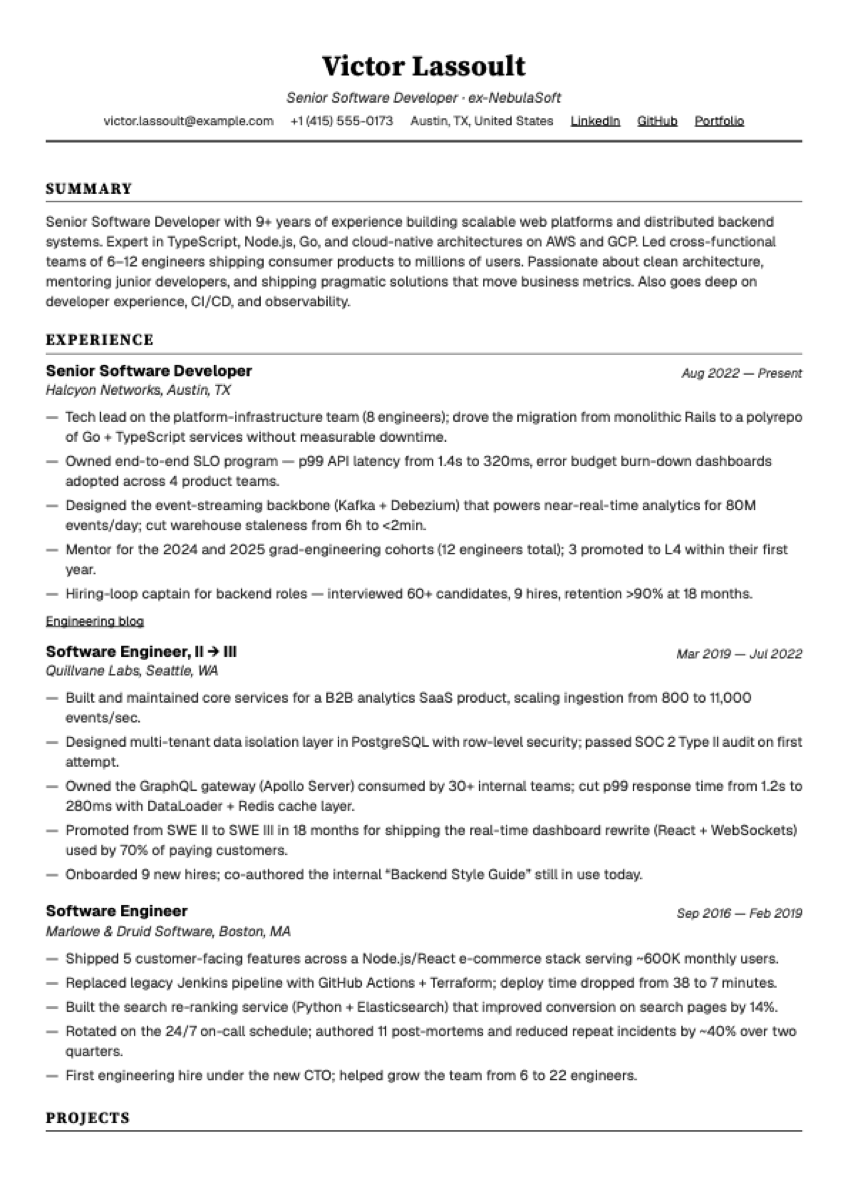
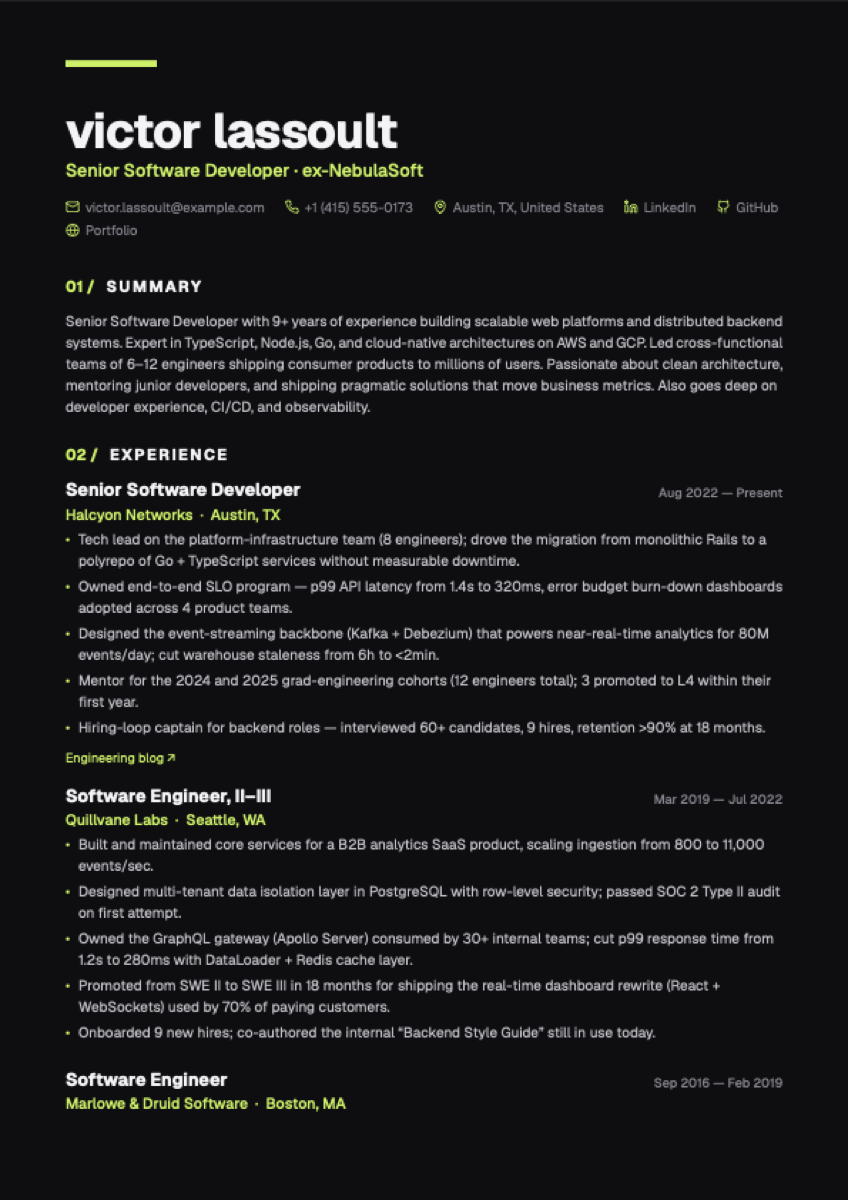
Because nearly all large employers screen applications through software before a human reads them, your resume must be machine-readable. The core rules: single-column layout, standard section headings ("Work Experience," "Education," "Skills"), standard fonts (Calibri, Arial, Georgia, Garamond, Times New Roman), no tables or text boxes for core content, no images or graphics containing text, contact details in the body rather than the header/footer, and standard date formats. For the complete deep dive, see our full guide to passing ATS.
You can build an ATS-friendly resume in minutes with Resumap's free resume builder, which uses parse-tested, ATS-friendly templates (single- and two-column, with the parsing results published), or modernize an outdated document with our PDF import and resume modernizer.
Frequently asked questions
How long should my resume be?
One page if you have under about 10 years of experience; two pages for senior, managerial, or highly experienced candidates. ResumeGo's 2018 study found recruiters were 2.3× as likely to prefer two-page resumes overall — and 2.9× for managerial roles — so don't reflexively cram. Prioritize relevance over hitting a page count.
Should I use an objective or a summary?
A summary. Objective statements are considered outdated by most recruiters; TopResume found resumes with a professional summary are about 36% more likely to lead to an interview.
How many bullet points per job?
Three to five for recent and relevant roles, fewer for older ones. Lead with your strongest, most relevant achievements.
Do I need to tailor my resume for every application?
Yes, at least lightly. Tailored resumes convert to interviews at roughly double the rate of generic ones (Huntr), and 83% of recruiters are more likely to hire candidates who tailor (Jobvite). Use a master resume to make tailoring fast.
PDF or Word?
A clean, text-based PDF is safe for most online applications and preserves your formatting. Use .docx if the posting asks for it or for legacy/government portals. Never submit a scanned or image-based PDF.
Should I include a photo?
In the US, Canada, UK, and Australia: no. Photos invite bias and aren't expected. (Norms differ in parts of continental Europe and some other regions — see our CV guide.)
How do I quantify achievements if my job didn't have obvious numbers?
Count volume (people, customers, transactions), frequency, budget or team size, time saved, error reduction, or percentage of target hit. Honest estimates are fine.
What's the best font?
Calibri or Arial are the safest, parsing cleanly across all major ATS. Georgia, Garamond, Helvetica, and Times New Roman are also fine. Use 10–12pt body text.
Should I include references?
No. "References available upon request" is unnecessary and wastes space; employers will ask when they want them.
How far back should my work history go?
Generally 10–15 years for detailed roles. Summarize or omit older positions, or group them under a brief "Earlier Experience" heading.