
In finance, the resume is audited before you are.
Hiring managers in accounting and finance read the way they work: looking for the number that does not reconcile. Vague scope, a credential without a status, a systems list that does not match the size of company you claim to have worked in — each one is a discrepancy, and discrepancies are what this function is trained to notice. The resumes that succeed are specific about ledger size, close cycle, systems and credential status, and dull in the best possible way.
- Roles covered
- 3 guides
- Screened on
- Scope + systems
- Typical length
- 1–2 pages
- Credential
- With status and date
Reflects general practice in US and European finance hiring as reviewed in 2026. Credential names and licensing paths differ by country — mirror the wording your own institute uses.
Scope is revenue size, entity count and what you closed
'Handled month-end close' is unreadable. Whose close? A single-entity company doing $4m, or a group with eleven entities, three currencies and an intercompany reconciliation? Write the size of the business, the number of entities, the systems, and your specific piece of the close — plus how long it took. 'Owned the close for three entities of a $60m group; brought the cycle from 12 days to 7' tells a controller everything they need to know about whether you can do their job.
What every finance and accounting resume has to prove
The size of the books you touched
Revenue, transaction volume, headcount on payroll, number of entities, currencies. Finance is one of the few functions where the reader can price your experience precisely if you give them the numbers — and will assume the smallest plausible version if you do not.
Credential status, stated exactly
CPA, ACCA, CIMA, CMA, ACA — with the status and date. 'CPA (licensed, Illinois, 2021)', 'ACCA — 11 of 13 papers, finals June 2026'. In-progress is respected; ambiguous is not, because it reads as an attempt to imply something untrue.
Systems at the level you actually used them
QuickBooks, Xero, NetSuite, SAP, Oracle, Sage — and Excel specifically: pivot tables, lookups, Power Query, model building. ERP names are hard filters in this function and are frequently the reason an otherwise strong resume never surfaces.
Controls, audit and accuracy
Clean audits, reconciliations you owned, variances you found, controls you wrote or tightened, error rates you reduced. This is the evidence that you are the kind of person the role is actually looking for.
Finance & Accounting resume examples by role
Each guide has a full annotated example, summaries by seniority and the keywords that role is filtered on.
Bullets that get read, and the ones that do not
Same experience, rewritten. The difference is always the same thing: something a reader can check.
Responsible for month-end close and reporting.
Owned the close for three entities of a $60m group in NetSuite — intercompany, accruals and revenue cut-off — and took the cycle from 12 days to 7 by moving accruals to a standing template.
Why: Entity count, system, the specific parts you owned and a cycle-time result. This is the bullet a controller reads and stops on.
Prepared financial statements and reports for management.
Produced the monthly board pack — P&L, balance sheet, cash flow and a 13-week rolling forecast — for a business doing roughly $18m, with commentary on the five largest variances.
Why: Names the artefacts and the size. 'Reports for management' could be a spreadsheet emailed to one person.
Assisted with the annual audit.
Ran the PBC list for two consecutive external audits; both closed with no adjustments and no management-letter points.
Why: 'Assisted' hides your role. Audit outcomes are objective, verifiable and rarely used — which is exactly why they land.
Improved reporting accuracy.
Rebuilt the revenue reconciliation after finding a $240k cumulative mismatch between the billing system and the ledger; monthly variance has stayed under $2k since.
Why: A found error with a fix and a sustained result is the strongest possible evidence in this function — it demonstrates the exact instinct being hired.
Keywords that recur across finance and accounting postings
Function-wide terms, not role-specific ones. Mirror them verbatim when the posting uses them — filters match strings, not meaning.
| Keyword | Priority |
|---|---|
| Month-end close | High |
| General ledger | High |
| Accounts payable / receivable | High |
| Reconciliation | High |
| Financial reporting | High |
| GAAP / IFRS | High |
| Excel (pivot tables, VLOOKUP) | High |
| Budgeting and forecasting | High |
| Variance analysis | Medium |
| Audit support | Medium |
| QuickBooks / Xero / NetSuite | Medium |
| SAP / Oracle ERP | Medium |
| Payroll processing | Medium |
| Internal controls / SOX | Medium |
How the resume changes as you move up
Bookkeeper / accounts assistant
Volume and accuracy: transactions per month, accounts reconciled, payroll headcount, systems. Name the businesses' size and sector — a bookkeeper across twelve small clients is a different job from one inside a single mid-sized firm.
Staff / senior accountant
The close is the spine of the page: what you own within it, how long it takes, which entities. Add audit outcomes and the credential status.
Financial analyst
Move from recording to explaining. Forecast accuracy, models you built, decisions your analysis drove, the variance you caught before anyone else. Excel and SQL depth matter more here than ledger mechanics.
Controller and above
Team size, systems implementations, audit and regulatory outcomes, cash and covenant management. Implementation projects (ERP migrations especially) are the most valuable thing on a senior finance resume.
How these resumes actually get filtered
Finance hiring filters hard on three things before a human reads anything: the ERP or accounting system named in the posting, the credential, and years in a comparable company size. That last one is why the size of your employers belongs in the company line rather than implied. Once a person reads it, the review is unusually literal — dates are checked for gaps, numbers are checked for plausibility, and anything that looks rounded or inflated is discounted. It is the one function where a plain, precise, slightly boring resume outperforms a polished one.
See what four real ATS parsers did with 36 resume layoutsMistakes specific to finance and accounting resumes
Writing 'CPA' when you are still a candidate.
Write the status and the date. In a function built on precision, an ambiguous credential is the worst possible first impression.
Omitting the size of the businesses you worked in.
Revenue, headcount or entity count in the company line. Without it, every claim on the page is unpriceable.
Listing 'Excel' with no indication of depth.
Everyone lists Excel. Say what you build in it — models, Power Query transforms, pivot-driven reporting packs — or drop it to the tools line.
Publishing figures that are not public.
For a private employer, use ranges or approximations ('roughly $60m revenue'). Precision about someone else's confidential numbers is a judgment failure in a function that runs on confidentiality.
A dense two-column layout to fit everything in.
Finance resumes are detail-heavy and tempting to compress. Whether the compression survives depends on the parser — we tested 36 layouts through four real systems and published which ones came through with the sections in the right order.
Templates that suit finance and accounting resumes
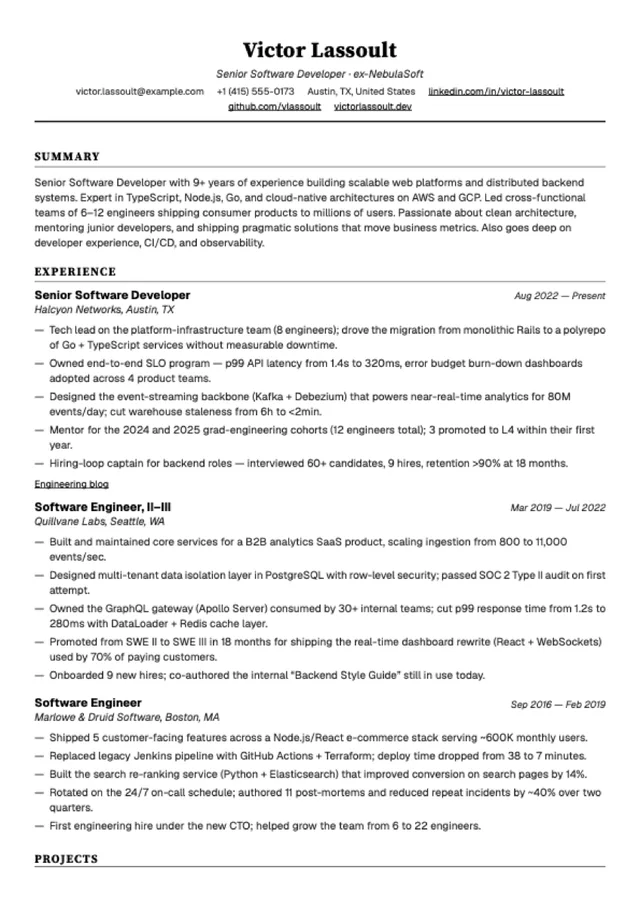
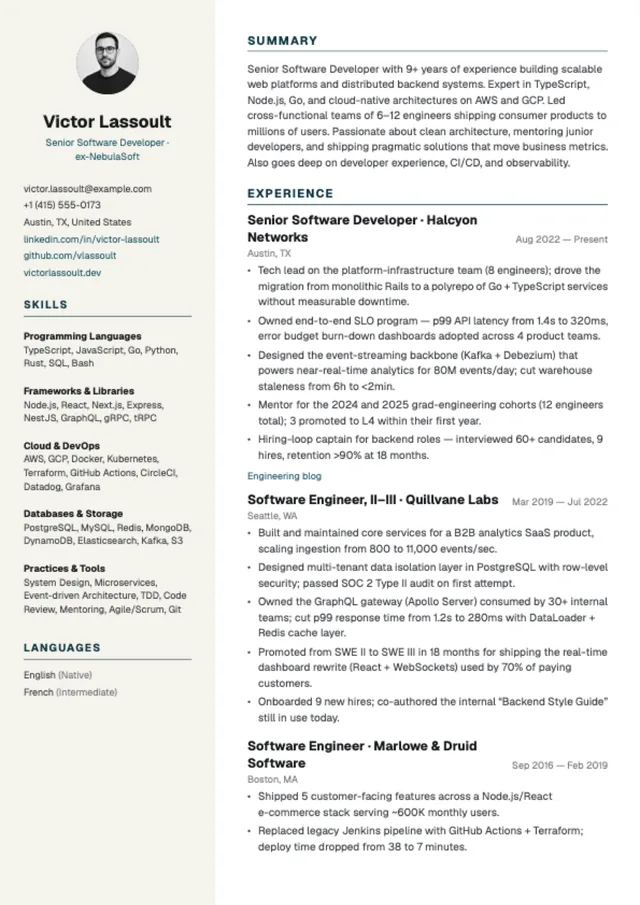
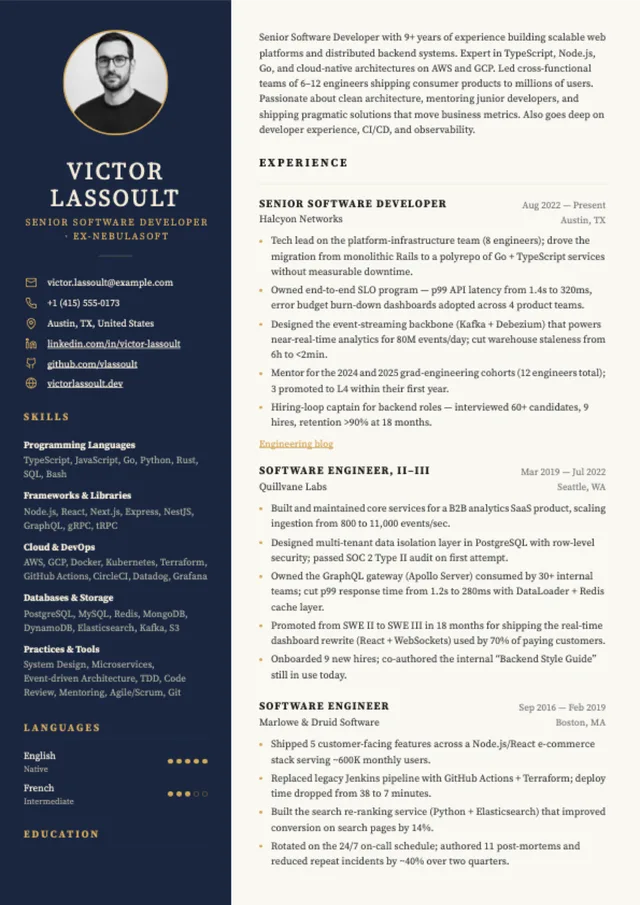
Finance & Accounting resume FAQ
Where do I put my CPA or ACCA on the resume?
After your name in the header if you hold it, and again in a credentials line with the licensing state or body and the year. If you are part-qualified, say exactly where you are — papers passed and your next sitting.
How do I show experience if my employer's numbers are confidential?
Approximate and say so: 'a privately held distributor with roughly $60m revenue'. Nobody expects exact figures from a private company; they expect the order of magnitude so they can calibrate.
Do I need to list every accounting system I have used?
List the ones you would be comfortable being tested on, and put the one from the posting first if you genuinely know it. ERP names are matched literally, so 'NetSuite' and 'Oracle NetSuite' are worth writing the way the posting writes them.
Is a one-page finance resume enough?
Up to about five years, yes. Beyond that, close scope, systems implementations and audit history justify a second page — but only those. A second page of duties is worse than no second page.
How should I explain a gap or a short stint?
Plainly and in one clause — contract end, redundancy, a role that was misrepresented, care responsibilities. Finance readers check dates as a matter of habit, so an unexplained gap draws more attention than the explanation ever would.
Other job functions
Build it on a template that has been through a real parser.
Unwatermarked PDF export, no subscription, and a score against any posting when you want one.
Build my resume