
Engineering resumes are read by engineers, who want to know what you can be assigned.
The person screening your resume does the job you are applying for. They are establishing three things in about twenty seconds: whether you are licensed, what scale of system you have actually been responsible for, and which phase of the work you did. Engineering resumes routinely answer none of them — they list projects by name, tools by category and responsibilities by verb, which leaves a technical reader unable to place you at all.
- Roles covered
- 3 guides
- First check
- PE status or EIT
- Second check
- Phase and your role
- Vocabulary
- Codes, loads, tolerances
Reflects US engineering hiring practice as reviewed in 2026. Licensure is state-by-state and matters very unevenly across disciplines: decisive in civil and building systems, common in mechanical consulting, largely absent in electronics and product development.
License, scale and phase — in that order
The license decides what work you can be given: a PE can seal drawings and carry professional responsibility, an EIT cannot, and experience does not substitute. Scale tells the reader what size of system you have been trusted with — service ampacity, construction value, tonnage, tolerance, acreage, pressure class. Phase tells them what you actually did: concept, detailed design, analysis, permitting, testing, commissioning, or construction administration. A project name without those three is a line a technical reader cannot use.
What every engineering resume has to prove
License status, stated exactly
PE with state and status, or EIT with the year and your exam date. Multiple states and reciprocity belong here too. Where the license is irrelevant to your discipline — most electronics and product work — say nothing rather than padding.
The scale of what you designed
Ampacity and voltage class, construction value, square footage, tonnage, pressure and temperature class, layer count, tolerance, throughput. This is the technical vocabulary of each discipline, and it is what lets a reader size your experience without asking.
The phase you owned
Concept, detailed design, analysis, prototyping, permitting, testing, commissioning, construction administration. 'Worked on' hides all of it. Naming the phase also tells the reader which skills you have actually practised recently.
Codes, standards and what happened at review
NEC, IBC, ACI, AASHTO, ASME, ISO, NFPA, the state DOT standard. Then the outcome: approvals obtained, comments resolved, inspection passed, compliance testing cleared, commissioned without rework. Design that survived a regulator or a construction site is stronger evidence than design volume.
Engineering resume examples by role
Each guide has a full annotated example, summaries by seniority and the keywords that role is filtered on.
Civil Engineer
Civil engineering resume examples that answer the license question first.
See the exampleMechanical Engineer
Mechanical engineer resume examples built like good drawings: toleranced.
See the exampleElectrical Engineer
Electrical engineering resume examples for two disciplines with one title.
See the example
Bullets that get read, and the ones that do not
Same experience, rewritten. The difference is always the same thing: something a reader can check.
Worked on the design of a mixed-use development project.
Took a 22-acre mixed-use site from concept through municipal permit in nine months against an eleven-month office baseline, sealing the grading, storm and utility package.
Why: Scale, phase, timeline against a benchmark and the fact that you sealed it. 'Worked on' is the single most common phrase in engineering resumes and conveys nothing.
Responsible for electrical design of commercial buildings.
Sealed electrical packages with services to 4000A for commercial and healthcare projects, including NFPA 99 essential branches and 1.5MW generator sizing.
Why: Ampacity, code and equipment capacity are the vocabulary a power engineer thinks in. They place your experience in one line.
Used simulation software to analyze designs.
Ran short-circuit, coordination and arc-flash studies in SKM across two industrial clients and produced the resulting labelling packages.
Why: Names the study type, the tool and the deliverable. Simulation as a category tells a technical reader nothing about what you can do unsupervised.
Improved a product design to reduce costs.
Redesigned a bracket assembly from five machined parts to one stamping — unit cost down roughly 40% at 20k annual volume, with the same load case verified in FEA.
Why: The mechanism, the volume, the saving and the verification. Cost claims without the load case verified are exactly what a reviewing engineer distrusts.
Keywords that recur across engineering postings
Function-wide terms, not role-specific ones. Mirror them verbatim when the posting uses them — filters match strings, not meaning.
| Keyword | Priority |
|---|---|
| Professional Engineer (PE) / EIT | High |
| CAD (AutoCAD, SolidWorks, Civil 3D, Revit) | High |
| design calculations and analysis | High |
| codes and standards (IBC, NEC, ASME, AASHTO) | High |
| FEA / simulation | High |
| specifications and drawing production | High |
| project phase (concept, detailed design, CA) | High |
| testing and commissioning | High |
| tolerance and materials selection | Medium |
| permitting and agency review | Medium |
| cost estimating / quantity take-off | Medium |
| GD&T | Medium |
| design for manufacturability (DFM) | Medium |
| cross-discipline coordination | Medium |
How the resume changes as you move up
Graduate / EIT
Degree accreditation, FE result and internships written as work — what you produced, in which tool, under whose supervision. Senior design projects count when they involved real analysis and constraint.
Design engineer
Ownership of packages or subsystems, with scale and code attached. This is where the software list should shrink and depth in two or three tools should show through the bullets.
Licensed / senior engineer
Sealing or technical sign-off, running projects end to end, client and agency contact, and mentoring EITs. Show judgment calls and trade-offs, not just deliverables produced.
Lead / engineering management
Teams, portfolios, fee and scope development, QA/QC methodology and technical standards you set. Keep a recent technical thread visible so you do not read as having left the discipline.
How these resumes actually get filtered
Engineering applications usually pass an applicant tracking system before a human sees them, and the matching is literal on software packages, codes and license terms — which is why 'PE', 'EIT', 'SolidWorks' and 'NEC' should appear in the exact form the posting uses. The reader afterwards is almost always a practising engineer, and they screen for assignability: can this person be put on a package, and does anything need to be sealed by someone else. That reader discounts adjectives entirely and reads numbers, codes and phases. It is a rare function where a plain, dense, technically specific resume outperforms a well-designed one.
See what four real ATS parsers did with 36 resume layoutsMistakes specific to engineering resumes
Not stating license status
PE with state and status, or EIT with the exam date. Where the license is irrelevant to the discipline, leave it out rather than padding.
Project names with no phase, scale or role
A technical reader cannot use a project name alone. Add what you did, how big it was, and what happened at review.
'Engineering software' with nothing named
SolidWorks, Civil 3D, Revit, Altium, SKM, ETAP, ANSYS. Licenses cost money and firms filter on the exact package.
Claiming to have sealed or approved work you did not
Sealing carries legal responsibility and is verifiable. Write 'produced under the seal of the engineer of record' where that is what happened.
A summary of adjectives
'Detail-oriented problem solver' is on every engineering resume. Use those lines for discipline, license, scale and one hard problem you solved.
Templates that suit engineering resumes
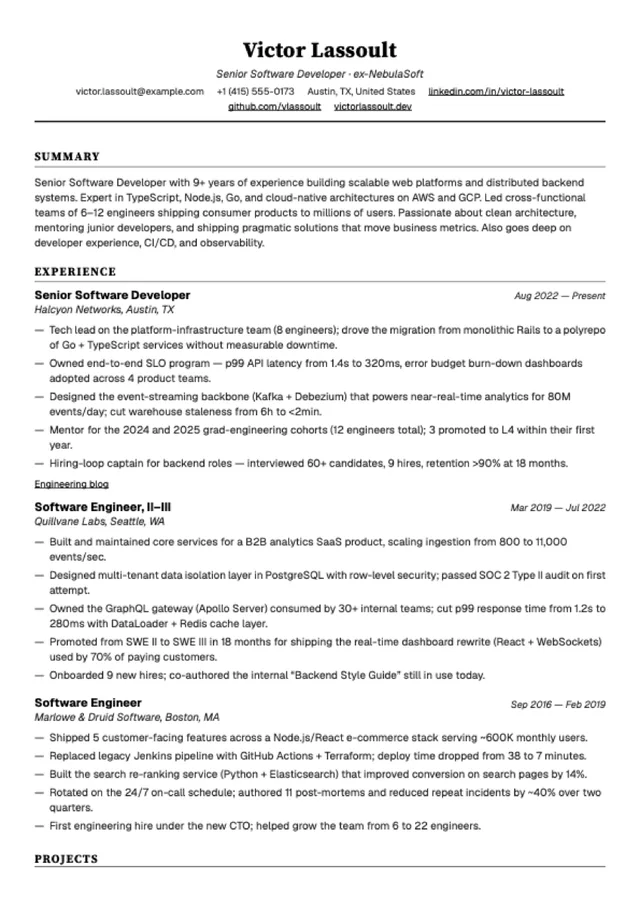
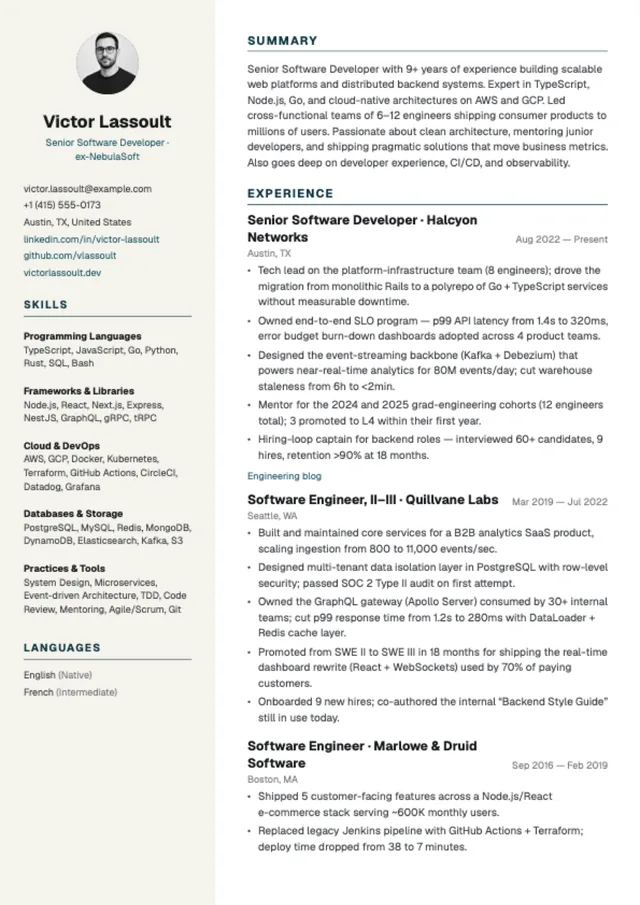
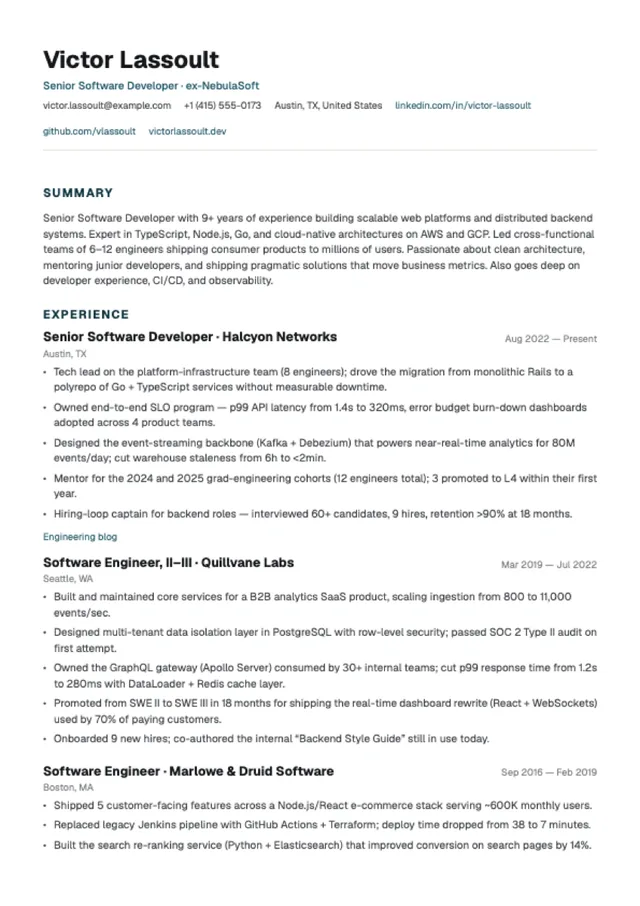
Engineering resume FAQ
How much does a PE license matter?
It depends on the discipline. Decisive in civil and building systems, where sealing carries legal authority; common and useful in mechanical consulting; largely irrelevant in electronics, embedded and most product development. Decide which market you are in before investing in the path.
What should I write about each project?
Phase, your role, scale and outcome. 'Detailed design and permitting for a 22-acre site, concept-to-permit in nine months' is usable; 'worked on a mixed-use development' is not. Construction value, ampacity, tonnage or square footage give the reader the size.
How do I write a resume as an engineering graduate?
Internships and senior design projects as work entries: the problem, the constraint, the tool, the analysis and what was built or tested. Lead with the ABET-accredited degree and the FE result, which together establish the license path where it matters.
Should I list every CAD and analysis package?
List the ones you would survive being questioned about and show depth in the bullets. A long tool list with no depth reads as coursework rather than practice — and the filter only needs the packages the posting names.
Does the resume layout matter for engineering roles?
It does, because these resumes are dense with codes, tools and dates and tempting to compress into two columns — and whether that survives parsing depends on the parser rather than on how tidy it looks. We ran the same resume through four production parsers in 36 layouts and published which ones came out with the sections in the right order.
Other job functions
Build it on a template that has been through a real parser.
Unwatermarked PDF export, no subscription, and a score against any posting when you want one.
Build my resume