
Healthcare resumes are checked for credentials before they are read.
Every other function screens on what you did. Healthcare screens on what you are permitted to do, and it does that first. A recruiter looking at a stack of clinical resumes is verifying a license number, a state, an expiry date and a scope of practice — and only then reading your experience. Get that block wrong and strong experience never gets looked at.
- Roles covered
- 11 guides
- Screened on
- Credentials first
- Typical length
- 1–2 pages
- License line
- Verbatim, with state
Reflects US clinical hiring practice as reviewed in 2026. Licensing rules and title protection vary by state and by board — always mirror the wording your own board issues.
The credential block decides whether the rest gets read
Put licenses and certifications in their own labelled section near the top, and write each one exactly as the issuing body writes it — credential, issuing state or body, license number if you are comfortable listing it, and expiry. 'RN, licensed in Texas (RN-1234567, exp. 03/2028)' is verifiable in seconds. 'Registered nurse with active license' is not, and a screener with forty resumes will not chase it. The same applies to BLS, ACLS, CNA and CPC: the acronym alone is not the credential, the issuing body is part of it.
What every healthcare resume has to prove
Licensure, in the state that matters
Name the state, not just the credential. If you hold a multistate license under the Nurse Licensure Compact, say so — it is a hiring advantage and screeners look for it. If you are license-eligible but not yet licensed in the posting's state, write that explicitly with the expected date rather than leaving it ambiguous.
Setting and acuity, not just job title
'Nurse' covers a 12-bed rural clinic and a level I trauma center. Name the setting, the unit and the patient load: 'Med-surg, 32-bed unit, 5:1 ratio' tells a hiring manager more than three lines of duties. Acuity is the single most useful qualifier in the function and most resumes omit it.
Systems you have actually charted in
EHR experience is a genuine filter, and the names are matched literally. Epic, Cerner, Meditech, Athenahealth — list the ones you have used and, where it applies, the modules. A resume that says 'electronic health records' matches nothing when the posting asks for Epic.
Outcomes that a clinician would recognize
Patient satisfaction scores, readmission or fall rates, infection-control results, throughput, chart-audit compliance. These exist in almost every clinical setting and almost nobody puts them on a resume. One credible number beats a paragraph of responsibilities.
Healthcare resume examples by role
Each guide has a full annotated example, summaries by seniority and the keywords that role is filtered on.
Registered Nurse
Nurse resume examples that clear the knockout filters.
See the exampleNurse Practitioner
Nurse practitioner resume examples that answer the scope question first.
See the exampleMedical Assistant
Medical assistant resume examples where the credential leads.
See the exampleCertified Nursing Assistant
CNA resume examples where the certification and the caseload lead.
See the examplePhlebotomist
Phlebotomist resume examples that lead with the credential and the numbers.
See the exampleDental Hygienist
Dental hygienist resume examples with the numbers your schedule already tracks.
See the exampleDental Assistant
Dental assistant resume examples that put the credential and the chairside first.
See the examplePharmacy Technician
Pharmacy technician resume examples built on the pay ladder.
See the examplePhysical Therapist
Physical therapist resume examples built on outcomes, not duties.
See the exampleCaregiver
Caregiver resume examples that prove reliability, not just kindness.
See the exampleMedical Biller and Coder
Medical billing and coding resume examples that lead with the credential and the accuracy rate.
See the example
Bullets that get read, and the ones that do not
Same experience, rewritten. The difference is always the same thing: something a reader can check.
Responsible for patient care on a busy unit.
Carried a 5:1 assignment on a 32-bed med-surg unit, including post-op and telemetry patients.
Why: Ratio and setting are how clinical hiring managers calibrate experience. 'Busy' is not a unit of measurement.
Helped improve patient satisfaction.
Unit HCAHPS communication score rose from 71 to 84 over four quarters; served on the shared-governance group that redesigned bedside handoff.
Why: Names the instrument, the movement and your specific role in it — which keeps it honest when you were one of many contributors.
Experienced with electronic medical records.
Charted in Epic (Ambulatory, MyChart) daily; trained six new hires on documentation workflows during the Cerner-to-Epic migration.
Why: Matches the literal system name the filter is looking for and turns a tool line into evidence of competence.
Maintained a clean and safe environment.
Zero reportable sharps incidents across 18 months; completed monthly infection-control audits with 100% documentation compliance.
Why: Safety claims are worth nothing without a measure attached. Audit compliance is one almost every clinical worker can retrieve.
Keywords that recur across healthcare postings
Function-wide terms, not role-specific ones. Mirror them verbatim when the posting uses them — filters match strings, not meaning.
| Keyword | Priority |
|---|---|
| Patient care | High |
| HIPAA compliance | High |
| Electronic health records (EHR) | High |
| Epic | High |
| BLS certification | High |
| Vital signs | High |
| Infection control | High |
| Patient assessment | High |
| Care plan documentation | Medium |
| Interdisciplinary team | Medium |
| Medication administration | Medium |
| Patient education | Medium |
| Cerner | Medium |
| CPR certified | Medium |
How the resume changes as you move up
Student, new grad or newly certified
Clinical rotations count as experience — list them with setting, hours and unit type. Lead with the credential and the graduation date, and put a short skills block above experience so a screener can see scope immediately.
1–4 years
Move rotations off and let real assignments carry the page. Add acuity, ratios and systems. This is the point where one or two outcome numbers separate you from an otherwise identical stack of resumes.
5+ years / charge or lead
Show scope beyond your own caseload: preceptorship, charge shifts, committee work, protocol changes you drove. Keep the credential block just as strict — seniority does not make it optional.
Management and clinical leadership
The resume shifts to budget, headcount, retention and regulatory outcomes — Joint Commission survey results, staffing models, turnover. Keep one section of hands-on clinical detail so you do not read as having left the floor entirely.
How these resumes actually get filtered
Clinical roles are usually filtered in two passes. The first is mechanical: does the resume contain the license type, the state, and the certifications the posting names — matched as literal strings by the applicant tracking system, which is why 'RN' and 'Registered Nurse' should both appear once. The second is a human scan, often by a nurse manager rather than a recruiter, looking for setting and acuity to judge whether you can carry the assignment on day one. A resume that clears the first and fails the second is the most common outcome in this function.
See what four real ATS parsers did with 36 resume layoutsMistakes specific to healthcare resumes
Burying the license at the bottom under 'Additional information'.
Give credentials a labelled section in the top third. It is the first thing verified and the cheapest thing to fix.
Listing duties that are identical for everyone with the title.
Anything true of every nurse, aide or tech is filler. Replace with setting, acuity, volume and outcome.
Writing 'HIPAA compliant' as a skill.
It is a legal baseline, not a differentiator. Show it through what you did — audit results, training you delivered, incident record.
Naming patients, employers' internal case IDs or any identifiable detail.
Describe the population, never the person. A resume containing identifiable patient data ends the application, and reasonably so.
Letting an expired certification sit on the page.
Expiry dates are checked. Renew it, remove it, or mark it 'renewal in progress, exam scheduled 04/2026' — an honest date reads far better than a stale one.
Templates that suit healthcare resumes
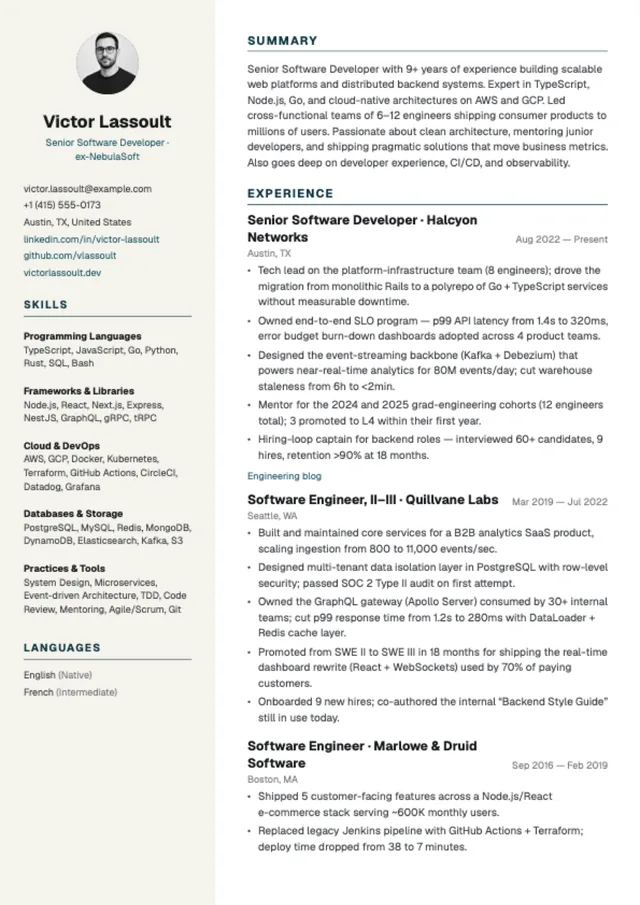
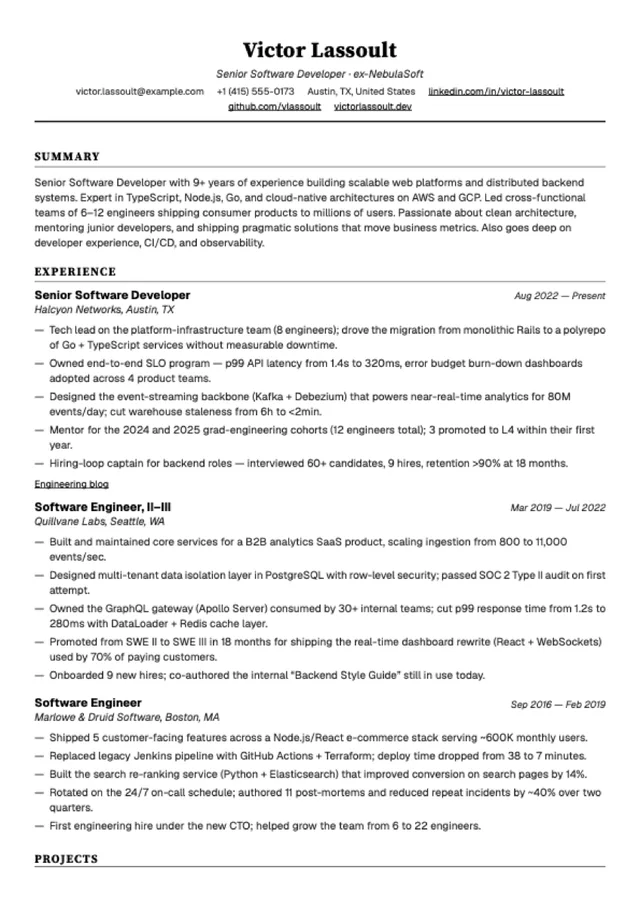
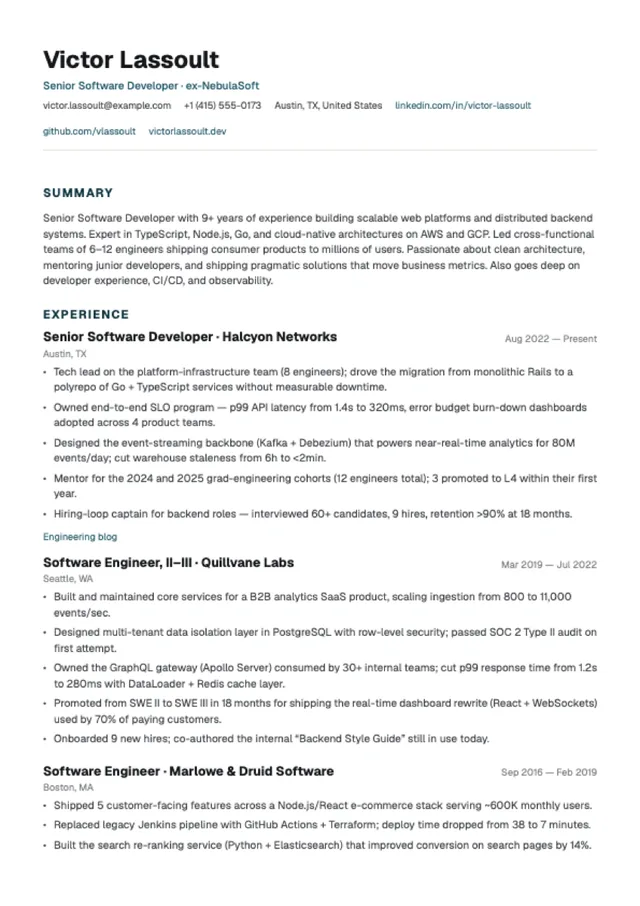
Healthcare resume FAQ
Should I put my license number on my resume?
It is common in nursing and allied health, and it speeds up verification because most state boards publish a public lookup. If you would rather not, write the credential, the state and the expiry, and add 'license number available on request'. What you should not do is leave the state off — that is the part the screener actually needs.
How long should a healthcare resume be?
One page for under five years of experience, two once you have several settings, credentials or leadership scope worth showing. Two pages is unremarkable in clinical hiring — a padded first page is not.
Do clinical hours from school count as experience?
Yes, early on. List rotations with the setting, the unit and the hours, the same way you would list a job. Once you have two years of paid clinical work, drop them.
Does the ATS actually read a two-column healthcare resume?
Sometimes, and that is the problem — it depends on the parser. We ran the same resume through four production parsers across 36 layouts and published the results: the failure mode is the order of the text stream, not the number of columns. Several two-column layouts parsed perfectly and some single-column ones did not.
What if I am licensed in one state and applying in another?
Say so plainly, in the credential block: the license you hold, whether it is a compact (multistate) license, and the date you expect endorsement in the target state. Recruiters deal with this constantly; ambiguity is what costs you the call, not the relocation itself.
Other job functions
Build it on a template that has been through a real parser.
Unwatermarked PDF export, no subscription, and a score against any posting when you want one.
Build my resume