
Recruiter resume examples for the toughest audience: other recruiters.
Your resume will be screened by someone who screens resumes for a living. That raises the bar in three specific ways: metrics are the native language (time-to-fill, req load, offer-accept — vague “full-cycle recruiting” reads as never having owned a number), a typo contradicts the exact competency you're selling, and repeating ATS folklore marks you as someone who doesn't understand the Greenhouse you claim to run. This guide shows how to write for that reader — corporate, agency, technical or executive search — with numbers that survive the interview probe.
- Ideal length
- 1 page
- The audience
- Other recruiters
- The proof
- Time-to-fill + offer-accept
- Agency currency
- Billings
Jordan Avery
Senior Technical Recruiter
Austin, TX · linkedin.com/in/jordanavery
Summary
Technical recruiter with 7 years across in-house and agency: 45+ engineering hires a year on a 30–35 concurrent req load, a 28-day average time-to-fill against a 42-day company benchmark, and an 89% offer-acceptance rate built on structured closing. Fluent in Greenhouse, LinkedIn Recruiter and Boolean sourcing at a 32% InMail response rate. I partner with hiring managers at intake, protect candidate experience under volume, and my numbers hold up when you probe them — because they're real.
Experience
Senior Technical Recruiter · Datastream Labs
2022 — Present
- Run full-cycle recruiting for 35+ concurrent engineering and product reqs in Greenhouse, holding a 28-day average time-to-fill vs a 42-day company benchmark.
- Closed 87 hires over two years at an 89% offer-acceptance rate through structured compensation conversations and pre-close alignment.
- Source passive candidates via Boolean and LinkedIn Recruiter at a 32% InMail response rate (team average 18%).
- Cut cost-per-hire ~24% by shifting a large share of hires from agency channels to direct sourcing.
Recruiter (360 desk) · Meridian Search Partners (agency)
2019 — 2022
- Built and ran a full desk: 22 placements in my best year at a ~$20K average fee — ~$450K personal billings, up 31% year over year.
- Won and grew 8 client accounts through business development alongside delivery.
- Maintained 92% 12-month retention across placed candidates by tightening role calibration at intake.
Sourcer · Meridian Search Partners
2018 — 2019
- Sourced 150+ qualified passive candidates per quarter and kept ATS data clean — the break-in rung of the trade.
Skills
Education
B.B.A. Management — University of Texas at San Antonio, 2018
Certifications
AIRS Certified Technical Recruiter (CTR) · LinkedIn Certified Professional Recruiter
Why this example works
The two numbers peers look for first
Req load (35+ concurrent) and time-to-fill against a named benchmark (28 vs 42 days) — the first things a recruiting leader scans for, because they define scope and speed. Without them, “full-cycle recruiting” is an empty phrase.
Tools named literally
Greenhouse, LinkedIn Recruiter, Boolean — named products, not “sourcing tools.” The reviewer operates these systems daily and skills-based screens map named tools to scorecard criteria. Generic tool language reads junior.
Agency chapter speaks in billings
$450K billings, 22 placements, ~$20K average fee, +31% YoY — the agency desk is a sales job and its resume currency is revenue. The corporate chapter above it speaks process metrics instead. One resume, two dialects, both fluent.
Recruiter resume summary examples
Three to four lines: scope, stack or specialism, one quantified win. Match the register to your seniority.
Entry / sourcer / coordinator
Recruiting sourcer with 18 months of top-of-funnel ownership: 150+ qualified passive candidates sourced per quarter via Boolean and LinkedIn Recruiter, a 28% response rate on cold outreach, and clean ATS data hygiene in Greenhouse. Before recruiting: two years of B2C sales, which is where the outreach instinct comes from. Ready for a coordinator or junior recruiter seat — the sourcing engine is already running.
Corporate / in-house recruiter
Corporate recruiter with 5 years of full-cycle ownership across G&A and technical functions: 60+ hires a year on a 25-req load, time-to-fill consistently under company benchmark, 90%+ offer acceptance, and hiring-manager satisfaction of 4.7/5 on internal surveys. I run tight intakes, protect candidate experience at volume, and treat the funnel as a system — measured, calibrated and improved every quarter.
Agency recruiter (360 / full desk)
Full-desk agency recruiter with 6 years owning both sides: $450K+ in annual personal billings, 20+ placements a year at a ~$20K average fee, and client accounts I opened myself and still hold. Business development, delivery and closing in one seat — a sales job where the product is people, run at consistent year-over-year growth. Looking for a desk with a stronger brand and a higher ceiling.
Technical recruiter
Technical recruiter with 6 years filling engineering, data and product roles: 45+ hires a year, a 32% InMail response rate on passive outreach, and time-to-fill a third faster than benchmark on hard-to-fill backend and ML reqs. I speak enough stack to screen credibly — the difference between spraying keywords and holding a real conversation with an engineer. AIRS CTR certified, fluent in Greenhouse and Lever.
Executive search
Executive search consultant with 8 years in retained work: market maps of 50–70 calibrated targets per search, shortlists of 3–5 finalists, and completed searches through VP and C-level across fintech and SaaS. Discretion is the working condition — references, approaches and negotiations handled with total confidentiality. Quality over volume: fewer searches, higher stakes, finished properly.
TA lead / manager
Talent-acquisition manager leading a team of 6 recruiters through 300+ hires a year: I own the hiring plan, the process (structured interviews, calibrated scorecards), the vendor budget, and the numbers — cost-per-hire down 24%, offer acceptance up 8 points, time-to-fill under benchmark for eight straight quarters. I built the employer-brand program and the sourcing engine; now I develop the people who run them.
Skills that belong on a recruiter resume
Core cycle
- Full-cycle recruiting
- Sourcing / passive candidates
- Screening & interviewing
- Offer negotiation & closing
- Pipeline management
- Intake / hiring-manager partnership
Tools
- Greenhouse · Lever
- Workday Recruiting · iCIMS
- LinkedIn Recruiter
- Boolean search
- Sourcing CRMs (Gem, SeekOut)
- HRIS basics (Workday, BambooHR)
Metrics & programs
- Time-to-fill / time-to-hire
- Offer-acceptance rate
- Req load management
- Cost-per-hire
- Candidate experience
- Employer branding · DEI sourcing
Bullet point formulas that get interviews
Fill the brackets with your numbers — the structure does the selling.
- Run [n] concurrent reqs — e.g. “35+ concurrent requisitions across engineering, product and design.”
- Hold a [n]-day time-to-fill vs benchmark — e.g. “28-day average against a 42-day company benchmark.”
- Close [n] hires at [x]% offer acceptance — e.g. “87 hires at 89% acceptance via structured closing.”
- Hit a [x]% sourcing response rate — e.g. “32% InMail response vs an 18% team average.”
- Bill $[amount] (agency) — e.g. “$450K personal billings, 22 placements, ~$20K average fee, +31% YoY.”
- Cut cost-per-hire [x]% — e.g. “24% by shifting hires from agency channels to direct sourcing.”
- Retain hires — e.g. “92% 12-month retention across 60 placements via tighter intake calibration.”
- Sustain [x]/5 hiring-manager satisfaction — e.g. “4.7/5 across 30+ reqs on internal surveys.”
- Fill volume fast — e.g. “300+ seasonal roles in 8 weeks at a 95% show rate.”
- Map markets (exec search) — e.g. “50–70 calibrated targets per search → shortlists of 3–5 finalists.”
ATS keywords for recruiter roles
Filters match tokens from the posting. These are the terms worth mirroring — verbatim — when they appear in the job ad.
| Keyword | Priority |
|---|---|
| full-cycle recruiting (agency: 360 / full desk) | High |
| talent acquisition | High |
| sourcing / candidate sourcing | High |
| ATS by name — Greenhouse, Lever, Workday, iCIMS (mirror the posting's system) | High |
| LinkedIn Recruiter (the product) | High |
| Boolean search | High |
| pipeline management | High |
| screening & interviewing (structured, phone screens) | High |
| offer negotiation · offer-acceptance rate | High |
| time-to-fill · requisition (req) load | High |
| hiring-manager partnership / intake meetings | High |
| passive candidates / headhunting | Medium |
| candidate experience | Medium |
| employer branding · diversity sourcing / DEI | Medium |
| high-volume recruiting · campus recruiting | Medium |
| quality of hire · cost-per-hire · sourcing CRMs (Gem, SeekOut) | Medium |
Don't guess — score your resume against the specific posting and see exactly which terms are missing.
How to write a recruiter resume
Write for a reader who screens resumes professionally
Your reviewer reads resumes all day, knows the 10-second scan they preach, and probes every number in the interview. That means three rules: metrics in every experience bullet (they're the native language), zero typos (your product is attention to detail — a misspelling contradicts the competency you're selling), and no ATS folklore. Claiming to “beat the bot” to a person who runs Greenhouse daily self-identifies as not understanding your own tools.
Lead with req load and time-to-fill
The two numbers a recruiting leader scans for first: how many reqs you carry concurrently (scope) and how fast you fill against a benchmark (speed). “Managed full-cycle recruiting for 35+ concurrent reqs at a 28-day time-to-fill vs a 42-day benchmark” answers both in one line. Add offer-acceptance rate — the closing metric — and you've covered the trinity. Without them, “full-cycle” is a phrase every applicant uses and none proves.
Speak the dialect of your segment
Corporate resumes lead with process quality: time-to-fill, offer-accept, candidate experience, hiring-manager satisfaction. Agency resumes lead with money: gross billings, placements, average fee, year-over-year growth — it's a sales job and reads like one. Technical recruiting adds stack literacy (name the languages you recruit for); executive search speaks market maps and shortlist quality. Moving between segments? Translate: billings become “hires delivered,” process metrics gain a revenue angle.
Keep metrics confidentiality-safe
Never name candidates, clients or salaries — use percentages, ratios and benchmarks instead: “reduced time-to-fill 22% vs team benchmark,” “60+ hires across fintech clients,” “placed at an average fee of ~$20K.” This is expected practice, not evasion, and it demonstrates the discretion the job requires. One more honesty rule: only claim numbers you can defend — a fabricated 94% offer-accept that collapses under one probing question is worse than an honest 78%.
Name the tools and skip the certificate padding
Name the specific systems — Greenhouse, Lever, Workday, iCIMS, LinkedIn Recruiter — because your reviewer uses them and skills-based screens match literal product names. Mirror the posting's ATS in particular. On certifications: none are required and none substitute for metrics; AIRS (CTR for technical) and the LinkedIn recruiter cert are reasonable tie-breakers, SHRM-CP/PHR lean HR-generalist. One clean certifications line, always below the numbers.
Skip the blank page.
Build this resume in Resumap — free templates, unwatermarked PDF, and an ATS check against the exact posting when you're ready.
Start freeMistakes that filter recruiters out
Duties instead of metrics
“Responsible for full-cycle recruiting” proves nothing to a peer. Req load, time-to-fill, offer-accept — recruiters who owned numbers show them.
No req load or time-to-fill
These are the first two numbers a recruiting leader looks for. Their absence reads as never having carried real scope.
No ATS or tools named
“Various sourcing tools” reads junior. Greenhouse, Lever, LinkedIn Recruiter, Boolean — name what you actually run.
A typo — fatal in this profession
Your product is candidate detail. One misspelling on your own resume contradicts the core competency. Proofread three times.
Invoking ATS folklore
White-text tricks and “beat the bot” talk flag you as not understanding tools you claim to operate. Clean format + honest keywords, done.
Hiding the agency money
Billings, placements and average fee are the agency currency — reviewers expect them. Present personal (not desk) figures you can defend.
Ignoring candidate experience
It's a scorecard line now. A recruiter resume without it dates itself — show a satisfaction score or a process you improved.
Recruiter salary ranges (US)
United States market. Absolute figures differ by country — the gaps between levels travel better than the numbers.
| Median (BLS 13-1071*, May 2024) | $72,910/yr |
| Rough spread (10th–90th) | ~$43K – $122K |
| Recruiter aggregators (self-reported) | ~$70K avg |
| Agency top billers (self-reported) | $150K+ (commission) |
| Senior technical / exec search | Premium above corporate base |
There's no standalone BLS code for recruiters — the closest is Human Resources Specialists (SOC 13-1071, which explicitly includes recruiting): median $72,910/year in May 2024, about 944,300 jobs, +6% growth through 2034 with ~81,800 openings a year, and a rough spread from the low $40Ks to about $120K+. Self-reported “recruiter” averages run somewhat lower (~$70K). The real levers are segment and structure: corporate pays base plus bonus; agency is commission-driven with high variance (top billers reportedly $150K+); technical and executive search carry premiums.
Primary source: U.S. Bureau of Labor Statistics (OEWS/OOH). Self-reported aggregator figures are labelled as such.
Certifications worth listing
- No recruiting certification is required, and none substitutes for demonstrated metrics — experience and defensible numbers are the currency (an honest read your recruiter audience already knows)
- AIRS (an ADP company) — the most recognized recruiting-specific training: CRP for generalists, CTR (Certified Technical Recruiter) for tech, CDR/CIR for diversity and internet sourcing
- LinkedIn Certified Professional Recruiter — inexpensive, tool-specific, a recognizable badge worth the ~90-minute exam
- SHRM-CP / PHR — respected but HR-generalist credentials; best if you sit inside a broader HR org or aim at HR leadership rather than pure TA
- Keep certifications to one compact line below the experience section — never above the metrics
Templates that fit recruiter resumes
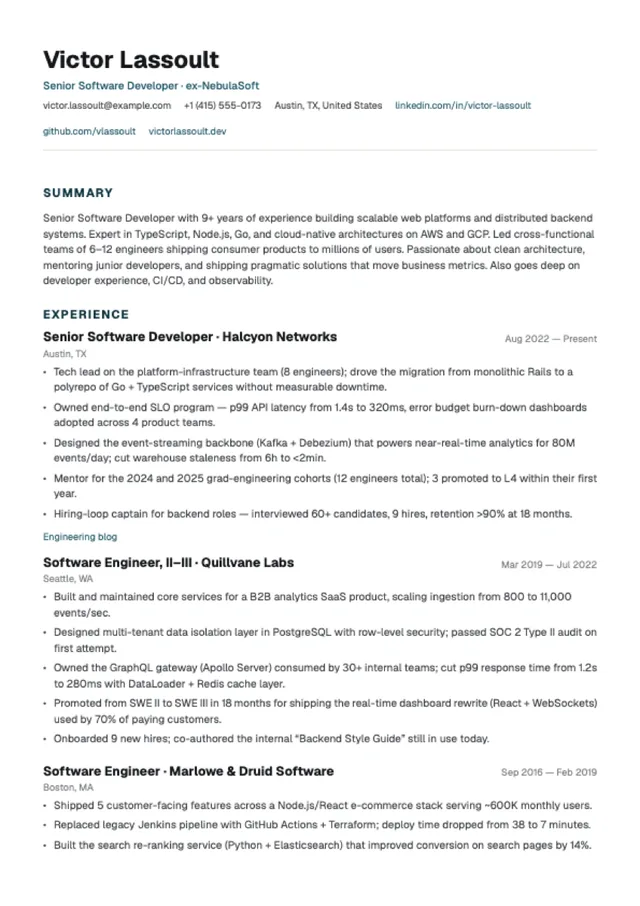
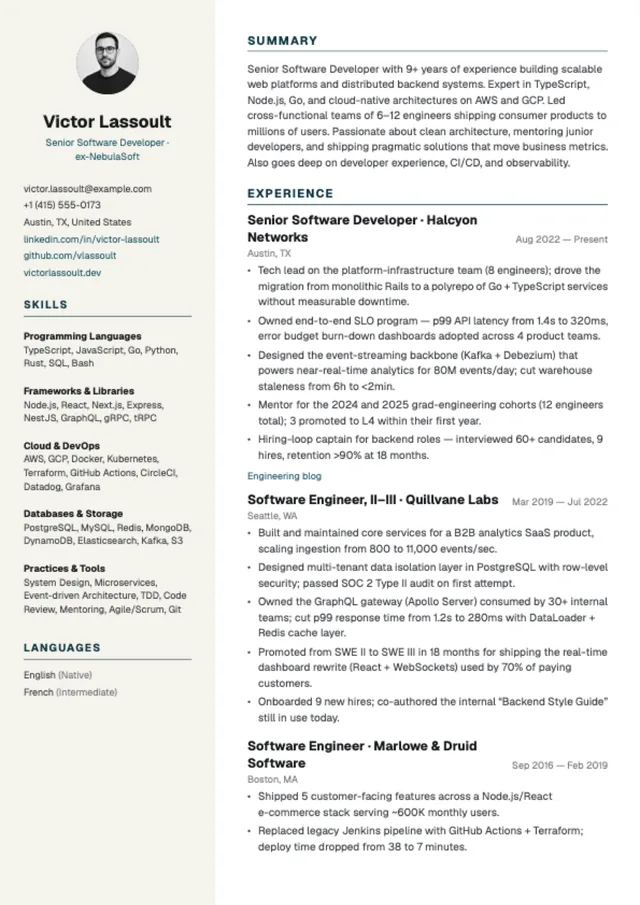
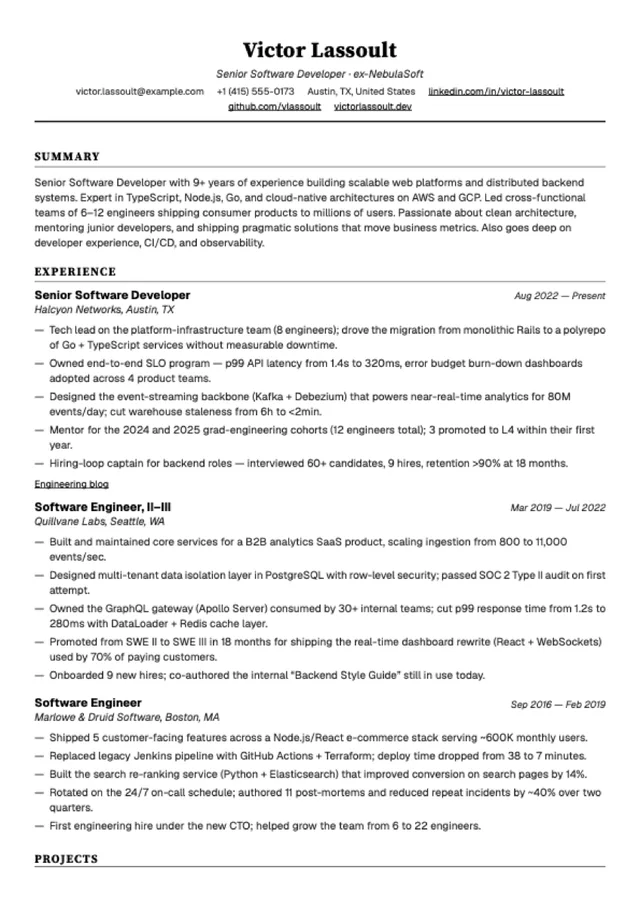
Recruiter resume FAQ
How does a corporate recruiter resume differ from an agency one?
They're different dialects. A corporate resume leads with process quality and stakeholder outcomes: time-to-fill against benchmark, offer-acceptance rate, req load, candidate experience, hiring-manager satisfaction. An agency resume leads with money and volume: gross billings, placement count, average fee, year-over-year growth, client accounts won — because agency recruiting is commission sales and reads like a sales resume. Crossing over? An agency recruiter targeting corporate should reframe billings as hires delivered and add stakeholder language; a corporate recruiter targeting agency should surface any revenue or volume angle they have.
How is a recruiter's own resume judged?
By peers, and harder than anyone else's. The reviewer screens resumes professionally, so three things carry disproportionate weight: metric credibility (they'll probe your numbers in the interview — only claim what you can defend), typos (a misspelling contradicts the attention to detail you're selling; for a recruiter it's a disqualifier, not a demerit), and tool fluency (they operate the ATS you name daily). The upside of the irony: a genuinely tight, quantified, honest recruiter resume lands harder with this audience than with any other, because they know exactly how rare it is.
How do I show metrics without breaching candidate or client confidentiality?
Use percentages, ratios and benchmarks instead of names and salaries: “reduced time-to-fill 22% versus team benchmark,” “placed 60+ candidates across fintech clients,” “average fee ~$20K” — never “placed Jane Doe at Acme for $185K.” Aggregate across clients, anonymize industries if needed, and keep dollar figures at the fee/billings level rather than individual compensation. This is standard, expected practice — and it quietly demonstrates the discretion that recruiting at any serious level requires.
Should I put agency billings on my resume?
Yes — billings are the agency currency and reviewers expect them. Present gross billings, placement count, average fee and the year-over-year trend: “$450K personal billings, 22 placements, ~$20K average fee, +31% YoY.” Two honesty rules: distinguish personal billings from desk or team totals (inflating with team numbers is discoverable in one reference call), and note split versus non-split placements if your market uses them. If you're moving to corporate, keep the billings line but translate the headline into hires delivered and client outcomes.
How do I break into recruiting with no experience?
The standard path runs Sourcer → Recruiting Coordinator → Recruiter. Sourcing is the entry ramp: it's measurable from week one (candidates sourced, response rates, screens booked) and teaches the tools — Boolean, LinkedIn Recruiter, ATS hygiene. On your resume, lead with transferable outreach and sales metrics (quota attainment, call volume, conversion), self-trained tool fluency (the LinkedIn recruiter certification is cheap and fast), and any research or people-facing work. Agencies also hire ambitious beginners directly onto desks — the trade-off is commission pressure from day one.
How important is naming ATS tools on a recruiter resume?
More important than for almost any other profession, for two reasons. First, your reviewer operates these systems daily — “Greenhouse” and “Workday Recruiting” are concrete shared vocabulary, while “various ATS platforms” reads as inexperience. Second, modern screening is skills-based: named tools map directly to scorecard criteria, so the literal string from the posting is what gets matched. Mirror the specific system the employer runs (it's usually visible in the posting or their careers site), and list the sourcing stack too — LinkedIn Recruiter, Gem, SeekOut, Boolean.
Is it true that ATS software auto-rejects most resumes?
No — and you of all candidates can't afford to repeat it. The “75% auto-rejected” claim traces to a 2012 sales pitch from a vendor that folded the next year; no methodology was ever published. As recruiters know first-hand, Greenhouse, Lever, Workday and iCIMS parse, rank and surface candidates — humans make the reject decisions, and auto-knockouts are limited to explicit questions like work authorization. On a recruiter's own resume, invoking the myth is actively self-discrediting; debunking it in an interview, if asked, is a credibility win. Resumap's ATS check scores your parse and keyword match against a specific job — the legitimate version of the concern.
More resume examples
Your recruiter resume, done properly — free.
Unwatermarked PDF, ATS-safe templates, and a real score against any posting when you want it.
Build my resume