
Support roles hand you a scorecard every week. Almost nobody puts it on the resume.
Whatever the queue — billing, retail service, or a help desk — you are measured continuously: resolution rate, quality score, satisfaction, handle time, escalations, adherence. Then the resume says you assisted customers and resolved issues. The person reading it is measured on the same numbers across their whole team, so quoting yours is the fastest way to stop looking like every other applicant. The second thing they are looking for is subtler: whether you reduce the work or merely absorb it.
- Roles covered
- 3 guides
- Screened on
- Resolution, not volume
- Underrated
- Tenure and adherence
- What promotes
- Contacts prevented
Reflects US service and support hiring practice as reviewed in 2026. Both major occupations here are projected to shrink slightly through 2034 as self-service absorbs routine contacts, while still generating very large numbers of annual openings from turnover — which is why reliability and quality read as strongly as experience.
Resolution beats volume, and prevention beats both
Everyone in this function handles a lot of contacts; the queue guarantees it. What separates candidates is whether the contact ended properly — first-contact resolution, quality score, escalation rate — and, one level up, whether fewer contacts arrive because of something you did. A knowledge base article that deflects a hundred tickets a month, a self-service rollout, a root-caused recurring fault, a cheat sheet the floor still uses: that is the evidence that gets someone promoted rather than replaced, and it is the half of the work automation makes more valuable rather than less.
What every customer service and support resume has to prove
Your scorecard, with the benchmark beside it
Quality score against target, first-contact resolution against the team average, CSAT, escalation rate, SLA attainment. You receive these weekly. A number without a benchmark could be excellent or poor and the reader has no way to tell.
The queue and the environment
Billing, retention, claims, technical, healthcare eligibility; or user count, sites, identity platform and ticketing system. Queues and environments differ enormously in difficulty and regulation, and the specialized ones are what pay above the median.
Evidence that you reduced the work
Documentation written and what it deflects, self-service enabled, a recurring problem root-caused, a process automated, a macro or template the team adopted. This is the difference between the resume of someone who stays on the queue and someone who moves off it.
Reliability, stated plainly
Schedule adherence, attendance, tenure. Annual openings in this function come almost entirely from turnover, which makes staying the single most expensive problem your future manager has. Two years anywhere is a competitive advantage worth writing down.
Customer Service & Support resume examples by role
Each guide has a full annotated example, summaries by seniority and the keywords that role is filtered on.
Customer Service Representative
Customer service resume examples built on your own dashboard numbers.
See the exampleCall Center Representative
Call center resume examples that use the scorecard you already get every week.
See the exampleTechnical Support Specialist
IT support resume examples written to be the first IT job, not the last one.
See the example
Bullets that get read, and the ones that do not
Same experience, rewritten. The difference is always the same thing: something a reader can check.
Assisted customers with inquiries and resolved issues in a timely manner.
Handled 60–75 contacts a day on billing and cancellations at 84% first-contact resolution against a 76% floor average, with a 91% quality score.
Why: The first sentence is the job posting read back. The second is a scorecard, benchmarked — which is the only version a supervisor can act on.
Responded to IT support tickets and escalated when necessary.
Closed 45–60 tickets a week at 78% first-contact resolution with an 11% escalation rate against a 19% team average.
Why: Resolution against escalation is the pair that says tickets ended with you. Volume alone measures the queue, not the technician.
Created documentation for common customer issues.
Wrote 40+ knowledge base articles; the top five now deflect roughly 120 contacts a month.
Why: Documentation as an activity is invisible. Documentation with a deflection number is proof you removed work rather than just absorbing it.
Known for excellent customer satisfaction and reliability.
CSAT 4.6/5 across roughly 900 surveyed contacts; 97% schedule adherence and no unplanned absences in 14 months.
Why: Both halves of the vague version turn out to be measurable. In a function defined by turnover, the attendance line is doing real work.
Keywords that recur across customer service and support postings
Function-wide terms, not role-specific ones. Mirror them verbatim when the posting uses them — filters match strings, not meaning.
| Keyword | Priority |
|---|---|
| customer service | High |
| first-contact resolution (FCR) | High |
| CRM / ticketing (Salesforce, Zendesk, ServiceNow) | High |
| de-escalation / conflict resolution | High |
| CSAT / NPS | High |
| SLA management | High |
| multi-channel support (phone, chat, email) | High |
| troubleshooting | High |
| quality assurance score | Medium |
| average handle time (AHT) | Medium |
| knowledge base / documentation | Medium |
| escalation management | Medium |
| schedule adherence | Medium |
| bilingual support | Medium |
How the resume changes as you move up
Entry / tier 1
Availability, reliability and any prior experience handling upset people — retail, hospitality, food service all transfer. Systems are taught; attitude and shift coverage are what get you hired.
Experienced representative or technician
The scorecard carries the page: resolution, quality, satisfaction, escalation, SLA. Name the queue or environment, and start showing the first documentation or process you owned.
Senior / escalation / tier 2
You take what the floor cannot. Escalations resolved at your level, specialized queues, training and nesting new hires, and the first real prevention work — a root cause fixed, a self-service path enabled.
Team lead and beyond
Team-level numbers instead of personal ones: service level, team FCR, 90-day attrition, quality across the group. From IT support the ladder also goes sideways into systems, cloud and security — which is worth signalling with a directional certification.
How these resumes actually get filtered
This function runs the highest application volumes of almost any, so the front of the process is heavily automated: systems, queue types and certifications matched literally against the posting. What follows is usually a supervisor or team lead reading fast, looking for two things — evidence the contacts ended well, and evidence you will still be there in six months. Both occupations here are projected to shrink slightly as self-service absorbs the simplest contacts while still producing very large numbers of openings from turnover, which shapes the screen: quality metrics and reliability outrank volume, and anything showing you reduce contacts rather than only answer them reads as a level above.
See what four real ATS parsers did with 36 resume layoutsMistakes specific to customer service and support resumes
Describing the job posting back at the reader
'Assisted customers and resolved inquiries' is what the requisition says. Your scorecard is what they do not have.
Volume with no quality figure
High contact counts and no resolution rate invites the assumption you rushed people. Pair them.
Quoting handle time on its own
Fast calls that do not resolve are expensive. Show AHT beside FCR or leave it off.
No evidence of prevention
Documentation, self-service, automation, root-cause fixes. This is what distinguishes the people who move up in this function.
Leaving out availability and tenure
Scheduling and turnover are the two operational problems your future manager actually has. Both are decision-relevant facts.
Templates that suit customer service and support resumes
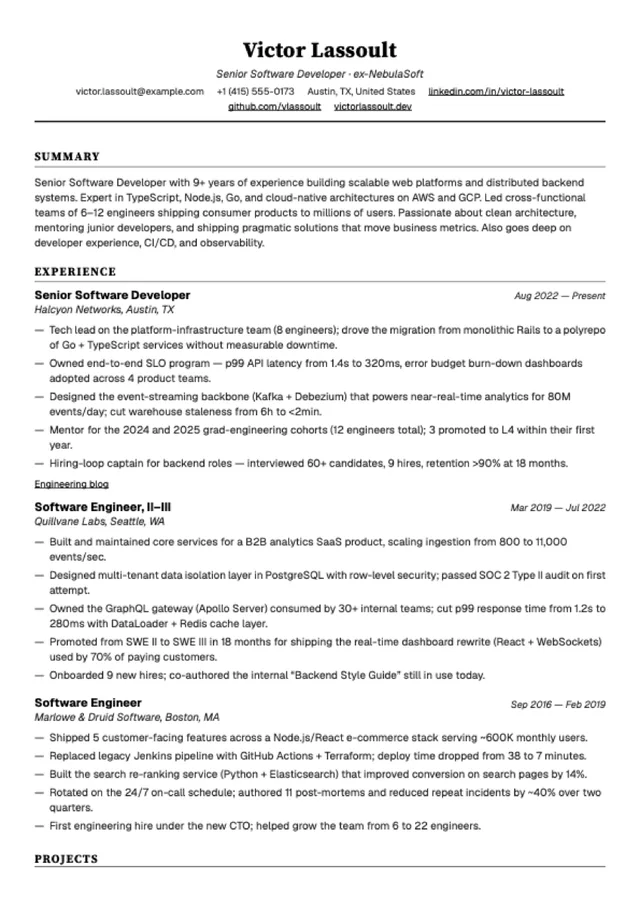
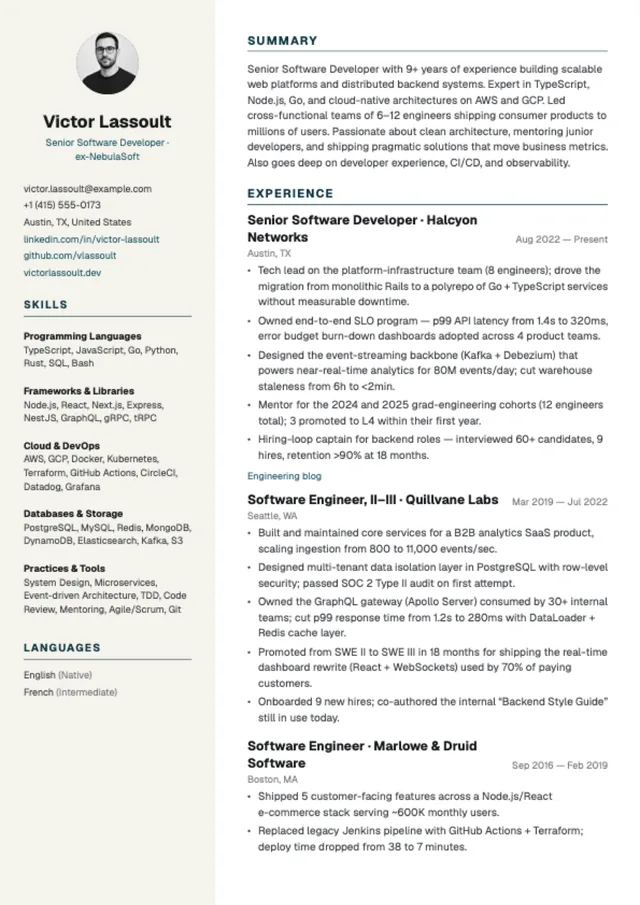
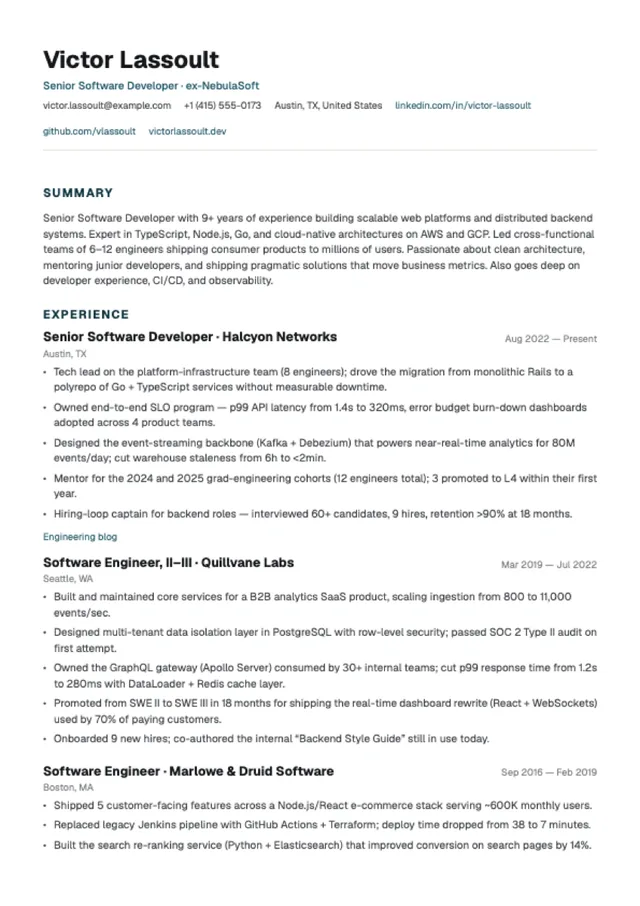
Customer Service & Support resume FAQ
What metrics should a customer service resume include?
The weekly scorecard: quality score, first-contact resolution, CSAT, escalation rate, SLA attainment, handle time and volume — each with the target or team average beside it. Without a benchmark the reader cannot tell whether a number is good.
What if I do not know my exact numbers?
Use ranges you can defend, or the qualitative version with the mechanism: 'consistently in the top quartile on quality', 'promoted from seasonal after one quarter on quality scores'. If you are still in the role, ask your supervisor for the last quarter's figures before you apply — they are usually happy to share them.
Is this function shrinking because of AI?
Partly. Both major occupations here are projected to decline slightly through 2034 as self-service absorbs routine contacts, and both still generate very large numbers of annual openings because turnover is high. The practical consequence is that the simple contacts go first, so the resume should emphasize the harder ones — escalations, regulated queues, root-cause work — and anything you automated.
How do I move from customer service into IT?
Technical support is the standard bridge. Get CompTIA A+, build a home lab you can describe specifically, and mine your current role for the technical work you already do. Then, once you are on a help desk, write the automation and documentation half of the job — that is what moves people into systems, cloud and security.
Does the resume layout matter here?
More than in most functions, because these postings attract hundreds of applications and are filtered by software before a person sees them. Keep it single-column and plain — we tested 36 layouts through four production parsers and found decorative templates are where the text order breaks.
Other job functions
Build it on a template that has been through a real parser.
Unwatermarked PDF export, no subscription, and a score against any posting when you want one.
Build my resume