
Legal resumes are read by lawyers, and they read for what you should not have written.
Every other function screens for what you achieved. Legal screens for judgment about disclosure — because the person reading has professional obligations you are about to demonstrate you either understand or do not. A matter described with a client name, a verb that implies you gave legal advice when you are not admitted, a license stated without a jurisdiction: each one answers a question the interview was going to ask, in the wrong direction. Get those right and the rest of the resume is ordinary work.
- Roles covered
- 3 guides
- Screened on
- License, then judgment
- Matters
- Described, never named
- Reader
- A practising lawyer
Reflects US legal hiring practice as reviewed in 2026. Licensure, title regulation and the definition of unauthorized practice are state-specific — California, for instance, regulates who may use the paralegal title by statute. Always check your own jurisdiction before writing the credential block.
Your verbs declare what you are licensed to do
In this function the difference between 'advised the client' and 'drafted the advice memorandum under partner supervision' is not style — it is a claim about your license. Non-lawyers who write advisory verbs are describing the unauthorized practice of law, and a hiring attorney reads that as a liability rather than ambition. Lawyers face the mirror-image problem: verbs that overstate seniority ('managed all aspects of the litigation') get tested by someone who has done the job. Write the verb that matches your actual authority, and the whole page becomes credible.
What every legal resume has to prove
License or qualification, with jurisdiction and status
For attorneys: every bar admission with year and status, plus federal court admissions. For paralegals and legal assistants: the certificate, the ABA-approved program, and — in California — the §6450 qualification the title legally requires. This block is checked before anything else, and vagueness reads as evasion rather than modesty.
Matters described by scale, never by identity
'A $40M contract dispute in federal court for a logistics client' tells the reader everything. Naming the client tells them something about you instead. Confidentiality obligations outlive the engagement and bind support staff as well as lawyers — the publicly filed and reported matter is the narrow exception, and even then ask what naming adds.
Volume in the units the business runs on
Caseload, matters managed, depositions taken, deals closed, filings and their on-time record, documents reviewed, billable hours against a target. Legal work is unusually measurable and legal resumes are unusually reluctant to measure it. A met billable target and a clean deadline record are both checkable and both rare on the page.
The platforms, named exactly
Westlaw, Lexis+, Relativity, Everlaw, Clio, iManage, NetDocuments, PACER and CM/ECF. Firms filter on the specific product because switching costs are real, and 'legal software' matches nothing at all.
Legal resume examples by role
Each guide has a full annotated example, summaries by seniority and the keywords that role is filtered on.
Bullets that get read, and the ones that do not
Same experience, rewritten. The difference is always the same thing: something a reader can check.
Advised clients on contract issues and negotiated favourable terms.
Drafted contract-review memoranda and negotiation positions for partner review across a 40-agreement portfolio; the counterparty accepted our indemnity language in 8 of 11 disputed clauses.
Why: The first version claims the practice of law. The second describes the same work accurately, adds volume and an outcome — and is safe whether you are admitted or not.
Worked on a high-profile case for a major client.
Supported a $40M breach-of-contract matter in federal court for a national logistics operator — managed a 1.2M-document review and the privilege log through production.
Why: 'High-profile' is an invitation to guess who. Scale, forum and industry give the reader more information and disclose nothing.
Responsible for managing case files and deadlines.
Held the deadline calendar for 70+ active matters in Clio across four years with zero missed filings; rewrote the e-filing checklist after two near-misses.
Why: In a statute-of-limitations business, a clean record over a stated caseload and period is the strongest evidence available — and almost nobody quantifies it.
Experienced with legal research and document management software.
Daily in Westlaw and Relativity; administered the Relativity workspace for two productions, including TAR review protocols and Bates numbering.
Why: Names the products a filter searches for and shows depth in them. Generic tool categories match no posting and impress no reader.
Keywords that recur across legal postings
Function-wide terms, not role-specific ones. Mirror them verbatim when the posting uses them — filters match strings, not meaning.
| Keyword | Priority |
|---|---|
| legal research (Westlaw, Lexis+) | High |
| litigation support | High |
| document review | High |
| drafting (pleadings, discovery, contracts) | High |
| e-discovery (Relativity, Everlaw) | High |
| case management (Clio, iManage) | High |
| court e-filing (PACER, CM/ECF) | High |
| due diligence | High |
| docket and deadline management | Medium |
| trial preparation | Medium |
| regulatory compliance | Medium |
| contract lifecycle management | Medium |
| billable hours | Medium |
| confidentiality / privilege | Medium |
How the resume changes as you move up
Legal assistant / support
Reliability is the product: matters on the calendar, filings and their rejection rate, attorneys supported, billing turnaround. Name the systems and keep every verb inside the supervision line.
Paralegal
Substantive support becomes the story — drafting under supervision, discovery management, e-discovery platform depth, deposition summaries, billable hours. Certification and, in California, statutory qualification belong up top.
Associate attorney
Admissions, practice area and level markers: what you drafted, argued, took, defended or closed. Precision about your role beats scale of matter — a partner is calibrating what you can be trusted with unsupervised.
Senior associate, counsel and in-house
Judgment and ownership: matters run end to end, clients handled directly, juniors supervised, outside counsel and budget managed, risk decisions taken. In-house adds business partnering — turnaround times, playbooks, spend control.
How these resumes actually get filtered
Large firms and corporate legal departments run applications through applicant tracking software like anyone else, so practice areas and platform names have to appear in the exact words the posting uses. After that the reader is a practising lawyer or a legal-operations professional, and the review is unusually literal: dates checked, admissions verified, level markers tested against the years claimed. It is also the one function where a candidate can be removed for what they included rather than what they left out — a named client, an advisory verb from an unlicensed writer, a matter detail that identifies someone. Write for the filter, then read the page once more as a compliance question.
See what four real ATS parsers did with 36 resume layoutsMistakes specific to legal resumes
Non-lawyers using advisory verbs
'Advised', 'negotiated', 'represented' describe the practice of law. Use drafted, prepared, coordinated, managed — and say 'under attorney supervision' where it applies.
Naming clients or unfiled matters
Describe by size, forum and industry. Confidentiality survives the engagement and binds support staff too; a leak on the resume is a work sample.
'Bar admitted' with no jurisdiction
Name every jurisdiction, the year and the status, plus federal admissions. Staffing decisions depend on it.
Treating 'legal assistant' and 'paralegal' as one job
Postings use them for two different roles with different pay. Read the duties, then mirror the employer's own title.
No numbers anywhere on the page
Caseload, filings, depositions, deals, review volume, billables, deadlines met. Legal work measures well and legal resumes rarely do it.
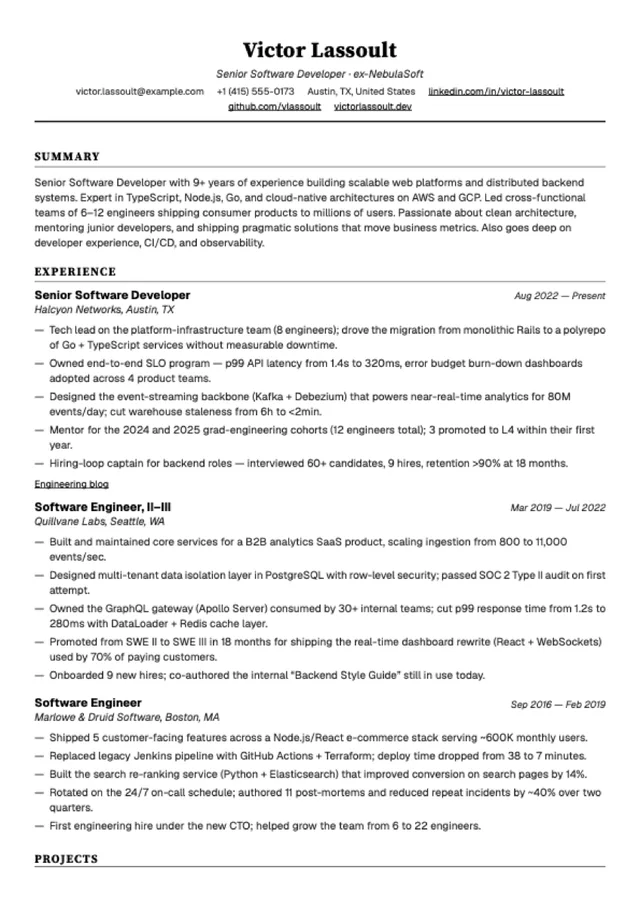
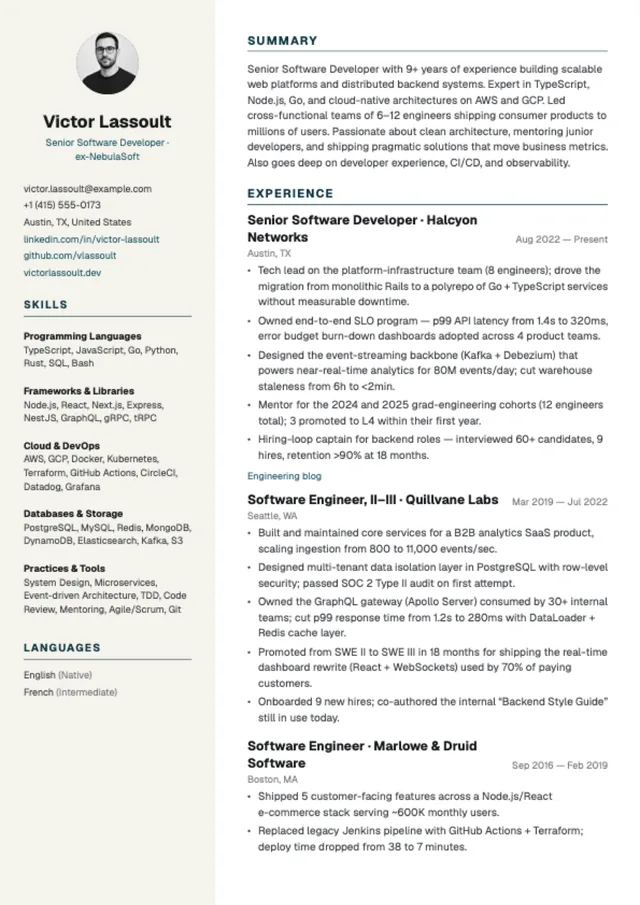
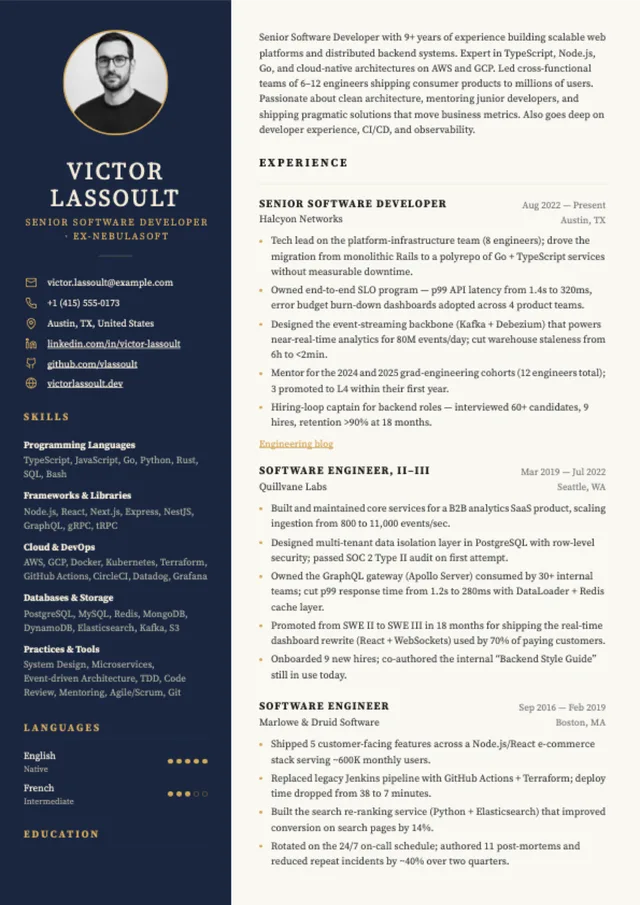
Templates that suit legal resumes
Legal resume FAQ
How do I describe legal work without breaching confidentiality?
Use size, forum, posture and industry instead of names: 'a $40M contract dispute in federal court for a logistics client'. Confidentiality obligations survive the engagement and extend to paralegals and support staff, not just attorneys. Publicly filed and reported matters are the exception — and even then, ask whether naming adds anything the description did not.
What is the difference between a paralegal and a legal assistant?
The industry has been separating them — paralegal for substantive legal support, legal assistant drifting toward administrative work — but postings still use both loosely for both jobs. Read the duties, not the title, and mirror whichever word the employer used so the filter and the reader both match you.
Where do bar admissions and certifications go?
In the top third, and for attorneys also in the contact line. Jurisdiction, year, status, plus federal court admissions. For paralegals, the certification body and year — and in California the statutory qualification, because the title is legally regulated there.
Do billable hours belong on a legal resume?
For firm roles, yes — a stated target met or exceeded shows you understand how the business makes money. For in-house, government and public-interest roles, use caseload, deal count, turnaround or budget instead.
Does resume formatting matter in legal hiring?
More than people assume. Legal resumes are dense with dates, admissions and matter detail, which tempts candidates into compressed two-column layouts — and whether that survives parsing depends on the parser, not on how tidy it looks. We ran the same resume through four production systems in 36 layouts and published which ones came out with the sections in the right order.
Other job functions
Build it on a template that has been through a real parser.
Unwatermarked PDF export, no subscription, and a score against any posting when you want one.
Build my resume