
Marketing resumes fail on attribution, not on ambition.
Every marketing resume claims growth. Very few explain what the writer actually did to cause it, over what period, from what baseline. Hiring managers in this function have all seen a campaign take credit for a number the product or the market produced — so they read defensively. The resumes that work are the ones that draw a straight line from a decision you made to a movement you can defend, and admit where the line is dotted.
- Roles covered
- 4 guides
- Screened on
- Attributable results
- Typical length
- 1–2 pages
- Portfolio
- Expected for creative
Reflects general practice in US and European marketing hiring as reviewed in 2026. Channel norms shift quickly — treat platform-specific expectations as the most perishable part of this page.
Show the baseline, the change, and your part in it
'Grew organic traffic 240%' means nothing without the starting point — from 400 sessions a month it is a rounding error, from 80,000 it is a career highlight. Write the baseline and the window: 'organic sessions from 12k to 41k a month over 14 months'. Then name your contribution honestly. 'I owned the content program; paid and PR were running alongside' costs you nothing and buys you the reader's trust for every other number on the page.
What every marketing and creative resume has to prove
Baselines and windows, not naked percentages
Every growth claim needs a from, a to and a period. A percentage on its own is the most inflatable number in marketing, and experienced readers discount it automatically.
The channel and the budget you actually ran
Spend under management is the fastest way to calibrate a marketer. '£40k/month across Google and Meta' places you instantly. So does the absence of a budget — owning organic and lifecycle on no spend is a different, equally legible skill.
Work someone can look at
Designers, writers and social managers are hired on the work. A portfolio link belongs in the contact line, not buried at the end, and it should open onto three strong pieces rather than forty. For each, say what the brief was and what happened.
Honest attribution
Say how you measured it — last-touch, a holdout test, a self-reported survey question, or a directional read. Marketers who name their measurement method read as senior, because juniors rarely know there is a choice.
Marketing & Creative resume examples by role
Each guide has a full annotated example, summaries by seniority and the keywords that role is filtered on.
Marketing Manager
Marketing manager resume examples that market the marketer.
See the exampleSocial Media Manager
Social media manager resume examples that tie posts to revenue.
See the exampleContent Writer
Content writer resume examples that show results, not adjectives.
See the exampleGraphic Designer
Graphic designer resume examples — the data document your portfolio deserves.
See the example
Bullets that get read, and the ones that do not
Same experience, rewritten. The difference is always the same thing: something a reader can check.
Increased website traffic by 240% through SEO.
Took organic sessions from 12k to 41k a month over 14 months by rebuilding the site's category pages and publishing 60 comparison articles; paid search was flat across the period.
Why: Baseline, window, mechanism — and the last clause rules out the obvious alternative explanation, which is what makes the claim survive an interview.
Managed social media accounts and grew the following.
Ran four channels for a 90k-follower B2B brand; shifted LinkedIn from reposts to original video, which took average post reach from 2.1k to 9.4k and produced 30–40 inbound demo requests a quarter.
Why: Followers are vanity; reach and inbound are the numbers a manager is judged on. Note the honest range on the last figure.
Created marketing materials for various campaigns.
Designed the launch system for a hardware product — landing page, six paid variants, packaging insert and trade-show stand. The winning ad variant halved cost per lead versus the previous quarter's creative.
Why: Names the artefacts and the one result design can legitimately claim. Vagueness in a creative bullet reads as work you cannot show.
Responsible for the email newsletter.
Rewrote a 45k-subscriber newsletter around one story per send; open rate 22% → 34%, unsubscribes unchanged, and it became the second-largest source of trial signups.
Why: Reporting the metric that did not move (unsubscribes) is what stops the improvement looking like it was bought with subject-line tricks.
Keywords that recur across marketing and creative postings
Function-wide terms, not role-specific ones. Mirror them verbatim when the posting uses them — filters match strings, not meaning.
| Keyword | Priority |
|---|---|
| Campaign management | High |
| SEO | High |
| Content strategy | High |
| Google Analytics (GA4) | High |
| Paid social / PPC | High |
| Email marketing / lifecycle | High |
| Brand positioning | High |
| A/B testing | Medium |
| Marketing automation (HubSpot) | Medium |
| CRO | Medium |
| Adobe Creative Suite / Figma | Medium |
| Copywriting | Medium |
| Budget management | Medium |
| Stakeholder reporting | Medium |
How the resume changes as you move up
Coordinator / assistant
Execution volume and reliability: campaigns shipped, channels supported, assets produced, tools you can operate unsupervised. One or two small owned results are enough at this stage.
Specialist / manager
Own a channel and its number. This is where budget under management, baselines and attribution method start to matter, and where a portfolio or a body of published work carries real weight.
Senior / head of channel
Strategy and trade-offs: what you chose not to fund, how you allocated across channels, what the mix looked like before and after. Show mentoring and agency or freelancer management.
Marketing leadership
Pipeline contribution, CAC and payback, team structure, positioning work. The page should read as commercial rather than creative — creative directors are the exception, where the work itself stays front and center.
How these resumes actually get filtered
Marketing postings attract very high volume, so the first cut is usually a keyword match on channels and platforms, and the second is a skim for numbers with context. Creative roles add a third gate that outranks both: the portfolio. If the work is strong the resume becomes a formality, and if the link is broken the resume rarely saves it. Worth knowing for designers specifically — a heavily styled resume is the one most likely to be mangled in parsing. We tested 36 layouts through four production parsers and published which survived, because 'looks beautiful' and 'reads correctly' turned out to be independent properties.
See what four real ATS parsers did with 36 resume layoutsMistakes specific to marketing and creative resumes
Percentage growth with no starting number.
Always give the from and to. Readers assume an unstated baseline was tiny, and they are usually right.
Claiming a company-wide result as personal.
Scope it to your channel and say who else was running. Overclaiming is the fastest way to lose a marketing interview, because the follow-up question is always 'how did you isolate that?'
A portfolio link that needs a password or is 404.
Check it the day you apply. A dead link in a creative application is read as a work sample in itself.
A resume designed so heavily that it stops being parsed.
Designers lose this one most often — text set as an image, or a layout whose text stream comes out scrambled. Prove taste in the portfolio; keep the resume readable by machines.
Listing every tool in the martech stack.
Name the ones you would be comfortable admin-ing. A long tool list with no depth signals a coordinator applying for a manager role.
Templates that suit marketing and creative resumes
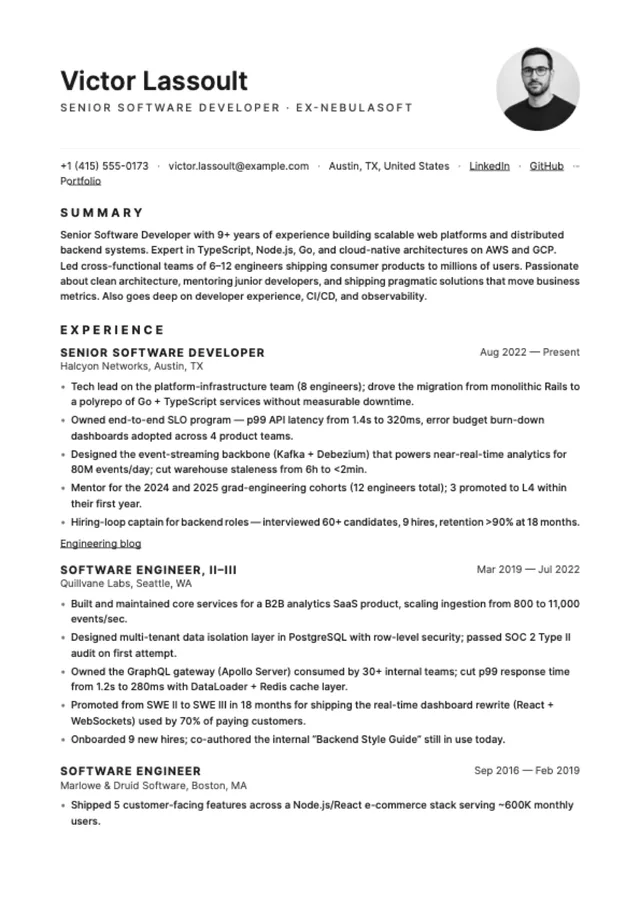
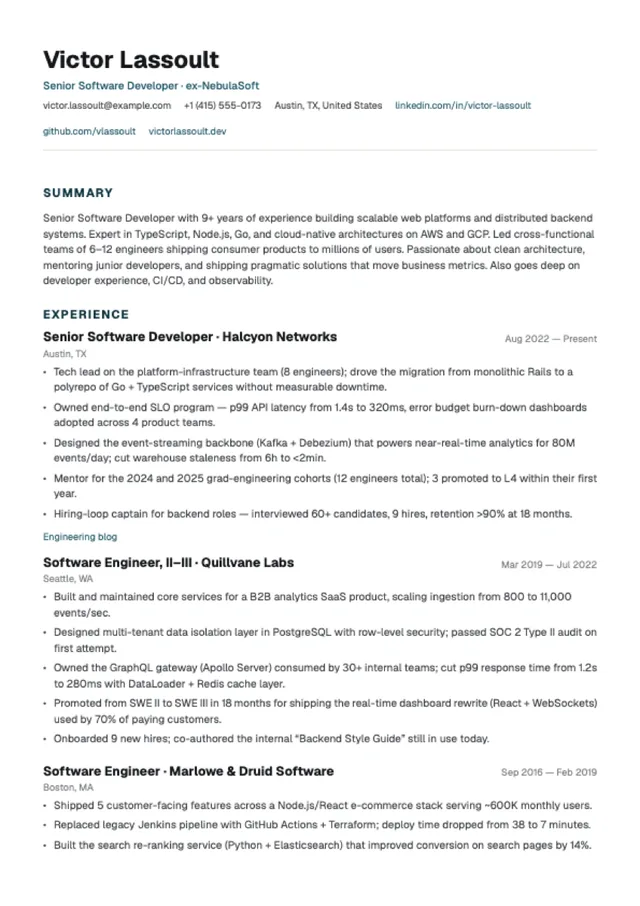
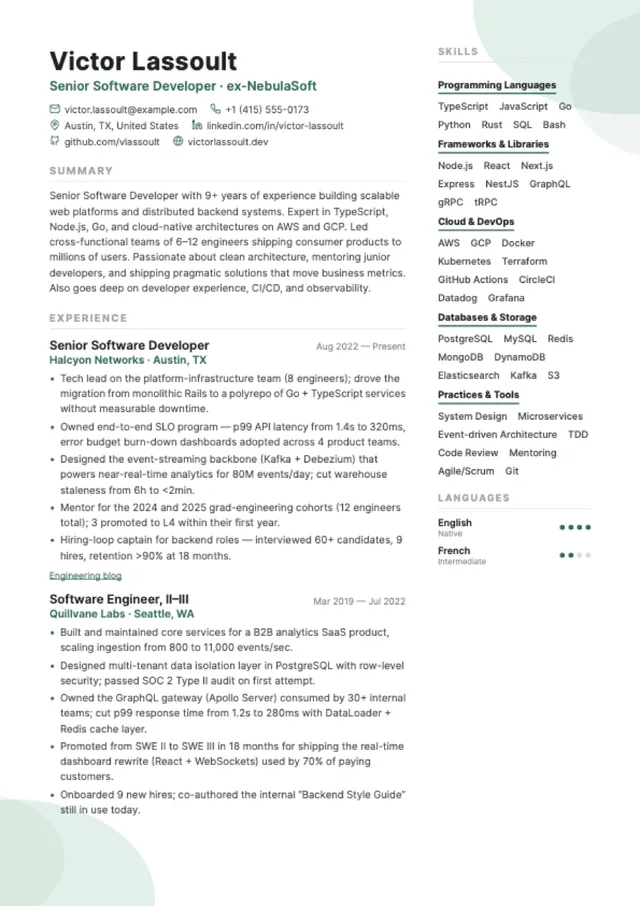
Marketing & Creative resume FAQ
How do I show results when marketing attribution is messy?
Say how you measured it. 'Last-touch in GA4', 'a two-week geo holdout', 'self-reported on the signup form' — naming the method is more persuasive than a confident number with no provenance, and it is the answer the interviewer was going to ask for anyway.
Should a designer's resume be heavily designed?
Restrained. It should show competent typography and hierarchy, and nothing else — the portfolio carries the creative argument. Text baked into an image or a layout that scrambles when parsed loses you applications you never hear about.
What goes in a marketing portfolio?
Three to five pieces, each with the brief, your role and the outcome. Case studies beat galleries. If you worked on a team, say which parts were yours — the honesty reads as senior.
Are certifications like Google Ads or HubSpot worth listing?
Worth a line, not a section. They clear a keyword filter and show initiative early in a career; they carry little weight once you have channel results to show for yourself.
How do I write a marketing resume with no agency or in-house experience?
Run something real and small: a freelance client, a side project, a volunteer campaign for a local organization. Then write it exactly like a job, with baseline, window and result. One genuine campaign with honest numbers beats a stack of certificates.
Other job functions
Build it on a template that has been through a real parser.
Unwatermarked PDF export, no subscription, and a score against any posting when you want one.
Build my resume