
Social worker resume examples that honor the work — and the confidentiality.
A social work resume carries two constraints most professions never face: the license tier decides which doors open at all, and confidentiality shapes every line you're allowed to write. The answer to both is the same discipline the job itself demands — precision. Your exact credential in the header (LCSW, LMSW, or license-in-progress, in your state's naming), and impact shown through aggregates: caseload size, families served, readmissions reduced — never an identifiable client. This guide maps the BSW→MSW→LCSW ladder honestly, gives each segment its own metric palette, and treats the hard parts of this profession with the respect they deserve.
- Ideal length
- 1 page (2 senior)
- The gate
- License tier (in header)
- The rule
- Aggregates, never clients
- Outlook
- +6% (~74K openings/yr)
Maya Castillo
Licensed Clinical Social Worker (LCSW)
Chicago, IL · LCSW, Illinois (in good standing)
Summary
Licensed Clinical Social Worker with 9 years across hospital and community mental health: a 45-client caseload of biopsychosocial assessments and treatment planning, discharge coordination that cut 30-day readmissions on my unit, and individual and group therapy grounded in CBT and motivational interviewing. Meticulous on documentation and HIPAA, steady in crisis, and honest about what this work costs and why it matters. Every number below is an aggregate — my clients' stories stay theirs.
Experience
Clinical Social Worker (LCSW) · Northside Community Health
2022 — Present
- Carry a caseload of ~45 adults in outpatient behavioral health: biopsychosocial assessments, treatment planning, and individual therapy (CBT, motivational interviewing).
- Facilitate two weekly therapy groups (10–12 members each) with outcome measures improving in aggregate across cohorts.
- Maintain 100% documentation compliance in Epic across audits, with case notes completed within 24 hours.
- Provide crisis intervention and safety planning, coordinating with psychiatry and community resources on same-day escalations.
Medical Social Worker (LMSW → LCSW) · St. Augustine Medical Center
2018 — 2022
- Coordinated ~25 discharges a week on medical-surgical units — care transitions, Medicaid/Medicare navigation and community referrals — contributing to a 19% drop in 30-day readmissions.
- Completed 3,000 supervised clinical hours and passed the ASWB Clinical exam to earn LCSW licensure (2021).
- Served on the interdisciplinary team for complex cases, documenting care plans in Epic.
Case Manager (BSW) · Harbor Family Services
2016 — 2018
- Managed a 35-family caseload of resource linkage, home visits and mandated-reporting duties, meeting 100% of state-required visit timelines.
Skills
Education
MSW — University of Illinois Chicago · BSW — Loyola University Chicago (CSWE-accredited)
Certifications
Licensed Clinical Social Worker (LCSW), Illinois · ASWB Clinical exam · CEUs current
Why this example works
The license leads — spelled out, state named
“Licensed Clinical Social Worker (LCSW), Illinois” in the headline, contact line and certifications — acronym and full form both, because a required-license knockout is the one real auto-reject in this field, and screens search both strings.
Impact without a single client detail
45-client caseload, ~25 discharges a week, 19% readmission drop, 100% documentation compliance — every number is an aggregate. No names, no initials, no describable cases. That discipline isn't just ethics; to a hiring manager it's evidence of judgment.
The ladder shown honestly
BSW case manager → LMSW medical social worker → supervised hours → LCSW. The progression itself is the qualification, and the “3,000 supervised hours, ASWB Clinical passed” line tells the exact story every social work employer knows how to read.
Social Worker resume summary examples
Three to four lines: scope, stack or specialism, one quantified win. Match the register to your seniority.
BSW entry / case manager
BSW case manager (CSWE-accredited) with 3 years in community services: a 35-family caseload of resource linkage, benefit navigation and home visits, with 100% compliance on state-mandated timelines and documentation. Steady with families in crisis, precise with case notes, and clear about scope — generalist practice done well, with an MSW on the horizon. Every metric here is an aggregate; client stories stay confidential.
Child & family social worker
Child and family social worker with 6 years in child welfare: a 35–40 case caseload, permanency outcomes I'm quietly proud of (12 reunifications or adoptions across 18 months), and 100% home-visit timeline compliance under court oversight. Trauma-informed, unshakeable in mandated-reporting duties, and experienced with CPS and juvenile court collaboration. This is heavy work; I do it with rigor and stay.
School social worker
School social worker (MSW, state DOE-certified) supporting a 60-student caseload across two buildings: IEP and 504 collaboration with special education teams, attendance interventions that moved chronic absenteeism down measurably, and family engagement that keeps plans working at home. Fluent in MTSS and crisis response on campus. The academic calendar is my clinical calendar — and my documentation is audit-ready.
Healthcare / hospital social worker
Medical social worker (MSW, LCSW) with 7 years in acute care: ~25 discharges a week of care transitions, Medicaid/Medicare navigation and community referrals, contributing to a measurable drop in 30-day readmissions on my units. Interdisciplinary to the core — nursing, case management, psychiatry — and fast, complete in Epic. High-throughput hospital social work is its own craft, and my numbers show it.
Hospice social worker
Hospice social worker (MSW) with 5 years on interdisciplinary teams serving 60+ families a year through end-of-life care: psychosocial assessments, advance-care planning, grief and bereavement support, and a bereavement program I helped launch with grant funding. Compliant with IDG documentation requirements and present in the hardest rooms. This work asks for steadiness and boundaries; I bring both.
Clinical LCSW / therapist
Licensed Clinical Social Worker in outpatient practice: ~25 weekly individual sessions plus two therapy groups, grounded in CBT, DBT skills and motivational interviewing, with DSM-5-TR diagnostic responsibility and aggregate outcome measures trending the right way. Paneled with major insurers, telehealth-fluent, documentation always current. Independent clinical practice is the tier the whole ladder climbs toward — I'm there, and my caseload holds.
Skills that belong on a social worker resume
Clinical & assessment
- Biopsychosocial assessment
- Treatment planning
- Crisis intervention
- CBT · DBT · MI (clinical)
- Trauma-informed care
- DSM-5-TR (clinical tier)
Case & care coordination
- Case management
- Community resources / referrals
- Discharge planning (healthcare)
- Medicaid / Medicare
- IEP / 504 (school)
- Advocacy
Compliance & systems
- Documentation / case notes
- HIPAA / confidentiality
- Mandated reporting
- EHR (Epic, Cerner)
- Interdisciplinary teams
- Caseload management
Bullet point formulas that get interviews
Fill the brackets with your numbers — the structure does the selling.
- Carry a caseload of [n] — e.g. “45 outpatient clients” / “35–40 child-welfare cases” (the field's scope metric).
- Coordinate [n] discharges/transitions weekly — e.g. “~25 discharges a week across med-surg units.”
- Reduce readmissions [x]% — e.g. “contributed to a 19% drop in 30-day readmissions” (healthcare).
- Achieve permanency outcomes — e.g. “12 reunifications or adoptions across 18 months” (child welfare).
- Meet [x]% of mandated timelines — e.g. “100% of state-required home-visit deadlines.”
- Hold [x]% documentation compliance — e.g. “100% across audits, notes within 24 hours, in Epic.”
- Facilitate [n] groups of [m] members — e.g. “two weekly therapy groups of 10–12.”
- Serve [n] clients/families per week/year — e.g. “40 intake assessments weekly” / “60+ hospice families annually.”
- Secure $[amount] in grants — e.g. “$85K to launch a bereavement program” (program roles).
- Move an aggregate outcome — e.g. “school attendance up 18% on my caseload” (never an individual's story).
ATS keywords for social worker roles
Filters match tokens from the posting. These are the terms worth mirroring — verbatim — when they appear in the job ad.
| Keyword | Priority |
|---|---|
| license spelled out + acronym — Licensed Clinical Social Worker (LCSW), LMSW, BSW, MSW | High |
| case management | High |
| biopsychosocial assessment (spell it out once) | High |
| treatment planning / care planning | High |
| crisis intervention | High |
| documentation / case notes — pair with the EHR name (Epic) | High |
| community resources / referrals | High |
| HIPAA / confidentiality | High |
| advocacy (weak alone — pair with an outcome) | High |
| trauma-informed care | High |
| discharge planning · Medicaid/Medicare · readmissions (healthcare) | Medium |
| CBT · DBT · motivational interviewing · DSM-5-TR (clinical) | Medium |
| child welfare · mandated reporting · permanency · home visits | Medium |
| IEP · 504 · special education · MTSS (school) | Medium |
| interdisciplinary team (IDT/IDG) · grief/bereavement (hospice) | Medium |
| caseload size (as a number) · group facilitation | Medium |
Don't guess — score your resume against the specific posting and see exactly which terms are missing.
How to write a social worker resume
Put your exact license tier in the header
The license is the one true knockout filter in social work hiring — postings requiring an LCSW screen for it before anything else. Put your exact credential beside your name, spelled out and abbreviated (“Licensed Clinical Social Worker (LCSW)”), with your state — and use your state's actual naming (LICSW in Washington and Massachusetts, LCSW-C in Maryland). If you're between tiers, say so precisely: “LMSW; accruing supervised clinical hours toward LCSW (~2,000 of 3,000, Illinois).” Trajectory stated plainly is a strength, not an apology.
Quantify with aggregates — never with clients
Confidentiality is this field's defining resume constraint: no names, no initials, no describable cases, ever. The honest workaround is volume and outcomes in aggregate — caseload size, discharges per week, permanency outcomes across a period, readmission percentages, documentation-compliance rates, group sizes, program reach. “Reduced 30-day readmissions 19% across ~25 weekly discharges” proves impact with zero client detail — and the discipline itself reads as clinical judgment to the people hiring you.
Write for your segment's scoreboard
Each branch of social work has its own metrics. Child welfare: permanency outcomes, visit-timeline compliance, court collaboration. Healthcare: discharges per week, readmission reduction, Medicaid/Medicare navigation, Epic. School: IEP/504 collaboration, attendance and behavioral outcomes, your state DOE certification. Clinical: session volume, modalities (CBT, DBT, MI), aggregate outcome measures. Hospice: families served, IDG documentation, bereavement programming. Borrowed metrics read off-target — use your segment's.
Show the ladder — including the rungs in progress
BSW → MSW → supervised hours → ASWB Clinical exam → LCSW is a story every social work employer reads fluently, so tell yours precisely: CSWE-accredited degrees, the license you hold, the hours you're accruing. A gap year in a field with this emotional load is common and defensible — date it, add one factual line if you want, and let current CEUs and licensure carry your currency. No over-explaining. The profession understands; the resume just needs to be honest and current.
Keep the format as careful as your case notes
Single column, standard headings, credentials formatted consistently (LCSW, not L.C.S.W. in one place and LCSW in another) — in a compliance-heavy profession, a sloppy resume undercuts the core competency. Mirror the posting's exact terms (“discharge planning,” “biopsychosocial assessment”), name your EHR, and skip the “75% of resumes get auto-rejected” myth some keyword sites still repeat: screening systems rank and surface, humans decide. The real auto-reject is a required-license question — which is exactly why the license leads.
Skip the blank page.
Build this resume in Resumap — free templates, unwatermarked PDF, and an ATS check against the exact posting when you're ready.
Start freeMistakes that filter social workers out
License or tier missing from the header
The field's #1 error. LCSW, LMSW, or “LMSW (LCSW-eligible)” beside your name, spelled out once, state named — it's the first and sometimes only screen.
Any identifiable client detail
Names, initials, describable cases — a confidentiality breach on the resume itself signals poor judgment. Aggregates only, always.
Vague “helped clients” language
“Passionate advocate who helped families” is interchangeable. A 40-case caseload with 100% visit compliance is you.
No caseload or volume numbers
Social work is measurable in aggregates. Absence of numbers reads as inexperience — count what confidentiality lets you count.
Duties instead of outcomes
“Provided case management” describes the field. Readmissions down, permanency achieved, timelines met — those describe your practice.
Inconsistent credential formatting
Mixing “L.C.S.W.” and “LCSW,” misspelling ASWB or CSWE — detail errors in a compliance profession cost trust. One format, proofread.
ATS-hostile layouts
Multi-column templates and text-in-graphics garble parsing. Clean single column, standard headings, both forms of every license.
Social Worker salary ranges (US)
United States market. Absolute figures differ by country — the gaps between levels travel better than the numbers.
| All social workers, median (BLS, May 2024) | $61,330/yr |
| Child, family & school (21-1021) | $58,570 median |
| Healthcare (21-1022) | $62,940 median |
| Mental health & substance abuse (21-1023) | $60,060 median |
| 90th percentile / psychiatric settings | $99,500+ (LCSW premium) |
BLS tracks social workers under four codes: the combined median was $61,330/year in May 2024 — child, family and school social workers $58,570; healthcare $62,940 (the often-quoted $68,090 is the mean, not the median); mental health and substance abuse $60,060 — with the overall range from under $41,580 (10th percentile) to over $99,500 (90th). Growth is +6% through 2034 with ~74,000 openings a year. The clearest pay levers: clinical licensure (LCSW unlocks insurance billing and private practice; psychiatric settings pay toward the top), setting (hospital > nonprofit), and state — California healthcare medians run ~$93K.
Primary source: U.S. Bureau of Labor Statistics (OEWS/OOH). Self-reported aggregator figures are labelled as such.
Certifications worth listing
- The degree floor: BSW (CSWE-accredited) for generalist entry; MSW (CSWE-accredited) required for the clinical track and most hospital, hospice and school roles
- License tiers vary by state — bachelor's-level (LBSW/LSW where offered), master's-level (LMSW/LSW/LGSW), and clinical (LCSW — called LICSW, LCSW-C or LISW-CP in some states); always list your state's exact credential
- LCSW is the clinical prize: MSW plus roughly 3,000 supervised post-MSW clinical hours over 2+ years (state range ~2,000–6,400) plus the ASWB Clinical exam — the only tier that practices therapy independently, bills insurance and opens private practice
- School social work usually adds a state Department of Education certification/endorsement tied to IEP service authority
- Case-management certifications (CCM, or NASW's C-SWCM) differentiate in case-manager and healthcare lanes — helpful, never gates
Templates that fit social worker resumes
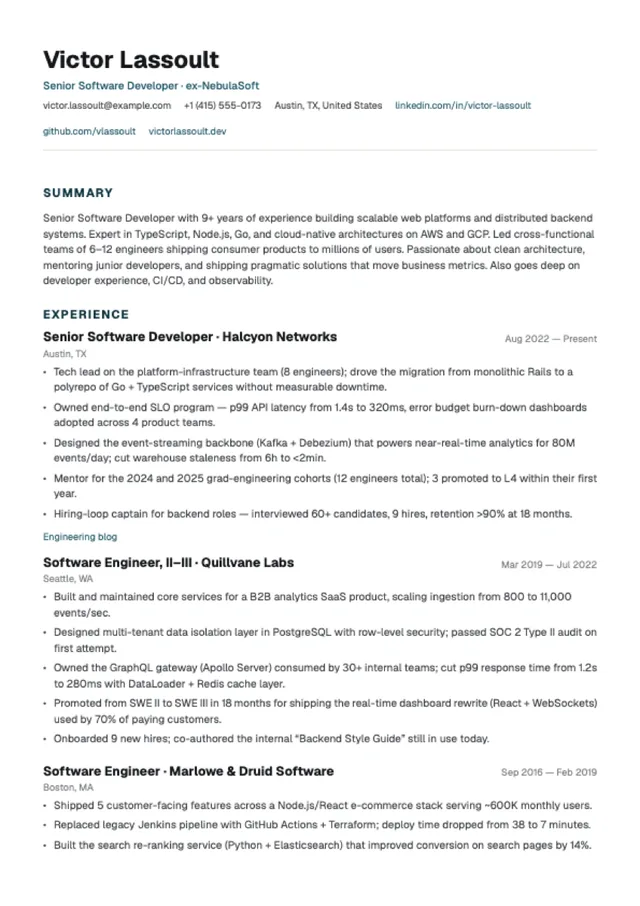
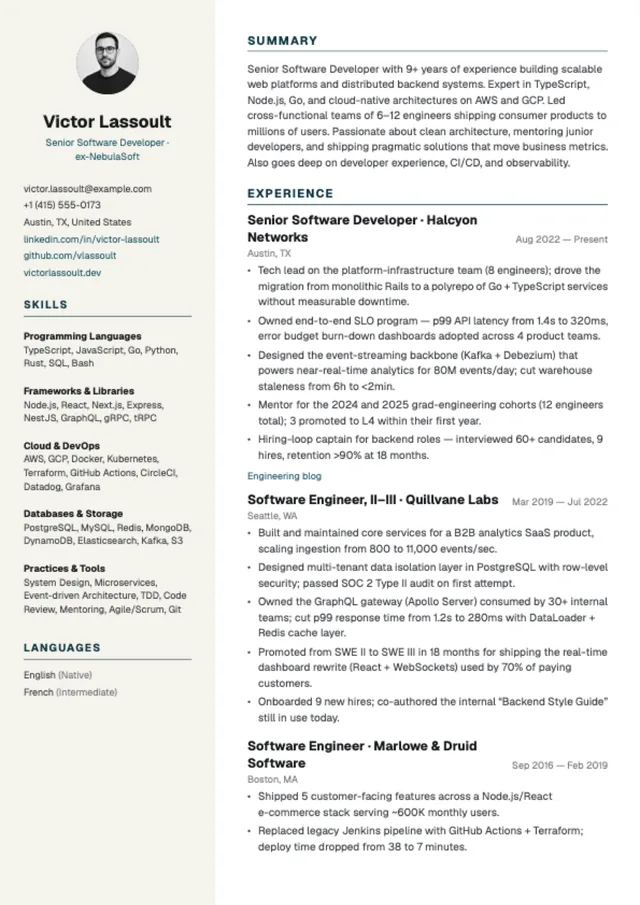
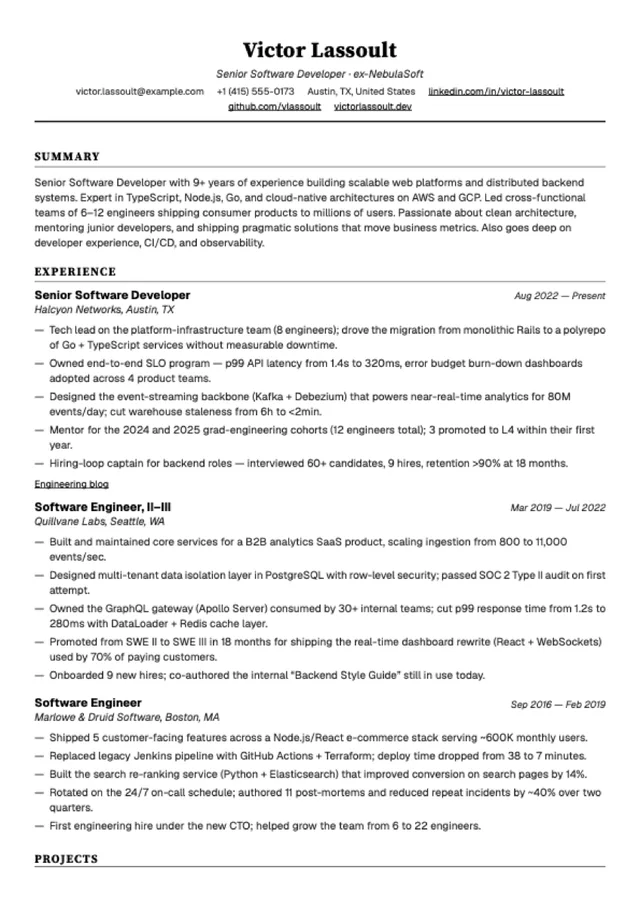
Social Worker resume FAQ
What's the difference between a BSW, an MSW and an LCSW?
It's a ladder of degree and license, not just titles. A BSW (bachelor's, CSWE-accredited) qualifies you for generalist practice — case management, community services. An MSW (master's) is required for the clinical track and most specialized healthcare, hospice and school roles, and lets you sit the ASWB Masters exam for LMSW-tier licensure. The LCSW (clinical licensure) requires the MSW plus roughly 3,000 supervised post-MSW clinical hours — the exact number and structure vary by state — plus the ASWB Clinical exam. Only the LCSW tier practices psychotherapy independently, bills insurance and opens a private practice. Your resume should state exactly which rung you're on, in your state's naming.
How do I show impact without violating client confidentiality?
Quantify in aggregates and never in individuals. Caseload size, clients or families served per week or year, discharges coordinated, permanency outcomes across a period, readmission-rate changes, documentation-compliance percentages, group sizes, program reach and grant dollars — all of these prove impact with zero client detail. What never belongs on a resume: names, initials, diagnoses tied to a describable person, or any “the case where…” story. Beyond ethics, the discipline works in your favor: a hiring manager in this field reads clean aggregate metrics as evidence of exactly the judgment they're hiring for.
How do I list LCSW supervision hours in progress?
Plainly and precisely — it's a status every social work employer understands: “LMSW; accruing supervised clinical hours toward LCSW (approximately 2,000 of 3,000 completed, Illinois).” This tells them your current scope of practice, your trajectory, and roughly when you'll be independently licensed, all in one line. Keep the hours current as you go, and once you're licensed, drop the count and simply list the LCSW with your state. If your supervision includes specific clinical modalities, those belong in your skills — the hours line is about licensure math.
Is a burnout gap acceptable on a social work resume?
Yes — and this profession, more than most, understands why. Social work carries a documented emotional load, and employment gaps are common and defensible. Handle it factually: date the gap honestly, optionally add one brief line (“planned break; returned with current CEUs”), and let your recent licensure status and continuing education carry your currency. Don't over-explain or apologize — a paragraph of justification draws more attention than the gap itself. What hiring managers actually screen for is whether your license is in good standing and your practice is current.
How do I move between segments — say, child welfare to healthcare?
Translate the transferable clinical core, then add the destination's vocabulary. Crisis intervention, biopsychosocial assessment, case management, interdisciplinary collaboration and airtight documentation carry across every branch of social work. Then speak the target segment's language: for healthcare, that's discharge planning, care transitions, Medicaid/Medicare and Epic; for schools, IEP/504 and your state DOE certification. Lead your summary with the destination role, keep one or two translated proof points from your current segment, and consider a bridging credential like the CCM for healthcare case management.
How should I frame private practice on a resume?
As a real role with business scope: “Psychotherapist, Private Practice (LCSW)” with your modalities, populations served in general terms, aggregate weekly caseload, and the operational competencies private practice proves — insurance paneling, telehealth delivery, HIPAA-compliant records, billing. No client details, ever, and no need to explain why you ran a practice or why you're returning to agency work; a one-line factual framing suffices. Private practice reads as evidence of the profession's highest tier of autonomy — present it with that confidence.
Is it true that ATS software auto-rejects most resumes?
No — the “75% auto-rejected” figure traces to a 2012 sales pitch from a vendor that folded the next year, and some social work keyword sites still repeat it. Screening systems parse, store and rank resumes; humans make the decisions. The one real auto-reject in this field is a knockout question — “Do you hold an active LCSW?” — which is precisely why your license belongs in the header, spelled out and abbreviated so either search string matches. Beyond that: clean single-column formatting, your segment's exact terms, and the EHR named. Resumap's ATS check scores your parse and keyword match against a specific job.
More resume examples
Your social worker resume, done properly — free.
Unwatermarked PDF, ATS-safe templates, and a real score against any posting when you want it.
Build my resume