
Logistics resumes are read for license class, record and throughput.
This function screens on things that are either true or not. Which license class and endorsements you hold. What your driving record and safety history look like. What equipment you are certified on, and how much you moved per shift. Recruiters here are filling seats against a schedule, and the resumes that get called are the ones where those facts are visible in the first ten seconds.
- Roles covered
- 3 guides
- Screened on
- License + record
- Typical length
- 1 page
- Drivers
- Class, endorsements, miles
Reflects general US logistics hiring practice as reviewed in 2026. License classes, endorsements and hours-of-service rules are jurisdiction-specific — write yours exactly as issued.
The license line, the record, and what you moved
For drivers: class, endorsements, years held, and a plain statement of your record — 'CDL Class A, HazMat and Tanker endorsements, held since 2018; 340,000 accident-free miles, clean MVR'. For warehouse: the equipment you are certified on and the volume you handled — 'sit-down and reach forklift certified; picked 180–220 lines a shift at 99.7% accuracy'. These are the lines a logistics recruiter is scanning for, and everything else on the page is supporting material.
What every logistics and warehouse resume has to prove
License class and endorsements, exactly
CDL A or B, HazMat, Tanker, Doubles/Triples, Passenger, air brakes — plus when you got it and any restrictions. Endorsements are hard filters that route you to entirely different job pools and pay bands.
Safety record with a number attached
Accident-free miles, years without a preventable incident, MVR status, DOT inspection history, CSA-relevant clean record. Safety is the main cost driver in this function, which is why a specific record outperforms any adjective.
Equipment and freight type
Dry van, reefer, flatbed, tanker; 53ft trailers, doubles; sit-down, reach truck, order picker, cherry picker, pallet jack. Freight type changes the job as much as the vehicle does — reefer and flatbed are separate skills, not variations.
Throughput and accuracy
Deliveries or stops per day, on-time percentage, miles per week, lines or units picked per shift, pick accuracy, inventory variance. This is the productivity evidence that separates you inside a pile of otherwise identical resumes.
Logistics & Warehouse resume examples by role
Each guide has a full annotated example, summaries by seniority and the keywords that role is filtered on.
Bullets that get read, and the ones that do not
Same experience, rewritten. The difference is always the same thing: something a reader can check.
Drove a truck and delivered goods to customers.
OTR dry van and reefer, 48 states — around 2,800 miles a week, 340,000 accident-free miles, 98% on-time delivery over three years.
Why: Freight type, range, weekly miles, safety record and service level. Every one of those is a filter a driver recruiter applies.
Worked in a warehouse picking and packing orders.
Picked 180–220 lines a shift by RF scanner in a 300k sq ft distribution center; held 99.7% accuracy and trained six new pickers on the WMS.
Why: Rate, accuracy, facility scale and the system name. Pick accuracy is the number warehouse supervisors are judged on.
Operated a forklift and other warehouse equipment.
Certified on sit-down, reach and order picker; ran the receiving dock for 30–40 inbound trailers a week with no damage claims in two years.
Why: Names the classes, the volume and a damage record. 'Other equipment' tells a hiring supervisor nothing they can act on.
Made deliveries on time and provided good customer service.
Ran a 120-stop residential route in a 26ft box truck; averaged 96% on-time with under 0.5% damaged or misdelivered parcels.
Why: Stop count, vehicle class and two service metrics. Last-mile hiring runs on exactly these figures.
Keywords that recur across logistics and warehouse postings
Function-wide terms, not role-specific ones. Mirror them verbatim when the posting uses them — filters match strings, not meaning.
| Keyword | Priority |
|---|---|
| CDL Class A / Class B | High |
| DOT compliance | High |
| Hours of service (ELD) | High |
| Forklift certified | High |
| Safety compliance | High |
| Pre-trip / post-trip inspection | High |
| Route planning | High |
| Inventory management | Medium |
| WMS (warehouse management system) | Medium |
| Order picking / packing | Medium |
| Shipping and receiving | Medium |
| RF scanner | Medium |
| Loading and unloading | Medium |
| Cycle counting | Medium |
How the resume changes as you move up
Entry / no experience
Lead with the license or certification and your availability for shift patterns. Any physical, high-volume or safety-sensitive work counts — construction, agriculture, military, retail stockroom. Attendance and reliability are legitimate selling points here.
Experienced driver or picker
The record and the rate carry the page: miles, stops, accuracy, on-time, incident history. Add endorsements and equipment breadth — each one opens a different pool of jobs.
Lead / dispatcher / supervisor
Team size, shift throughput, scheduling, safety program participation, training delivered. The numbers move from your output to the shift's.
Operations management
Cost per unit shipped, labor planning, fleet utilization, inventory accuracy, DOT audit outcomes and turnover. Keep the license block — it still proves you came up through the work.
How these resumes actually get filtered
Driver and warehouse hiring is high-volume and compliance-heavy, so the front of the process is almost entirely mechanical: license class, endorsements, age and experience minimums, and location. DOT-regulated carriers then verify employment history and pull your motor vehicle record, which means dates and records on the resume should match what the check will find exactly. For warehouse roles the human read is short — a supervisor looking for equipment certifications, shift availability and a rate. Because so many applications arrive, the resume that puts license, record and rate in the top third gets contacted while better-qualified but vaguer ones do not.
See what four real ATS parsers did with 36 resume layoutsMistakes specific to logistics and warehouse resumes
Writing 'CDL' without the class and endorsements.
Class A and Class B are different jobs. Endorsements route you to different pay. Spell them all out with the issue date.
Saying 'excellent safety record' with nothing behind it.
Give the miles or the years, and say the MVR is clean if it is. It is checked either way, so the specific version costs you nothing.
Omitting the freight or facility type.
Reefer, flatbed, tanker, hazmat, cold storage, e-commerce fulfilment — these are not interchangeable, and the mismatch is why applications get passed over silently.
Leaving gaps between carriers unexplained.
Carrier changes are routine in this industry and DOT-regulated employers verify employment history anyway. Write the dates accurately and account for gaps in a clause.
A designed template with graphics and columns.
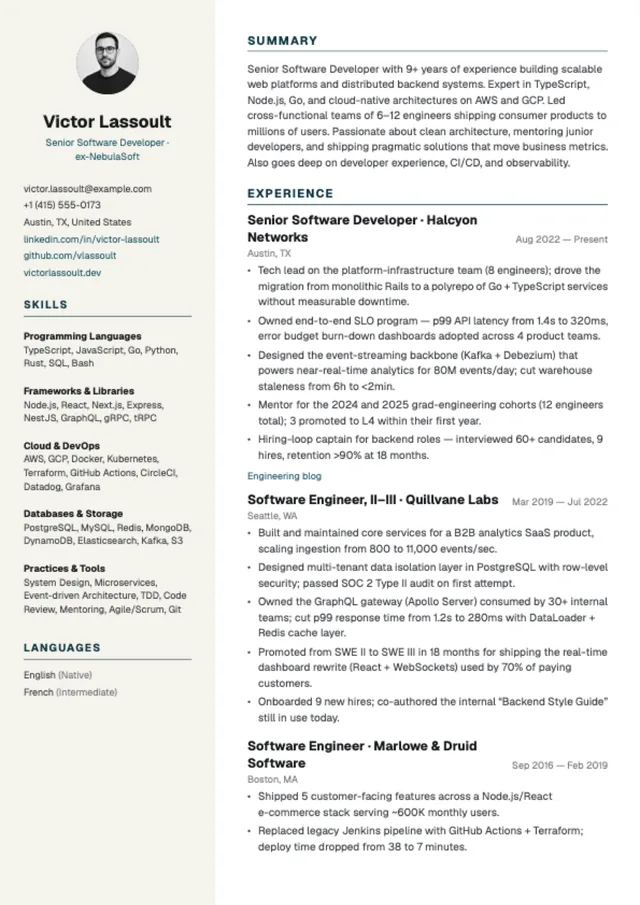
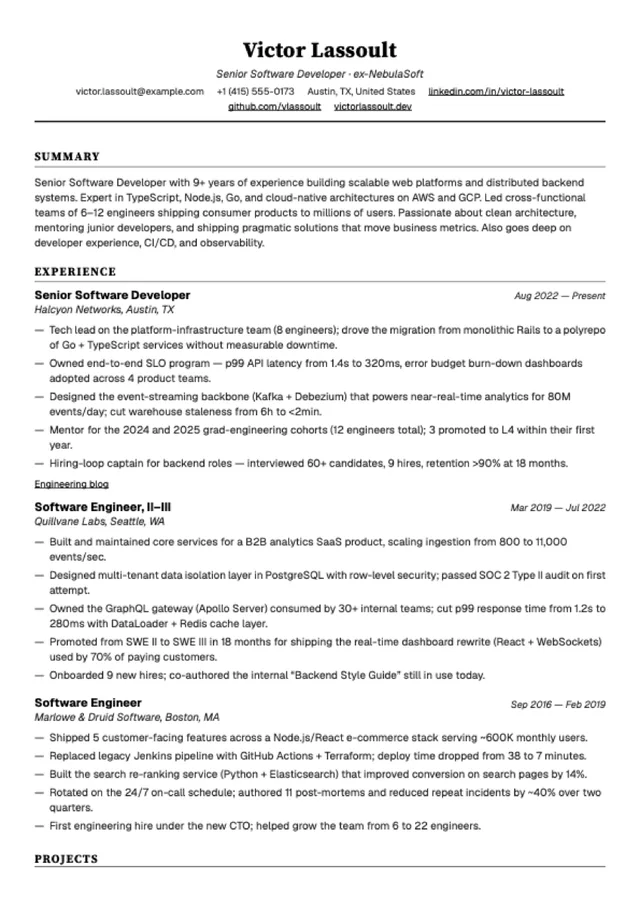
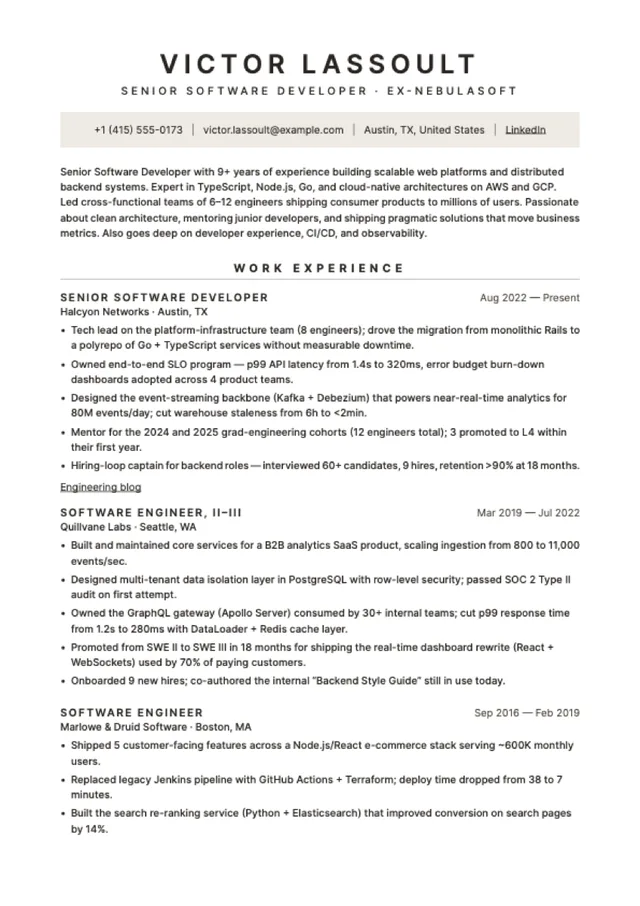
High-volume logistics hiring runs through applicant tracking software. Plain and single-column parses reliably; decorative layouts are where the text order breaks, per our own template testing.
Templates that suit logistics and warehouse resumes
Logistics & Warehouse resume FAQ
What goes at the top of a truck driver resume?
The license line: class, endorsements, date first held, and your record — accident-free miles and MVR status. Recruiters filter on that block before reading anything else.
How do I write a warehouse resume with no experience?
Lead with certifications you can get cheaply — forklift, OSHA 10 — plus shift availability and any physical or high-volume work you have done. Reliability and open availability genuinely move you up the list at entry level.
Should I list every carrier I have driven for?
List them accurately with correct dates. DOT-regulated employers verify the last several years regardless, so omissions surface later and cost more than a short stint would have.
Do I include my accident history?
State the positive plainly — accident-free miles, clean MVR — and do not volunteer detail on incidents. What you must not do is claim a clean record you do not have: the record is pulled, and the discrepancy ends the process.
Is one page enough for a driver with 20 years of experience?
Yes. Detail the last three employers and group the rest into one 'earlier experience' line. The license block, record and equipment list are what the job depends on, not a full history.
Other job functions
Build it on a template that has been through a real parser.
Unwatermarked PDF export, no subscription, and a score against any posting when you want one.
Build my resume