
Trades resumes are hired on tickets, equipment and safety record.
A foreman reading a trades resume wants three answers fast: what are you licensed or certified to do, what have you actually worked on, and are you going to be a safety problem. Career advice written for office jobs is actively unhelpful here — nobody wants a personal brand statement. They want the ticket, the class, the equipment, the hours and a clean record, written plainly enough to check in a minute.
- Roles covered
- 4 guides
- Screened on
- Tickets + equipment
- Typical length
- 1 page
- Certs
- With class and expiry
Reflects general US trades hiring practice as reviewed in 2026. Licensing is state and jurisdiction specific — always write the credential exactly as your licensing authority issues it.
The ticket block: what you are allowed to do, and where
Put licenses and certifications near the top with the class, the issuing jurisdiction and the expiry — 'Journeyman Electrician, Ohio (lic. 12345, exp. 06/2027)', 'AWS D1.1 3G/4G, current', 'EPA 608 Universal', 'CDL Class B with air brakes'. These are pass/fail filters: an employer either can put you on the job or cannot, and no amount of experience compensates for a missing or lapsed card. Apprenticeship hours belong here too — hours completed and the program are how a foreman places you on the ladder.
What every skilled trades resume has to prove
The tickets, with class and expiry
License class, certification code, jurisdiction, current status. This block is the single most-read part of a trades resume and the one most often written too vaguely to be useful.
The equipment and systems you have run
Brands and models, not categories. Specific processes (MIG, TIG, stick, flux-core and the positions you are certified in), specific systems (rooftop units, VRF, chillers, three-phase), specific diagnostic gear. This is how a shop decides whether you can start unsupervised.
The kind of work and the scale
Residential, commercial, industrial, new build or service. Voltage, tonnage, pipe size, vehicle class. 'Commercial service — 5 to 60-ton rooftop units across 40 retail sites' places you instantly; 'HVAC technician' does not.
A safety and reliability record
OSHA 10 or 30, years without a recordable incident, inspection pass rate, callback or comeback rate, attendance. Safety is a hiring cost in this function and the people who write about it plainly get read differently.
Skilled Trades resume examples by role
Each guide has a full annotated example, summaries by seniority and the keywords that role is filtered on.
Electrician
Electrician resume examples built license-first, like the hiring is.
See the exampleWelder
Welder resume examples built process, position, code — and pass rate.
See the exampleHVAC Technician
HVAC technician resume examples that lead with the 608 and the fix rate.
See the exampleAutomotive Technician
Automotive technician resume examples that talk flag hours, not just wrenches.
See the example
Bullets that get read, and the ones that do not
Same experience, rewritten. The difference is always the same thing: something a reader can check.
Performed electrical installations and repairs.
Ran commercial service for a 40-site retail account — panel upgrades to 400A, lighting retrofits and emergency callouts; passed 30+ AHJ inspections with two corrections total.
Why: Scale, voltage, work type and an inspection record. The correction count is the credibility detail: nobody has zero.
Welded parts according to specifications.
GMAW and FCAW on structural steel to AWS D1.1, 3G and 4G positions; plate 1/4in to 1in, held around 97% first-pass on visual and UT across an 18-month run.
Why: Process, code, positions, thickness range and a reject rate. This is the language a welding supervisor thinks in.
Diagnosed and repaired HVAC systems.
Service tech on 5–60 ton rooftop units and VRF; ran roughly 8 calls a day with a comeback rate under 3%, plus preventive maintenance on 120 units across 12 sites.
Why: Tonnage, call volume and comeback rate. Comeback rate is the number service managers care about most and almost never see on a resume.
Worked safely and followed all procedures.
OSHA 30 certified; four years with no recordable incidents and no lost-time injuries across industrial sites, including confined-space and LOTO work.
Why: 'Worked safely' is what everyone writes. A record with a duration attached is what an employer's insurer would want to see.
Keywords that recur across skilled trades postings
Function-wide terms, not role-specific ones. Mirror them verbatim when the posting uses them — filters match strings, not meaning.
| Keyword | Priority |
|---|---|
| Blueprint reading | High |
| Preventive maintenance | High |
| Troubleshooting and diagnostics | High |
| OSHA 10 / OSHA 30 | High |
| Hand and power tools | High |
| Code compliance (NEC / local) | High |
| Equipment installation | High |
| Schematics and wiring diagrams | Medium |
| Lockout/tagout (LOTO) | Medium |
| Work order documentation | Medium |
| Customer service (service calls) | Medium |
| Forklift / aerial lift certified | Medium |
| Apprenticeship hours | Medium |
| Quality inspection | Medium |
How the resume changes as you move up
Apprentice
Hours and program first — 'IBEW Local 46 apprenticeship, 4,200 of 8,000 hours' — then the work you have been on and the tools you can run. Reliability and attendance are legitimate selling points at this stage.
Journeyman
The license, the work types you can be dropped into alone, the equipment list. Volume and quality figures start to matter: calls per day, inspection results, first-pass rates.
Lead / foreman
Crew size, scheduling, materials and job costing, apprentices trained, jobs delivered to program. You are being read for whether you can run a job, not just a task.
Master / supervisor and service management
Master license, permits pulled, contracts and subcontractors, safety program ownership, budget. The trade detail stays — it is the proof you came up through the work.
How these resumes actually get filtered
Trades applications are usually screened by someone who runs the work — a foreman, a service manager, a shop owner — and often in the field on a phone. The first filter is binary: do you hold the ticket and can you legally do the job in this jurisdiction. The second is whether the equipment on your resume matches the equipment in their bay. Because the reader is technical and time-poor, a plain one-page document with a clear ticket block and a specific equipment list outperforms anything designed. Large contractors add an applicant tracking system to the front of that process, which is why the certification names should appear in the exact form the posting uses.
See what four real ATS parsers did with 36 resume layoutsMistakes specific to skilled trades resumes
Listing a certification without the class, jurisdiction or expiry.
Write it exactly as the card reads. It is a pass/fail filter, and an unverifiable ticket is treated as no ticket.
Letting a lapsed card sit on the page.
Renew, remove, or mark it with the renewal date. Expiries get checked before an offer, and a surprise there kills it.
Naming tool categories instead of equipment.
'Diagnostic equipment' means nothing. Name the brands, models and processes — that is what tells a shop you can start on Monday.
Copying office-resume advice about soft skills and personal branding.
Cut the summary to two plain lines about trade, license and the work you want. The tickets and the equipment list are the pitch.
A heavily designed resume with icons and columns.
Keep it single-column and plain — many trades employers use basic applicant systems, and the layouts that fail parsing hardest are the decorative ones. Our template testing put the failure down to text order, not looks.
Templates that suit skilled trades resumes
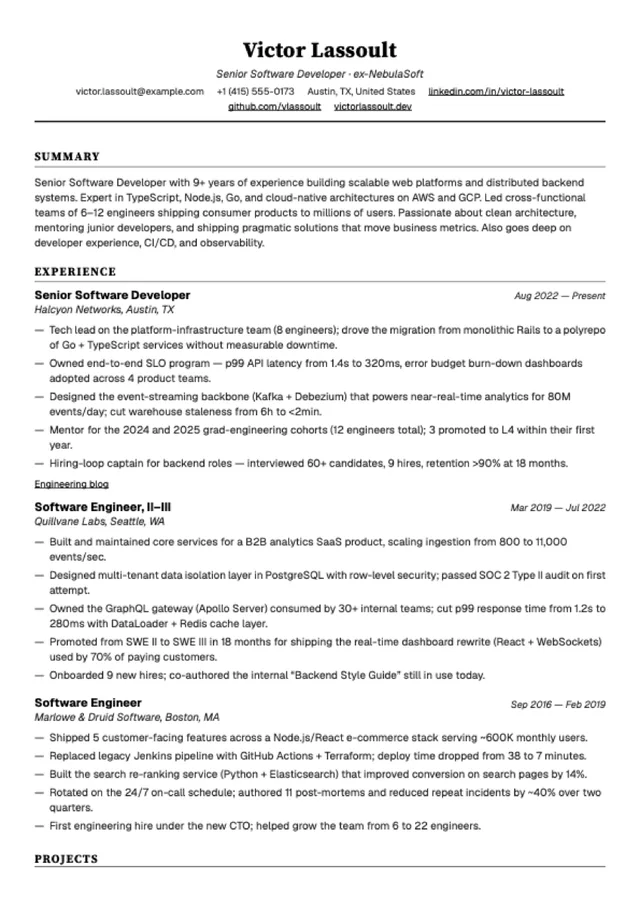
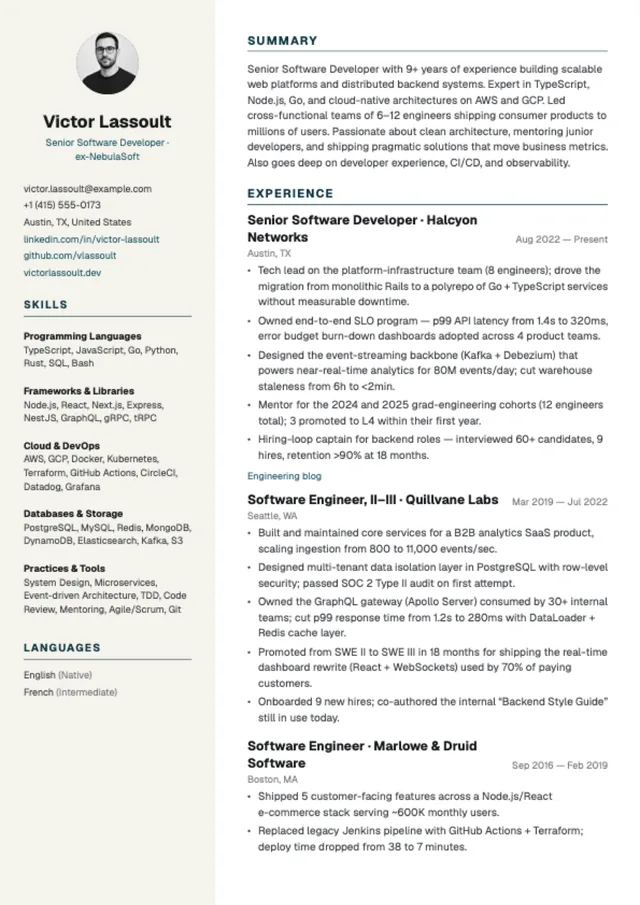
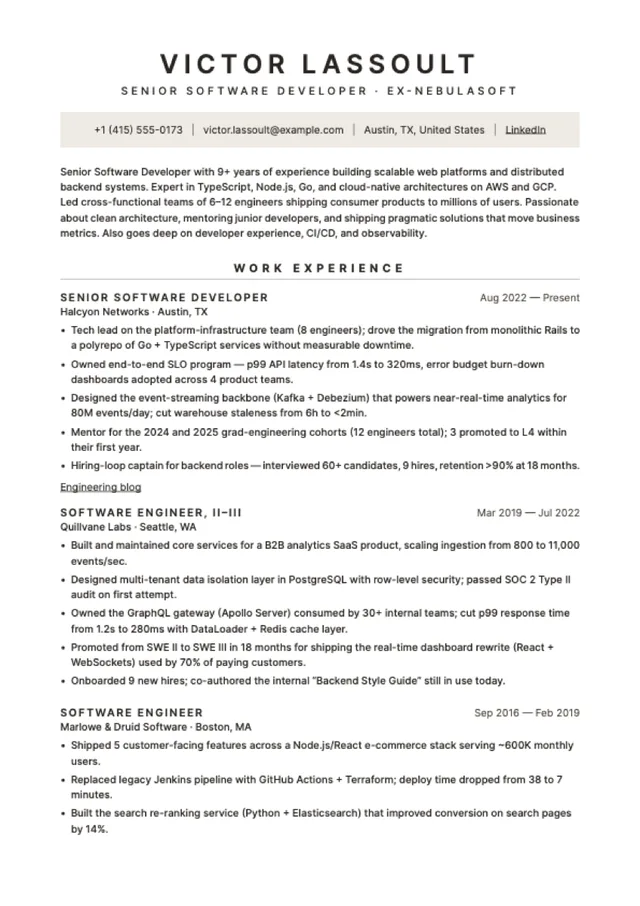
Skilled Trades resume FAQ
Where do licenses and certifications go on a trades resume?
Top third, in their own labelled block, with class, jurisdiction, number if you are comfortable, and expiry. It is the first thing checked and the cheapest thing to get right.
How do I show apprenticeship hours?
Hours completed against the total, plus the program or local: 'IBEW Local 46, 4,200 of 8,000 hours'. It places you on the ladder immediately and is far more useful than a date range.
Should a trades resume be one page?
One page, almost always. Twenty years of experience still fits when you group early jobs into a short 'earlier experience' line and let the ticket block and equipment list carry the weight.
What if I have gaps between jobs from seasonal or project work?
Normal in this function and not worth hiding. Group project work under one employer heading or write 'seasonal/project work' with the span. What foremen dislike is unexplained silence, not seasonality.
Do I need a fancy template?
No — plain and single-column is the right call. Some designed layouts parse fine and some scramble, and you cannot tell which from looking at them. We published per-template results from four real parsers if you want to check a specific one.
Other job functions
Build it on a template that has been through a real parser.
Unwatermarked PDF export, no subscription, and a score against any posting when you want one.
Build my resume