
Management resumes get judged on scope and on what kept working after you left.
Every management resume claims to have led, coordinated and overseen. None of those words carry information. What a hiring manager is establishing is the size of what you ran — budget, headcount, sites, volume — and whether anything you built outlasted your attention. A process that survived your holiday, a store that held its numbers after you were promoted, a schedule that stopped needing rescue: those are the claims that distinguish an operator from someone who was simply present while things happened.
- Roles covered
- 4 guides
- Screened on
- Budget, headcount, sites
- Weakest verb
- 'Oversaw'
- Best evidence
- It held without you
Reflects US operations and management hiring practice as reviewed in 2026. Titles in this function are unusually loose — 'manager' spans a two-person team and a nine-figure P&L — so scope stated in numbers matters more here than in almost any other family of roles.
Scope is the number; the outcome is what survived
Two clauses do most of the work on a management resume. The first is scope: budget owned, people managed, sites or stores, volume, headcount supported. Without it every claim underneath is unpriceable, and readers assume the smallest plausible version. The second is durability: the process still running, the person you promoted who now does your old job, the store that held its comp after you moved, the schedule that stopped generating overtime. Anyone can report activity during their tenure — evidence that it held afterwards is what separates a manager from a coordinator with a bigger title.
What every operations and management resume has to prove
The size of what you ran
Budget, direct and indirect reports, sites, store volume, throughput, project value. This is the first thing calibrated and the thing most often missing. One clause in the company line prices your entire page.
Outcomes in the numbers the business already reports
Cost per unit, comp sales, shrink, labor as a percentage, on-time delivery, cycle time, utilization, turnover, budget variance. These exist in the reporting pack already, which makes them checkable — and checkable is what makes them believed.
What you did about people
Turnover reduced, internal promotions, time to competence, retention at 90 days, vacancies filled from within. Operations lives or dies on whether the team stays, and the people numbers are the ones most managers leave off and most hiring managers care about.
The projects nobody volunteers for
A move, an opening, a turnaround, a system migration, a restructure, an audit. These get assigned to trusted people, so having one on the record is itself a signal — and each comes with an obvious outcome to state.
Operations & Management resume examples by role
Each guide has a full annotated example, summaries by seniority and the keywords that role is filtered on.
Project Manager
Project manager resume examples that prove delivery.
See the exampleOperations Manager
Operations manager resume examples that own the numbers, not the buzzwords.
See the exampleOffice Manager
Office manager resume examples for a title that spans two pay bands.
See the exampleStore Manager
Store manager resume examples written in the numbers a district manager thinks in.
See the example
Bullets that get read, and the ones that do not
Same experience, rewritten. The difference is always the same thing: something a reader can check.
Oversaw daily operations and managed a team.
Ran an $8.4M store with 42 staff and four department leads; +6.2% comp against a district average of +1.8%.
Why: Scope plus a result stated against a benchmark. 'Oversaw' is the least informative verb in management writing — it describes proximity, not responsibility.
Responsible for reducing costs across the department.
Renegotiated four vendor contracts at renewal for an 18% cut in recurring spend, with no service complaint over the following year.
Why: Names the mechanism, the size and the quality qualifier. A saving with no service measure attached reads as a cut rather than a negotiation.
Improved team performance and morale.
Cut hourly turnover from 78% to 41% in eighteen months by rebuilding onboarding and fixing the scheduling practice staff were leaving over; promoted four people into leads.
Why: Morale is unmeasurable and therefore discounted. Turnover is measurable, expensive, and the problem your next employer already has.
Managed multiple projects simultaneously.
Ran six concurrent workstreams for a $2.4M program across three departments; delivered two weeks inside the plan with the scope agreed at kickoff.
Why: Value, count and the fate of the original scope. 'Multiple' is what people write when they would rather not be specific.
Keywords that recur across operations and management postings
Function-wide terms, not role-specific ones. Mirror them verbatim when the posting uses them — filters match strings, not meaning.
| Keyword | Priority |
|---|---|
| P&L / budget management | High |
| team leadership | High |
| process improvement | High |
| stakeholder management | High |
| vendor and contract management | High |
| KPI and performance reporting | High |
| scheduling and resource planning | High |
| hiring, onboarding and retention | High |
| inventory / supply chain | Medium |
| health and safety compliance | Medium |
| change management | Medium |
| Lean / Six Sigma | Medium |
| cost reduction | Medium |
| ERP / workforce management systems | Medium |
How the resume changes as you move up
Coordinator / supervisor
Volume and reliability: shifts covered, tasks scheduled, staff supervised, processes documented. Show that things ran when you were the senior person present.
Manager
Budget, team and a number you own. This is where scope has to appear in the company line and where the first durable improvements — a process, a retention change, a cost line — belong.
Senior manager / multi-site
Managing managers, standardising across units, and results that hold at more than one location. Show the thing another site adopted, because that is the evidence of transferable method rather than personal effort.
Director and above
P&L, headcount planning, organizational design, systems investment and the decisions you took under uncertainty. The page becomes commercial: what the function cost, what it returned, and what you chose not to do.
How these resumes actually get filtered
Management postings attract volume, so the first pass is usually mechanical: years of experience, budget or team size where the posting states a threshold, industry, and systems. That is why scope belongs in the company line rather than buried in a bullet — a filter looking for 'managed a team of 20+' needs to find the number. The human pass is normally the hiring manager themselves, reading against their own scorecard, and they discount adjectives almost completely. Two things get read closely: the benchmark attached to your results, and whether anything you built kept working. A page of activity with neither reads as a job description someone happened to occupy.
See what four real ATS parsers did with 36 resume layoutsMistakes specific to operations and management resumes
'Oversaw', 'coordinated', 'was responsible for'
Verbs of proximity. Say what you decided, what it cost and what changed as a result.
No scope anywhere on the page
Budget, headcount, sites, volume. Without them the reader defaults to the smallest reading of every title you hold.
Results with no benchmark
Against plan, against the district, against last year. An unbenchmarked improvement could be the market rather than the manager.
Leaving the people numbers out
Turnover, internal promotions, retention at 90 days. In operations these are performance metrics, not HR trivia.
A resume that ends when your tenure does
Say what survived — the process still in use, the person promoted into your role, the store that held its numbers. Durability is the senior signal.
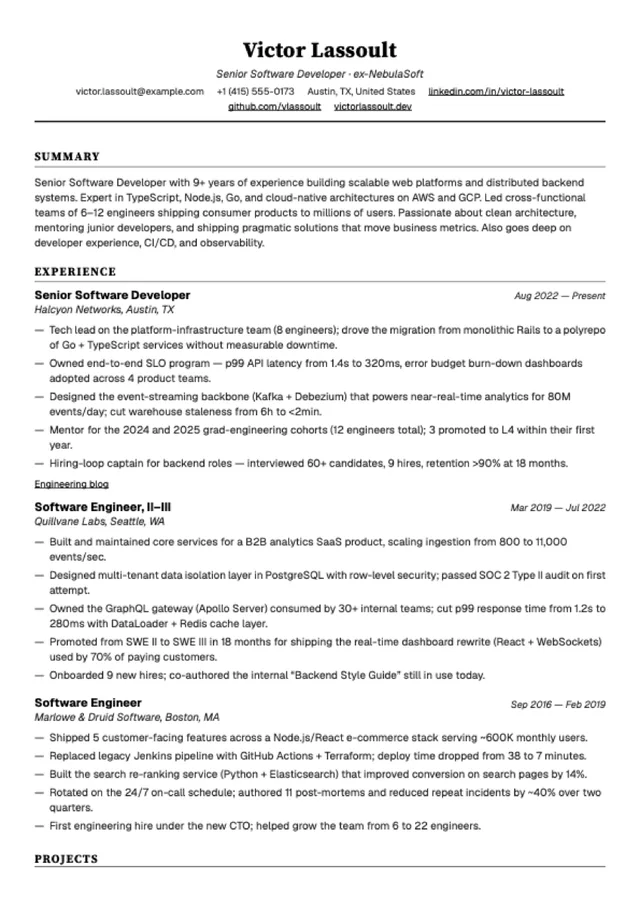
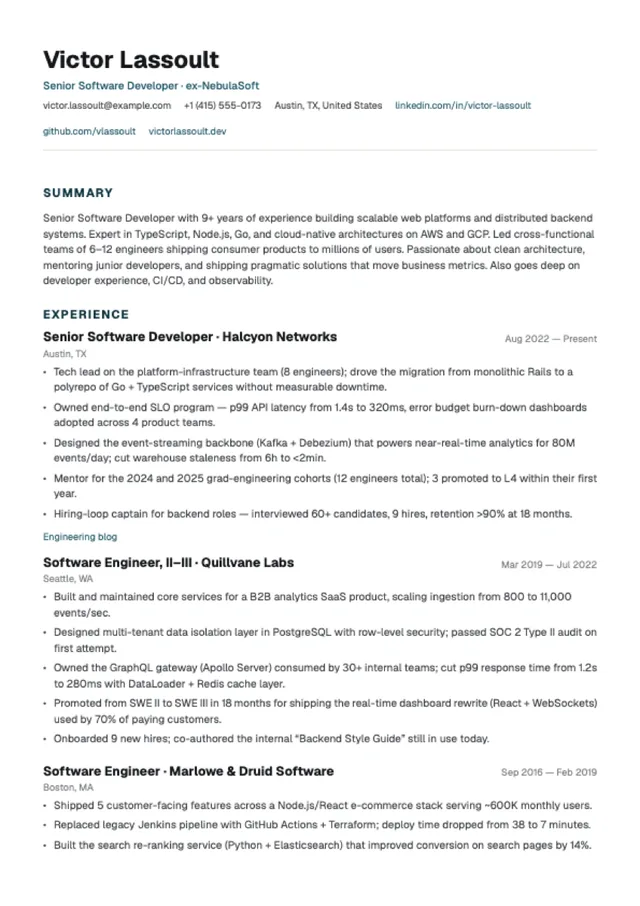
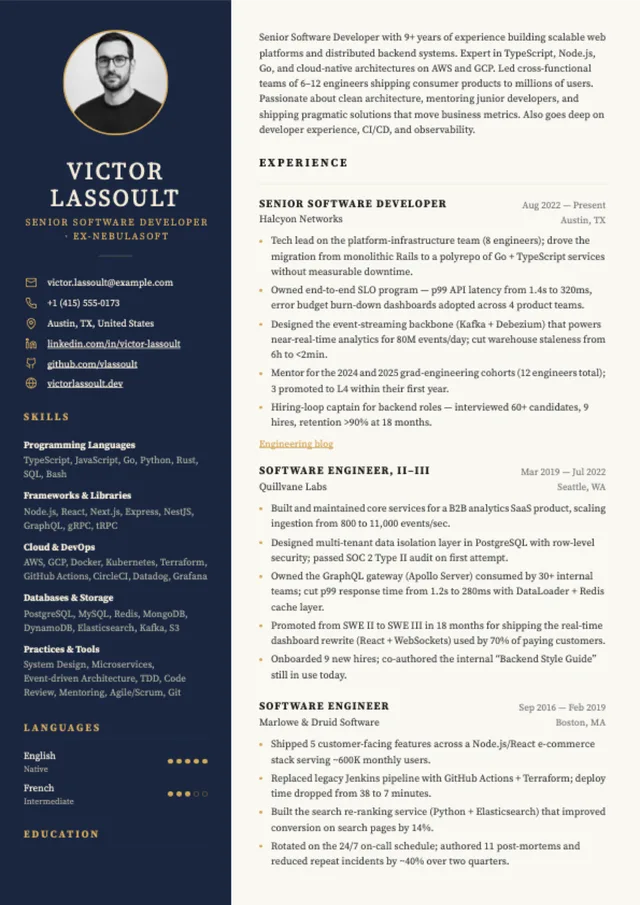
Templates that suit operations and management resumes
Operations & Management resume FAQ
What scope should a management resume state?
Budget owned, direct and indirect reports, sites or stores, volume or throughput, and project value where relevant. Titles in this function are unusually loose, so the numbers are what actually communicate seniority.
Which outcomes are worth including?
The ones already in your reporting pack: budget variance, cost per unit, comp sales, shrink, labor percentage, on-time delivery, cycle time, utilization and turnover. They are checkable, which is why they are believed — and always give the benchmark you were measured against.
How do I show management ability without the title?
Take the projects: a move, an opening, a turnaround, a system rollout, a seasonal hiring cycle. Each has an obvious outcome and each demonstrates coordination across people who do not report to you — which is the harder half of management anyway.
Should I include a team's failure or a bad year?
Include the direction and the context if you improved it — a turnaround from a bad position is a stronger story than a flat good one. What reads poorly is a resume with no numbers, because the reader assumes the missing ones were unflattering.
One page or two?
One page up to manager level. Two once you have multi-site or director scope, provided the second page carries budget, structure and outcomes rather than more duties.
Other job functions
Build it on a template that has been through a real parser.
Unwatermarked PDF export, no subscription, and a score against any posting when you want one.
Build my resume